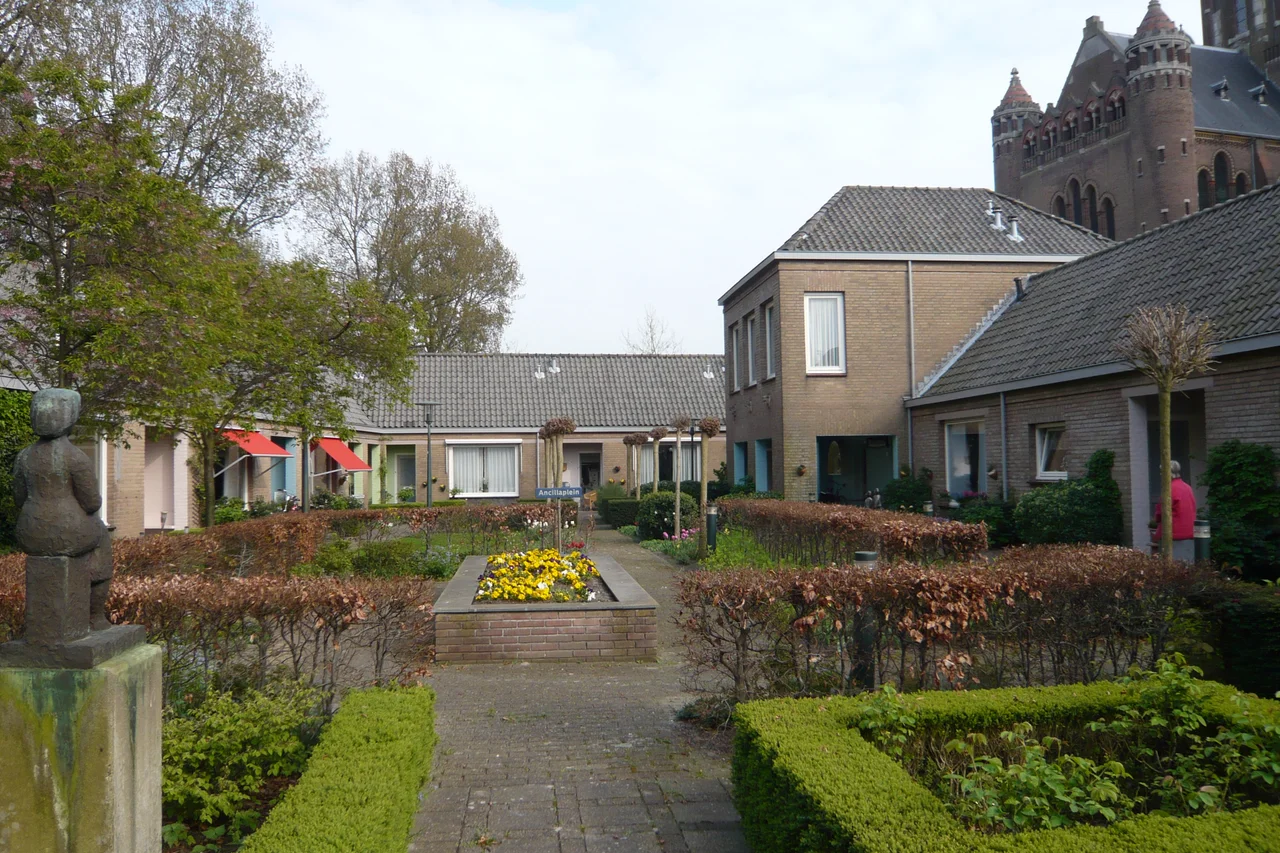

Hofje Codde en Van Beresteijn
In 1598, a Catholic curate named Pieter Jansz Codde wrote his will and left instructions that, from the proceeds, four small rooms, camerkens, should be founded for poor elderly women in Haarlem. The Reformation had just stripped the Catholics of their churches and their public worship. Codde, who served the old Sint-Bavokerk before it was taken over by the Protestants, could not openly fund a Catholic charity. The hofje he left behind has now been quietly housing devout Catholic women in Haarlem for more than four centuries, surviving the loss of two buildings, an enforced merger with a painter's bequest, and a Frans Hals scandal that nearly destroyed its reputation. It is, today, the wealthiest hofje in a city famous for them.
The Hofje in the Hidden Quarter
A hofje is a particular kind of Dutch institution: private charitable housing, usually arranged around a quiet courtyard, founded by a wealthy individual for the elderly poor. Haarlem has more of them than any other Dutch city. Codde's executor, Hendrick Spoorwater, built the first version in 1609 on the Nauwe Damsteeg behind the clock tower of the Sint-Bavokerk, next to an underground Catholic chapel called the Franciscusstatie that had been founded for friars driven out of their old monastery in 1581. Spoorwater served as the first regent, lived in the hofje, and died there. The original was called Het Spoorwaters Hofje on old city maps, and being Catholic remained one of the entrance requirements, as it still does. The residents could walk through the back gate to attend Mass in the hidden chapel. None of those buildings survive. The Joh. Enschede printing firm, which produced Dutch guilder banknotes, slowly swallowed the entire block over the eighteenth and nineteenth centuries.
A Painter's Sister and a Painter's Lie
Nearly a century after Codde, in 1684, the landscape painter Claes van Beresteyn founded a second hofje on the Lange Herenstraat. The Beresteyns were a wealthy Haarlem family with deep ties to the city's painters. The painter Pieter Soutman was a friend and served as regent. The two hofjes were managed by the same board from the start and merged their accounts in 1731. The combined foundation owned a small collection of family portraits, hung in the regent's room for centuries. Among them was what the regents believed to be a Frans Hals portrait of Emerantia van Beresteyn, sister of Nicolaes van Beresteyn, painted around 1634. It was actually by Pieter Soutman, but no one knew that at the time. In 1882 the regents sold it to Mathilde Hannah Rothschild for funds to rebuild. The Dutch papers erupted. The hofje was accused of selling a national treasure for private gain. Three years later the regents sold three more paintings believed to be by Frans Hals to the Louvre in Paris: twin marriage portraits of Catharina Both van der Eem and Paulus van Beresteyn from 1629, and a Beresteyn family group portrait. Those marriage portraits hang in the Louvre today as Hals masterworks. The family group is now attributed to Soutman as well. The hofje commissioned copies by Petrus Theodorus van Wijngaerdt, and the copies still hang in the regent's room.
Moving in the Shadow of Saint Bavo
In 1968 the hofje moved for the second time in its history, to a modern building on the J. Cuyperstraat next to the Cathedral of Saint Bavo on the Leidsevaart canal. The street is named for Joseph Cuypers, the architect who designed that nineteenth-century Catholic cathedral after centuries of Protestant rule had ended. The location is a deliberate echo of the original 1609 placement next to the old underground Catholic chapel. The residents can again walk a few steps to Mass. The building itself is unassuming, set back from the street, easily missed by tourists hunting for picturesque seventeenth-century courtyards in the old city center. There is no carved sandstone gate, no symmetrical box hedges, no postcard tableau. From outside, it looks like an ordinary mid-century Dutch institutional building.
What the Money Does
Catholic women in Haarlem aged sixty and over are still welcome to live there for free. The wealth from the Rothschild and Louvre sales, scandalous when it happened, has now been compounding for nearly a century and a half, and the foundation uses some of its income to support other Haarlem hofjes including the Johan Enschede Hof, the Gravinnehof, and ongoing work at the Frans Loenenhofje. The board has also commissioned studies on whether the centuries-old hofje model of communal almshouse living can survive the modern age, with its assumptions about privacy, isolation, and what old age should look like. The hofje itself is, in a sense, the answer: four hundred and twenty-six years after Codde wrote his will, devout Catholic widows in their seventies and eighties still wake up in rooms paid for by a curate who never lived to see the building finished, and by paintings their predecessors sold.
From the Air
Located at 52.377N, 4.621E in central Haarlem, immediately adjacent to the neo-Gothic Cathedral of Saint Bavo on the Leidsevaart canal. The hofje itself is a small mid-twentieth-century building set behind the cathedral and is difficult to identify from the air, but the cathedral's twin spires at roughly 65 meters tall are the most prominent landmark in this part of Haarlem and locate the site precisely. Nearest airport: Amsterdam Schiphol (EHAM), approximately 13 km east-southeast.
Nearby Stories
- Polanen Castle 1.6 km away
- Gouda 2.6 km away
- Princess Amalia Wind Farm 3.5 km away
- The Green Cathedral 4.2 km away
- Egmond Abbey 7.1 km away
- Dorestad 7.7 km away
- Hollandse Kust Zuid Offshore Wind Farm 11 km away
- Enkhuizen 16 km away