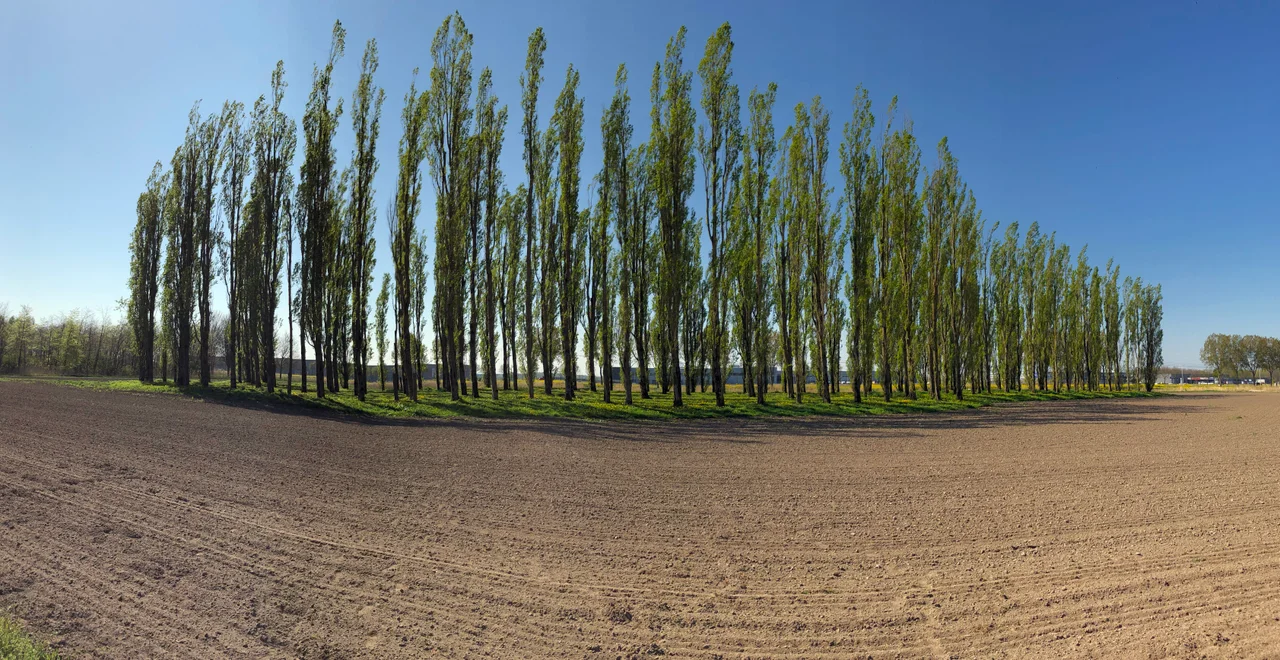

The Green Cathedral
Imagine planting a cathedral. Not building one - planting one. In 1987 the Dutch conceptual artist Marinus Boezem walked out onto a patch of brand-new polder near Almere - land that had been seabed thirty years earlier - and began setting Lombardy poplar saplings into the soil in a very specific pattern. The pattern was the floor plan of the Cathedral of Notre-Dame in Reims, the coronation church of French kings, traced at full size: 150 metres long, 75 metres wide. The saplings were thin enough to grip in one hand. The idea was to wait.
A Floor Plan, a Polder
Boezem, born in 1934, had been thinking about this work since the late 1970s, well before the polder he wanted was even ready to plant. Southern Flevoland was new ground in every sense: drained from the IJsselmeer, levelled, and offered up to Dutch artists in a remarkable government program that turned the empty new province into one of the largest open-air galleries on Earth. On 16 April 1987, Boezem and his crew set 178 Lombardy poplars (Populus nigra italica) on a low knoll a half-metre above the surrounding fields. The trees stood in two long parallel rows where the nave walls would be, with a transept crossing them and a curve of saplings where the apse would close around the altar. From the ground it looked like a tidy bit of forestry. From the air, anyone who knew Reims would recognize it instantly.
The Cathedral Grows In
Lombardy poplars are not patient trees. They go up like green spears, slim and vertical, and within a decade the saplings were taller than houses; today the mature trees reach roughly 30 metres - close to the springline of a real Gothic vault. Walk inside the planting and the effect is unmistakable. The trunks function as columns, the high feathered crowns close overhead like ribbed vaulting, and the spaces between rows feel like aisles. Stone has been laid in the floor to trace the cross ribs and structural beams of the original cathedral, so the geometry holds up at eye level too. Deer ate enough young trees in the early years that replacements had to be set in - the only ongoing maintenance for a building made of wood that grows itself.
A Sanctuary People Actually Use
What Boezem may not have predicted is how thoroughly the Dutch would adopt the Green Cathedral as an actual sanctuary. Couples have married inside the nave. Memorial services are held in the apse. Yoga classes, choir rehearsals, art performances and ecumenical gatherings all take their turn under the canopy; theatre group Suburbia staged a piece called Judas there in 2015, and the artist Melanie Bonajo set her 2013 performance Matrix Botanica, Biosphere Above Nations in the same space. A cathedral, it turns out, is not the same thing as a church - and once you build a quiet, beautiful, vaguely sacred space in a country full of secular searchers, people will arrive with their own reasons to be there.
Death and Resurrection in Beech
The most haunting thing about the Green Cathedral is that Boezem designed it to die. Lombardy poplars are short-lived - sixty or eighty years is a generous estimate - and the planting is already past middle age. Not far from the main cathedral, Boezem cleared the same Gothic floor plan as a negative space inside a young beech forest. The cathedral here is the absence: a Reims-shaped void where the beech trees were never planted, ringed by trees that were. As the poplars decline and fall, the beeches around the clearing will keep growing inward, eventually filling the sky above that empty floor plan with a second cathedral - this one in slow-growing hardwood, good for centuries. One building gives way to another, the way medieval cathedrals always did, just at the speed of trees instead of stonemasons.
What the Polder Remembers
Stand inside the nave at sunset and the geometry does something strange to the polder. The wide flat horizon that defines Flevoland - the new land, where every road is straight and every field is rectangular - is broken, briefly, by a Gothic geometry that comes from another country and another millennium. Reims is 400 km away. The polder is 30 years old. The cathedral floor plan is 800 years old. And the poplars planted in 1987 are doing exactly what Boezem asked them to do: hold the shape long enough for the next forest to figure out what comes next.
From the Air
The Green Cathedral lies at 52.32 degrees N, 5.32 degrees E, on the south side of the Kathedralenpad in the Pampushout woods between Almere and Zeewolde. From 3,000 to 5,000 feet on a clear day the planting reads as a very deliberate elongated rectangle of densely packed poplars - the only Gothic geometry on a flat plain of straight Dutch field boundaries. The beech-forest counterpart sits a short walk away to the northeast. Nearest airport is Lelystad (EHLE), about 15 km north; Amsterdam Schiphol (EHAM) is 35 km west. The IJmeer and the long causeway of the Hollandse Brug are clearly visible to the northwest.
Nearby Stories
- Amstelveen 4.4 km away
- 2001 United Kingdom foot-and-mouth outbreak 7.2 km away
- Dorestad 9.7 km away
- Schoonhoven 11 km away
- Noordhollandsch Kanaal 13 km away
- Liemers 15 km away
- Urk 15 km away
- Den Hulst 21 km away