.JPG)
2001 United Kingdom foot-and-mouth outbreak
The pyres burned for months. From the Lake District to Devon, the bodies of cattle and sheep were stacked into pits or piled onto layered rafts of railway sleepers and straw, doused with diesel, and set alight - sometimes 80,000 animals in a single week. From the air, columns of black smoke marked the geography of the outbreak as plainly as any map. From the ground, the smell defined seasons. Farmers who had spent thirty years building bloodlines watched lorries take whole flocks away. Vets had nightmares for years. The 2001 foot-and-mouth epidemic was a disease event, but it became something larger: a wound in rural Britain that closed slowly, and not everywhere completely.
How It Began
On 19 February 2001 a vet at the Cheale Meats abattoir in Little Warley, Essex, examined pigs from a holding in Buckinghamshire and the Isle of Wight and noted the blisters, lameness, and fever of a disease the United Kingdom had not seen in epidemic form since 1967. Foot-and-mouth disease is rarely fatal to adult animals, but it is among the most contagious of all livestock diseases, and a single confirmed case triggers an immediate, devastating response. Four days later the source was identified: Burnside Farm at Heddon-on-the-Wall in Northumberland, where pigs had been fed catering swill that had not been properly heat-sterilised. The meat in that swill - probably illegally imported, since the UK had banned imports from countries known to harbour the virus - carried foot-and-mouth into the food chain. The farmer, Bobby Waugh, was later banned from keeping animals for fifteen years.
The Disease Spreads
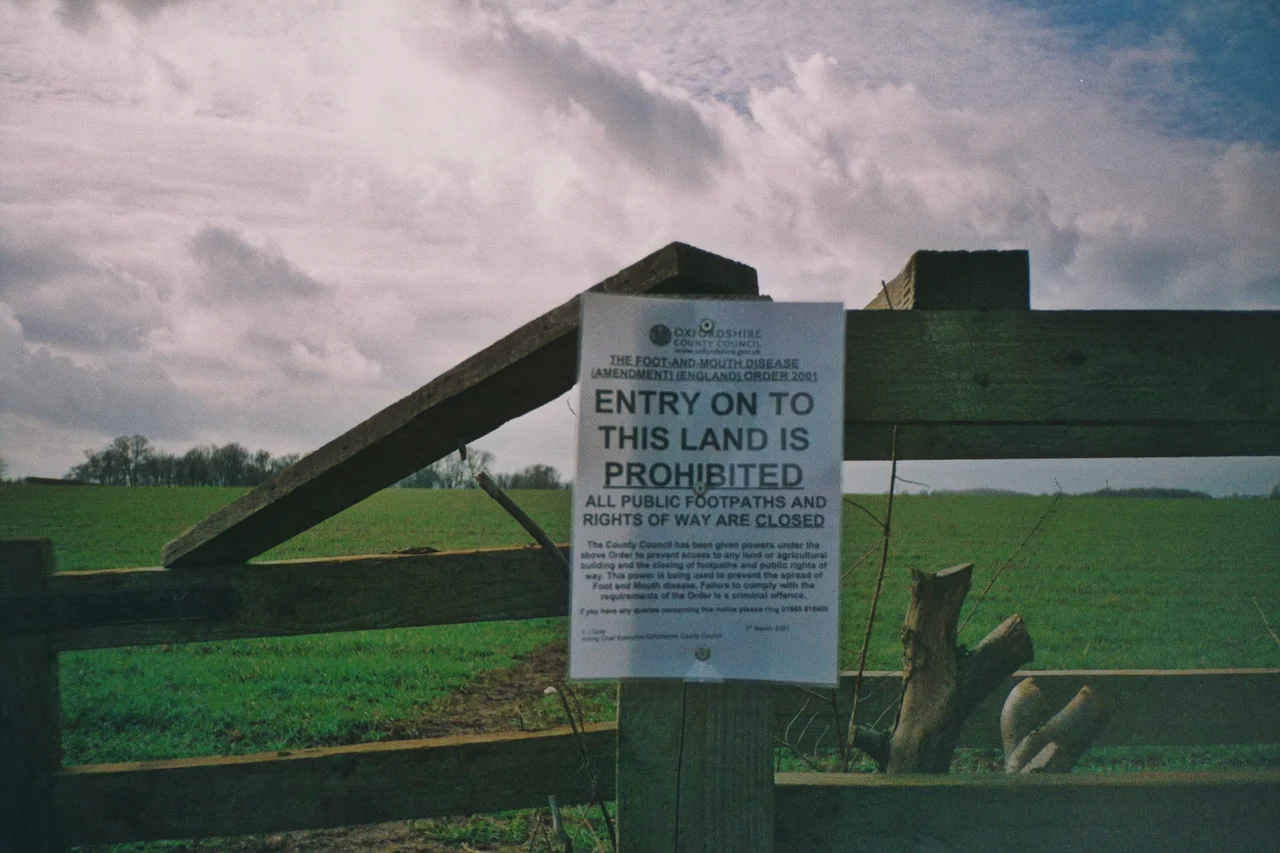
By the time the first case was confirmed, the virus had already travelled. Animals had moved through markets and abattoirs for weeks, carrying infection silently. Within days cases were reported in North Wales, Devon, and Cornwall; by early March the disease had reached southern Scotland and the Lake District, where the high stocking density of Cumbrian sheep gave it room to flourish. Cumbria alone would account for 893 of the eventual 2,000 confirmed cases - nearly half. Public footpaths were closed across England and Wales. Cheltenham Festival was cancelled; the Isle of Man TT scrapped; Crufts postponed; the general election delayed by a month, the first such postponement since the Second World War. Disinfectant mats appeared at the entrances to villages and farms. The countryside fell quiet in a way that those who lived through it still describe as eerie.
The Cull
The government's response was massive and crude: a contiguous cull, in which all sheep within three kilometres of a confirmed case were to be killed, whether they showed symptoms or not. Vaccination, which would have spared millions of animals, was repeatedly considered and repeatedly rejected after lobbying from the National Farmers' Union, which feared that vaccinated animals would be excluded from export markets worth £592 million a year. Tourism losses, by comparison, ran to billions. The British Army was called in under Brigadier Alex Birtwistle to manage the logistics of slaughter and disposal. About 80,000 to 93,000 animals were killed each week at the peak. Six million animals in total - cattle, sheep, pigs, the occasional goat - were destroyed. Many had been healthy. The pyres of carcasses became the defining image of the epidemic, and the silent fields its defining emptiness.
The Human Cost
The cost cannot be counted in animals alone. Farmers who had to watch their stock destroyed - flocks built over decades, breeding lines that could not be reconstructed, animals known by name - suffered consequences that ran far past the cheque from compensation. The Department of Health commissioned a longitudinal study, led by Maggie Mort at Lancaster University, that documented the trauma in Cumbrian communities through interviews, focus groups, and diaries kept across the worst years. The book that emerged in 2008 carried a title that says what the official reports could not: *Animal Disease and Human Trauma, emotional geographies of disaster*. Suicide rates rose. Marriages strained. Children grew up in homes where the kitchen radio carried daily case counts and where bedtime stories were sometimes interrupted by the sound of lorries arriving for another farm down the road. The epidemic killed no one directly. It broke many people anyway.
Beyond Britain
The virus did not stop at the Channel. The Netherlands had the worst outbreak outside Britain, 26 cases, and chose vaccination as a control strategy - then, under EU export rules, slaughtered all the vaccinated animals anyway. The Dutch destroyed 271,454 animals in total: 135,127 pigs, 90,704 cattle, 34,861 sheep, 9,628 goats, and 1,134 others. Ireland had one case in County Louth and threw the resources of an entire state at containing it, including Irish special forces sniping deer that might carry the virus across farmland. The 2001 Saint Patrick's Day festival was cancelled. Three Six Nations rugby matches involving Ireland were postponed. France had two cases. Belgium, Spain, Luxembourg, and Germany carried out precautionary slaughters that proved unnecessary. Across Europe, livestock movement froze.
What Changed
The 2001 outbreak ended officially on 14 January 2002. Three government inquiries followed - one on the handling, one on the science, one on the future of farming - and a Scottish inquiry on top. The Ministry of Agriculture, Fisheries and Food, judged to have failed, was abolished and replaced by Defra. The law was changed to permit vaccination rather than mass slaughter in future outbreaks. Local abattoirs, whose closure had forced animals to travel long distances and helped spread the virus, became a topic of policy concern - though many never came back. Cumbria's tourism took years to recover. Some farmers never restocked. Twenty-five years on, the question raised by the 1967 inquiry and ignored after - whether the United Kingdom had truly learnt anything from its last epidemic - hangs over every new disease alert in the British countryside.
From the Air
The article's mapped point (52.34 N, 6.05 E) actually sits in the Dutch province of Overijssel - reflecting the Netherlands as the worst-affected country outside the UK. The epidemic's true epicentre was Cumbria in north-west England (Heddon-on-the-Wall is 55.0 N, 1.8 W). Over the Dutch farmland of Overijssel and Gelderland today, the patchwork of dairy pastures, intensive pig units, and the canal grid that links them tells the story of why containment here was so difficult. Recommended altitude 3,000-5,000 ft AGL for a sense of the landscape's scale. Nearest fields: Teuge (EHTE) and Lelystad (EHLE) for the Dutch viewpoint; Carlisle (EGNC) and Newcastle (EGNT) for Cumbria and the original Northumberland source farm.
Nearby Stories
- Twickel Castle 4 km away
- Putten 4.3 km away
- Winterswijk 7.6 km away
- Den Hulst 9.7 km away
- Liemers 9.8 km away
- Urk 12 km away
- Coevorden 13 km away
- Assault on Nijmegen 17 km away