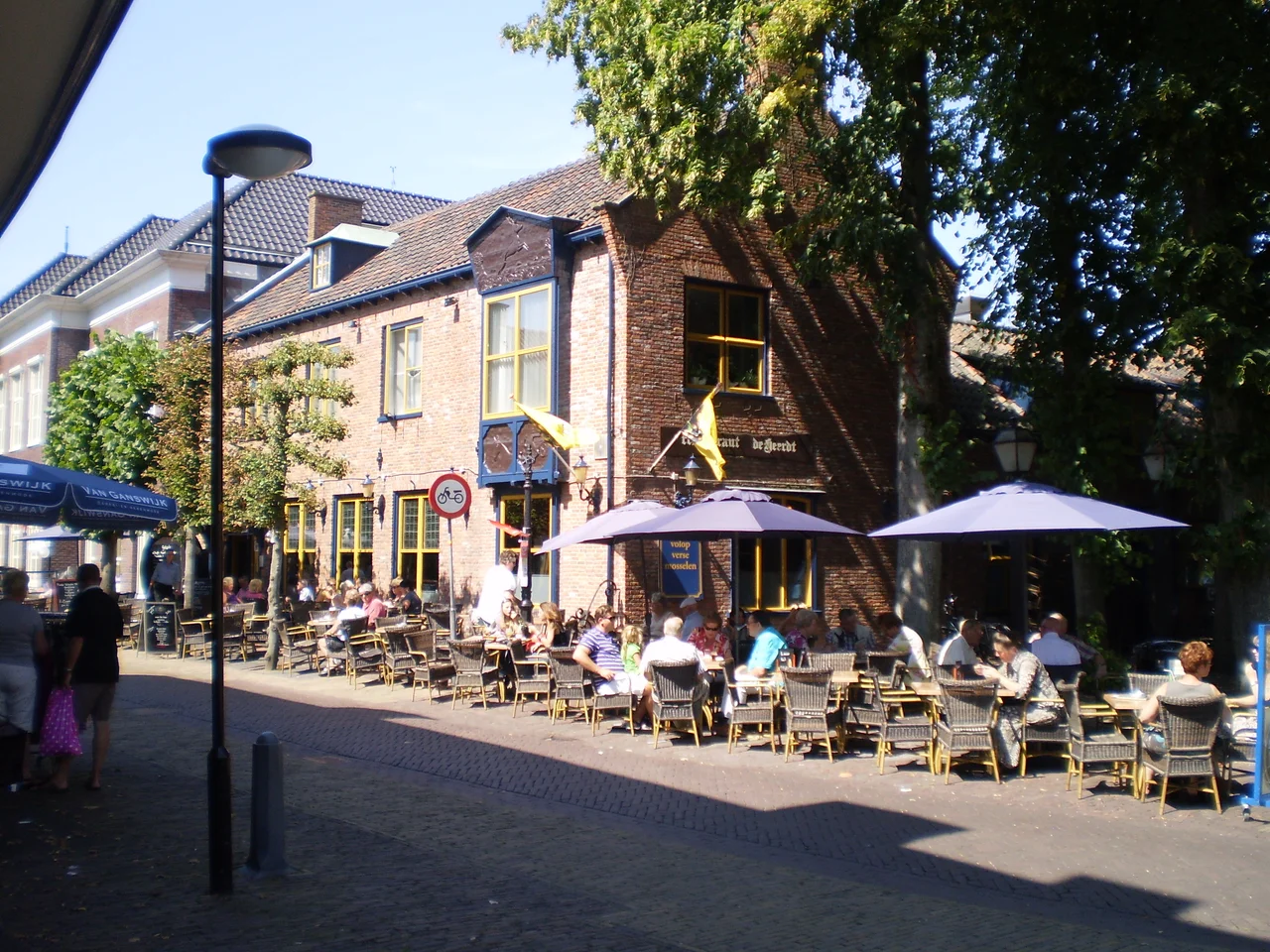

Putten
Putten was first written down in the year 855, in a document recording who owed what to which monastery, and for the next thousand years it stayed more or less the same kind of place: a Reformed farming village on the western edge of the Veluwe, sheep on the heath, cows in the meadows, a single late-Gothic church at the center of everything. Then, on one autumn morning in 1944, almost every man in town was taken away. Putten has never quite separated itself from that morning. Walk down the Dorpsstraat today and you can still feel both Puttens at once - the practical, market-day Veluwe village, and the village that lost its men.
Older Than the Coastline
There were small settlements here in Roman times, and by the 10th century a stone church anchored a cluster of hamlets that would eventually swallow neighboring villages whole. Parts of present-day Nijkerk and Voorthuizen were once Putten land, until they spun off as independent communities - Nijkerk in 1530, Voorthuizen later. The shoreline mattered too: until a sea dyke was built in 1356, the old Zuiderzee periodically reclaimed the western fields. The dyke held, mostly. It broke spectacularly more than once, and as late as 1916 a North Sea storm sent water surging across the lowlands. Only with the closing of the Afsluitdijk in 1932 did the inland sea finally become a freshwater lake and stop threatening the cows.
Paper, Pines and Patients
Agriculture has always paid the bills in Putten, but it was never the only trade. From the 17th through the 19th century the village ran paper mills, taking advantage of the clean streams running off the Veluwe sand. When the railway arrived in 1863, Putten suddenly had a different export: peace and quiet. Tuberculosis patients from the cities began coming up to convalesce in boarding houses and small sanatoria, breathing the pine-scented air the doctors of the time prescribed. The village suffered, too - burned to the ground at least five times in the 15th, 16th and 17th centuries by armies passing through on someone else's business. The Veluwe has always been beautiful and inconveniently located.
The Weight of October
One date dominates the village calendar. On 1 and 2 October 1944, in retaliation for a Dutch resistance ambush near Nijkerk, the Wehrmacht surrounded Putten and deported almost every man between 18 and 50 - 602 of them in the end - to concentration camps at Neuengamme and elsewhere. Only 48 came home. Two German officers were eventually tried and convicted after the war, but no court could undo what had happened in the church and the schoolyard that week. Every 2 October the village still holds a silent commemoration at the Vrouwtje van Putten Herdenkingshof, the Little Lady of Putten Memorial Garden, beside the Oude Kerk. The statue of a widow in traditional Veluwe dress, sculpted by Mari Andriessen and unveiled by Queen Juliana in 1949, looks across the square toward the church from which the men of Putten were marched away.
Wednesdays at the Market
Daily life in modern Putten is, mercifully, less dramatic. Agriculture still matters, but the service sector dominates now, and tourism leans hard on what's around: the Veluwe, the largest national park in the Netherlands, rolling out to the east in heather and ancient woodland; the long sandy beach at Strand Nulde on the Veldmeer to the west. The biggest weekly event is the Wednesday market on the square, the largest in the northwest Veluwe - cheese, smoked sausage, fresh fish from the IJsselmeer, flowers, and the kind of unhurried catching-up that small Dutch towns specialize in. The A28 motorway runs by to the west, the train line between Utrecht and Zwolle stops at the local station, and most everyone in town has been to school with most everyone else.
Faces of the Village
Putten's home-grown roster is small but eclectic. Hendrik van Boeijen, born here in 1889, served as a national politician and Minister of the Interior during the years just before the war. The trance and electro producer Ummet Ozcan, born in 1982, grew up in Putten before turning into a regular at Tomorrowland and the Amsterdam Dance Event. The American-Israeli show jumper Danielle Goldstein lives in town and rides under the Israeli flag at the Olympics. And on autumn Sundays at SDC Putten, the local club, you can still find Sander Duits in the squad - a defender who, after some 400 club appearances elsewhere, came home to finish his career on familiar grass. A village this size doesn't need many stars to feel populated.
From the Air
Putten sits at 52.26 degrees N, 5.61 degrees E in the province of Gelderland, just west of the Veluwe national park and about 60 km east of Amsterdam. From 6,000 to 10,000 feet on a clear day the village reads as a tight cluster of rooftops between dark forest to the east and the open polder and Veldmeer to the west. The A28 motorway runs north-south just outside town, the Utrecht-Zwolle rail line stops at Putten station, and the Oude Kerk's square tower is the obvious anchor in the village center. Nearest major airport is Amsterdam Schiphol (EHAM); smaller traffic uses Lelystad (EHLE) just to the north.
Nearby Stories
- Amstelveen 4.4 km away
- 2001 United Kingdom foot-and-mouth outbreak 7.2 km away
- Dorestad 9.7 km away
- Schoonhoven 11 km away
- Noordhollandsch Kanaal 13 km away
- Liemers 15 km away
- Urk 15 km away
- Den Hulst 21 km away