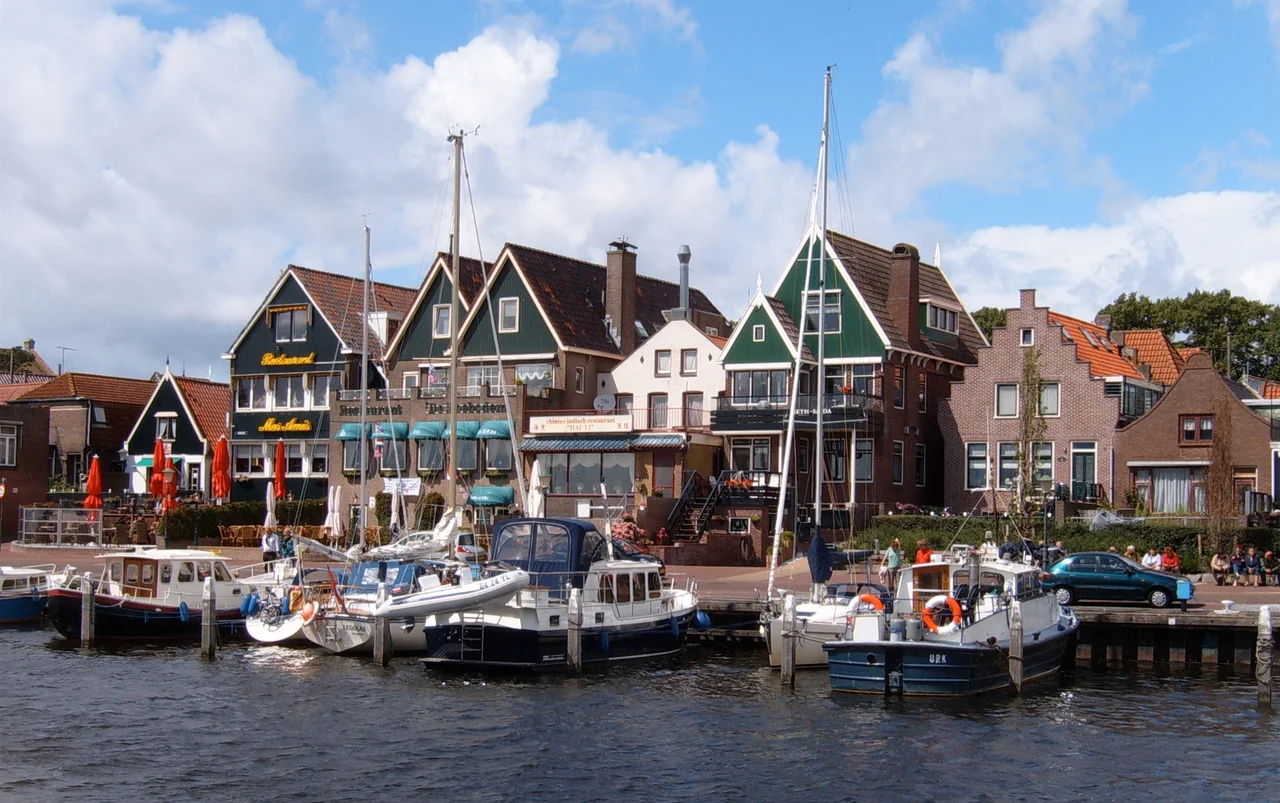

Urk
On Urk, children are told they were not delivered by a stork. They came from a stone. The Ommelebommelestien sits about thirty meters offshore in the IJsselmeer, a single exposed rock that has never been anything other than a rock, and the village understands it as the door through which Urkers enter the world. Strangers - vreemden - come from cabbages or storks like everyone else. Urkers come from the stone. The legend says a father must row to Schokland to fetch the key, which is why an Urkish man asked if he has been to Schokland is actually being asked if he has children. The folktale is centuries old. It survives because Urk's idea of itself - that Urkers and the rest of the world are categorically different things - has survived everything else.
The Island That Was
Until 1939, Urk was reachable only by boat. It had been an island in the Almere, an inland sea that became part of the Zuiderzee in the 13th century after the North Sea broke through. For most of recorded history it sat in open water, a few hundred souls clinging to a rise of clay above the waves, dependent on the herring fleet and on what their boats could bring back. Then came the Zuiderzee Works. In October 1939, dike-builders closed off the channel from Lemmer, and the salt water around Urk began to turn brackish. The Afsluitdijk further north was sealing the Zuiderzee off from the North Sea entirely; the inland sea was becoming the IJsselmeer. Within years the seabed surrounding Urk had been pumped dry and turned into the Noordoostpolder. The island simply stopped being one. It became a hill on a wide flat plain.
Taote, Snoar, Kalletjen
The dialect tells you what isolation does to a language. On Urk, the word for father is taote - older than standard Dutch, older than the Netherlands as a country. The Urkish vowel system has more sounds than standard Dutch, and the pronunciation drifts closer to English than to anything spoken in Amsterdam. The reason is the same reason the legend of the stone stayed alive: radio came late, books were a luxury, and primary school often ended at age eight or nine because children were needed to work. The dialect also carries unexpected tenants. From the eleven- and twelve-year-old Urkish girls who left to work as domestic servants for Jewish families in Amsterdam came loanwords like snoar, sister-in-law, from Yiddish shnur; and kalletjen, girlfriend, from the Hebrew kallah for bride. Napoleon's occupation deposited French. The dialect kept everything. Linguists give it its own group, which feels right - it is a language that has never quite decided to merge.
The Tightest Vote in the Netherlands
Urk votes the way Urk speaks: unlike anyone else. In Dutch national elections the SGP, a Reformed Christian party that draws roughly two percent nationally, routinely takes more than half the Urkish vote. In 2012 it crossed fifty-one percent here outright, an absolute majority in a country where coalitions are everything. The ChristenUnie and CDA pick up most of the rest. Turnout is consistently among the highest in the Netherlands, sometimes approaching ninety percent. Liberal parties barely register; the green and socialist parties almost not at all. The mainland calls this the Bible Belt. Urkers call it normal. Religious life - active, conservative Reformed congregations - remains central, and church attendance is woven into the rhythm of the working week the way it largely is not elsewhere in the country.
The Largest Fleet
Urk has the largest fishing fleet in the Netherlands. That distinction has cost it something. The boats have to travel further now - the local seas that fed the island for centuries are gone, and the North Sea quotas tighten every year. The harbour still works hard. Fish arrive at Urk and go back out to Europe within hours. The town has also been youngest in the country: in 2021, forty-four percent of the population was under twenty-five, a fertility rate well above the Dutch average, families that stay families. There are dark threads here too - the town has been touched by drug-trafficking scandals tied to its fishing economy - but the dominant image remains the working harbour and the boats coming home. The light over the IJsselmeer in late afternoon catches the masts and the white hulls, and it looks like a place that has decided not to follow the rest of the country anywhere it does not want to go.
Two Writers, Quietly
Urk has also been a place outsiders came to be themselves. The detective novelist Albert Cornelis Baantjer was born here in 1923 and spent his later career writing about Amsterdam police inspector De Cock. Less known: in the 1930s the writer Jef Last lived on Urk and fell in love with a fisherman, and the love affair produced Zuiderzee, one of the first novels in Dutch literature to deal openly with homosexuality. A decade earlier the writer and resistance hero Willem Arondeus had spent time on the island and written homoerotic poetry there. The conservative Calvinist village was, quietly and not always knowingly, a place where two gay men in two different decades found enough room to work. It is one of the small contradictions Urk holds without seeming to notice.
From the Air
Urk lies at 52.66 degrees north, 5.60 degrees east, on the western edge of the Noordoostpolder in Flevoland. From altitude the former island is still legible as a slight rise above the polder grid - the surrounding flat farmland was the IJsselmeer seabed seventy years ago. The harbour and lighthouse mark the western point. Recommended viewing altitude is 2,500 to 4,500 feet. Lelystad airport (EHLE) is roughly 30 km south. Schiphol (EHAM) is about 75 km southwest. Strong westerlies sweep across the open IJsselmeer year-round; expect crosswinds and reduced visibility in autumn and winter.
Nearby Stories
- Amsterdamsche Droogdok Maatschappij 0.4 km away
- Mediumwave Transmitter Flevoland 2.4 km away
- North Holland 6.4 km away
- 2001 United Kingdom foot-and-mouth outbreak 6.6 km away
- Heerenveen 7.9 km away
- Koopvaarders Lock 9.9 km away
- Súdwest-Fryslân 12 km away
- Giethoorn 12 km away