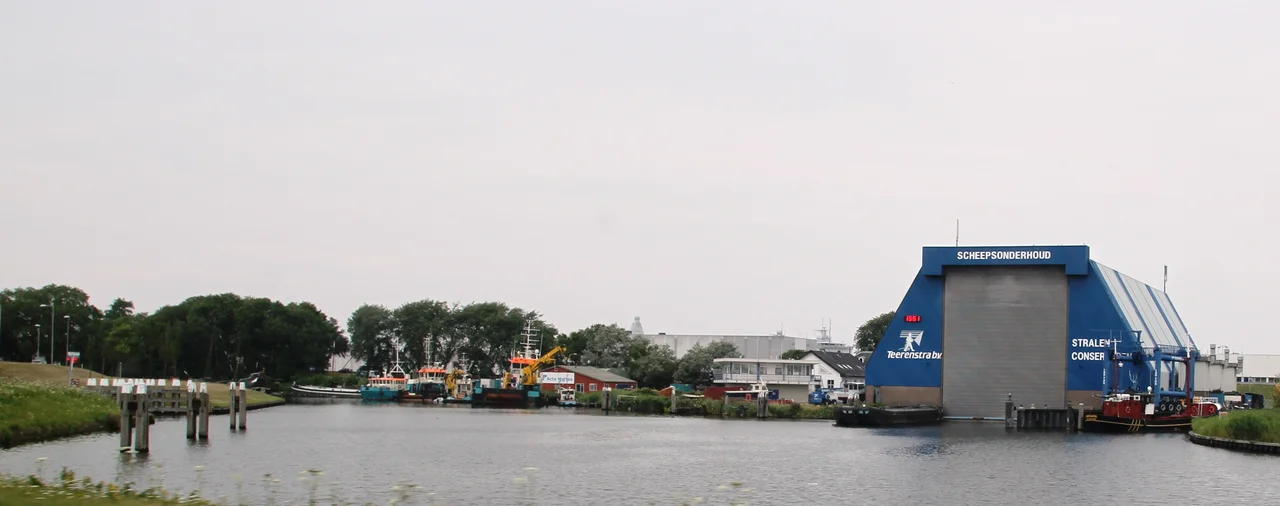

Koopvaarders Lock
Four different locks have worn the name Koopvaarders at this single bend of water in Den Helder, each one a confession that its predecessor had grown obsolete. The first opened in October 1817, just nine metres across the gates. The latest, opened in 1985, swallows ships up to ninety-three metres long. In between lies a two-hundred-year argument between merchants and the navy, between the tides of the North Sea and the polders of North Holland, between what a lock could do and what commerce kept demanding.
Why a Lock Here at All
The Nieuwediep was a happy accident of geography, a strip of deep water close to a low coast that the Dutch navy began carving into a real harbor in 1781. By 1818, after independence had been restored and King William I had taken stock of his commercial possibilities, the calculation changed. A harbor was not enough. Amsterdam was withering as a port, the Zuiderzee was silting, and the only way to keep the old capital connected to ocean trade was to dig a new canal northward to the open sea. That canal needed a gate at its far end. The lock at Nieuwediep would have to do what nothing else in North Holland could: lift commercial ships from inland water levels up to the salt and tide of the North Sea, every day, in both directions, without flooding the polders behind it.
A Naval Lock That Was Too Narrow
The first Koopvaarders Lock opened in 1817 and was almost immediately wrong. Amsterdam's city council pointed out the problem in 1819: at nine and a third metres wide, the gates could not pass a frigate. Even modest merchantmen of 160 lasts had a beam of over nine metres before you counted the rigging. The city demanded eleven-metre locks. By the time planners reconciled the demands of trade with the demands of war, the figure had crept above fifteen metres, wide enough for any warship except the largest ships of the line. The 1817 lock did not vanish. It was handed over to the navy, renamed Marine Schutsluis, and quietly recast as the back door to the maritime harbor while a successor was tendered in 1823 on the canal's true mouth.
Five Million Bricks and 1,678 Piles
The second lock failed in less than thirty-five years. By the 1850s commercial ships had outgrown it again, and the workaround, sending them through the navy's wet dock, was dropping the water level enough to ground heavy warships and pickling the polders with salt. So they built a third lock. The contract went to N. Swarte of Haarlem in 1851 for 360,000 guilders. A steam engine pumped the foundation pits dry. On 19 August 1853 the last of 1,678 piles was driven into the sand. Twenty-two masons laid five million bricks in twenty-four weeks. The pile drivers, working 31,209 day-shifts against the masons' 2,975, were the lock's true authors. Koopvaarders Lock III opened on 1 August 1857 and served until 1985, when modern bow thrusters and the occasional unscheduled collision, including the American supply ship Springbuck slamming the gates in 1977, finally retired it.
The Bacteria That Ate a Lock
Koopvaarders Lock IV opened on 8 May 1985 after costing fifty-five million guilders and reducing the time to lift a ship from more than fifteen minutes to seven. It should have lasted a century. Then in 2015 inspectors crawled the steel shoring and found enormous holes. Not corrosion from salt water, not impact damage. Bacteria. Microbes were eating the metal. The problem turned out to be far worse than the first reports suggested, and emergency repairs in 2019 only bought time. The lock closed for full renovation on 15 June 2020. While engineers rebuild it, traffic detours through the old navy wet dock, the same workaround that drove the construction of Lock III in 1851. The flood gate at Boerenverdriet is being converted to a proper lock for pleasure boats, and the rebuilt Lock IV will be lengthened to handle ships of 105 metres. Some problems get solved. Others just rotate.
What the Old Locks Became
Koopvaarders Lock II was demolished in 1859, won by a contractor named C. Dekker from Sliedrecht for 16,200 guilders. Koopvaarders Lock III met a stranger fate. Its chamber was sealed on the sea side and a Dutch firm called Teerenstra BV built a hall over it, repurposing the brick basin into an environmentally enclosed space for repainting ship hulls. The 1857 masonry that once handled sixty or seventy vessels a day, including thirty sand barges and ten offshore-industry boats, now contains the fumes of fresh marine paint. The first lock, the navy's narrow original, was long ago absorbed into the harbor that grew up around it. Four locks, all named for the merchant trade, all bent eventually by the ships that outgrew them.
From the Air
Located at 52.95 north, 4.79 east, at the seaward end of the Noordhollandsch Kanaal where it meets the Nieuwediep at Den Helder. The lock complex sits within the old fortification ring just south of the Willemsoord naval yard, visible from the air as a narrow rectangular cut between the canal and the harbor. The nearest airfield is De Kooy (EHKD), the former naval air station, about 2 km north. Schiphol (EHAM) is roughly 70 km south. Texel airfield (EHTX) lies 15 km north across the Marsdiep. Best viewing altitude 2,500 to 4,000 feet in clear weather, when the geometry of canal, lock, wet dock and harbor reads as one continuous nineteenth-century engineering exercise.
Nearby Stories
- Zuiderzee Museum 3.6 km away
- Battle of Bergen, 1799 7.8 km away
- West Frisian Islands 12 km away
- Tjaskers in Friesland 13 km away
- Princess Amalia Wind Farm 16 km away
- Battle of Camperdown 28 km away
- Holmes's Bonfire 33 km away
- Antiope 35 km away