.jpg)
Battle of Camperdown
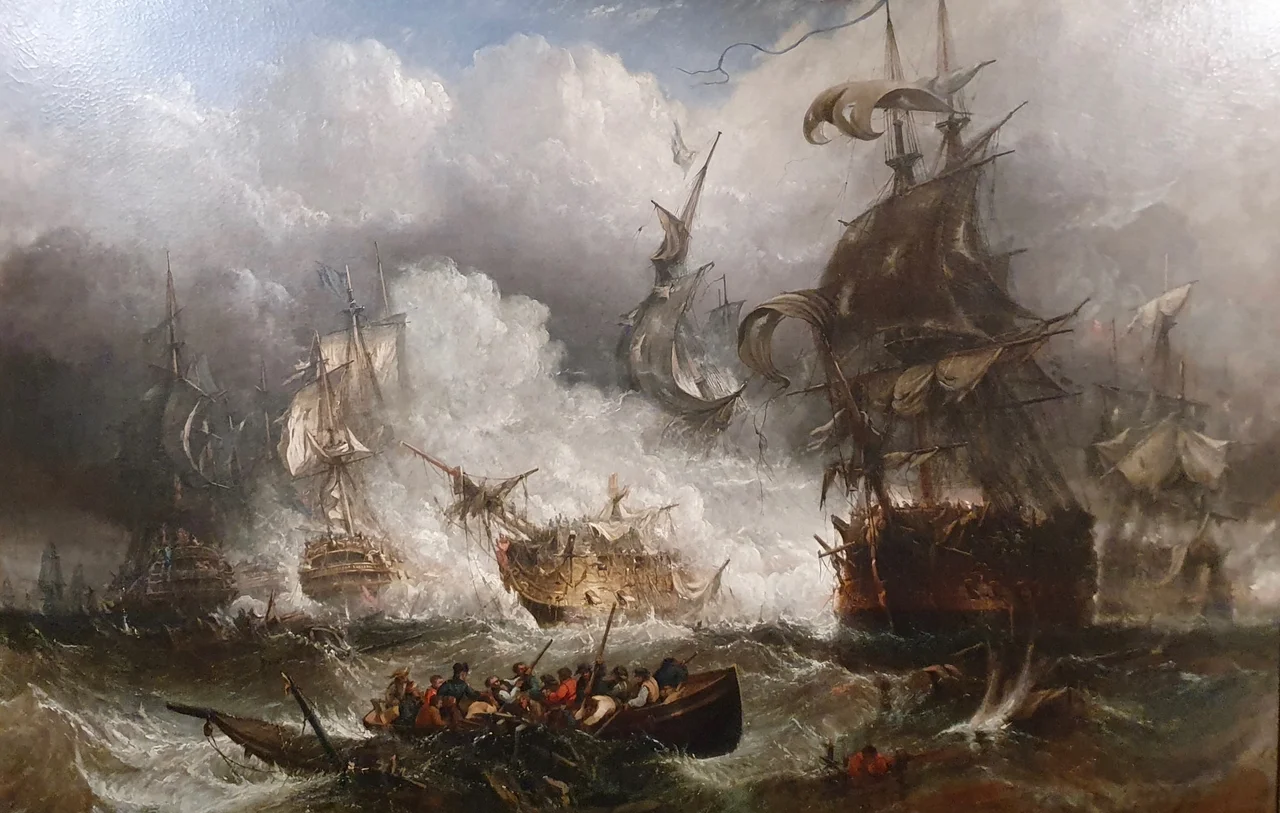
"I am determined to fight the ships on land if I cannot by sea." Admiral Adam Duncan said that aloud on the morning of 11 October 1797, watching a Dutch fleet draw steadily toward the shallow coastline off Camperduin. He meant it. The Dutch had been at sea for two days trying to escape him, and Duncan - a 66-year-old Scot of enormous physical presence, six feet four inches tall and broad as a doorway - had no intention of letting them slip back into the safety of the Texel anchorage. By the end of the afternoon, the Dutch fleet would be shattered, both admirals would be wounded, and roughly 540 Dutch sailors would be dead. And a French-Dutch invasion of Britain and Ireland that had been a year in the planning would quietly fall apart.
Why the Dutch Were at Sea
The Dutch fleet of 1797 was not really Dutch. The old Republic of the United Provinces had collapsed two years earlier when French revolutionary armies marched into Amsterdam. In its place was the Batavian Republic - a French client state with a Dutch crew. Paris and The Hague had been planning a combined invasion of Britain and Ireland, exploiting Irish revolutionary sentiment to open a second front against the British. The Dutch fleet, under Vice-Admiral Jan de Winter, had been ordered to sea to support the operation. By the time De Winter cleared the Texel on 8 October, the French half of the plan had already disintegrated, but the Dutch sortie went forward anyway. Duncan's ships were waiting.
Duncan's Mutinous Fleet
The British North Sea Squadron Duncan commanded was not in fighting trim - at least not on paper. The previous spring, large parts of the Royal Navy had mutinied over pay and conditions. At the Nore anchorage, sailors had hauled down the union flag and replaced it with a red flag of defiance. Duncan, blockading the Texel with crews that had not been paid in years, kept his fleet on station partly through sheer personal magnetism: standing on his own quarterdeck, he reportedly dangled a mutinous sailor over the side by his shirt collar to remind the rest who was in charge. By October he had two fully-loyal ships, the Venerable and the Adamant, holding the Texel blockade alone for a critical stretch - while signaling continuously to imaginary ships over the horizon to convince the Dutch they were still outnumbered.
The Attack
At 09:00 on 11 October, Duncan signaled to prepare for battle. De Winter, recognizing he could not outrun the British, formed his sixteen ships into a defensive line of battle on a northeasterly heading, drifting steadily toward the lee shore as he did so. Duncan's plan was the same one Nelson would make famous at Trafalgar eight years later: smash the enemy line in two places at once, force a melee where British gunnery and seamanship would tell. By 11:53 Duncan had given up on textbook line tactics altogether. He raised the signal for each ship to pick its opposite number and engage "as closely as possible." His fleet split into two ragged divisions and bore down on the Dutch line directly, sails blanketing each other in the confusion of the attack.
Three Hours of Hell
The fight that followed was the bloodiest fleet action between Europeans of the entire eighteenth century. Ships came alongside at pistol range and traded broadsides for two and a half hours - thirty-two-pounder shot at point-blank range, smashing through oak hulls and turning splinters into shrapnel. Vice-Admiral Onslow, leading the southern British division, drove the 64-gun Monarch through a gap in the Dutch line and raked Rear-Admiral Hermanus Reijntjes's flagship Jupiter from stern to bow. Duncan in Venerable laid himself alongside De Winter's Vrijheid. Eventually De Winter's flagship was so completely dismasted that he is said to have remarked, when he came aboard Venerable to surrender, that it must be the first time two admirals fought a battle so completely on their feet, since there was nothing left aboard either ship to sit on. By the end of the afternoon, eleven Dutch ships had surrendered. Roughly 540 Dutch sailors lay dead and 620 wounded. The British casualty list ran to 228 killed and 812 wounded - heavy by any measure, but for the magnitude of the victory, modest.
What It Meant
The political consequences were immediate. The planned French-Dutch invasion of Britain and Ireland was now impossible: De Winter's fleet, the maritime arm of the operation, no longer existed in any meaningful form. The Irish Rebellion of 1798 would go ahead the following year without the foreign army it had been promised, and it would be crushed. Duncan was raised to the peerage as Viscount Duncan of Camperdown. His name became attached to a country estate near Dundee, to a Royal Navy battleship, and eventually to a parkland public space in Scotland that still carries the name today. De Winter, treated with elaborate courtesy as Duncan's prisoner, was repatriated to the Batavian Republic and lived to see Napoleon crowned emperor. But the men he had taken to sea did not come home with him. They are still there, beneath the southern North Sea, in waters now criss-crossed by container ships, ferries, and the slow blades of wind turbines that did not exist for another two centuries.
From the Air
The battle was fought roughly 30-40 km offshore from the village of Camperduin on the North Holland coast, in waters centered near 52.75°N, 4.20°E. The shoreline itself - long pale beach backed by dune ridges, with the modern Hondsbossche seawall reinforcement visible from the air - is the most identifiable landmark. Best viewed from 3,000-6,000 ft on a clear day. Nearest airports: Amsterdam Schiphol (EHAM) 40 km southeast, Den Helder Airport (EHKD) 25 km north. The wind farms now standing in these waters (Hollandse Kust Noord, Princess Amalia) sit on the same patch of sea where the action took place.
Nearby Stories
- Battle of Texel 7.4 km away
- Marquette Castle 7.8 km away
- Battle of Callantsoog 9.1 km away
- Luchterduinen Offshore Wind Farm 18 km away
- Battle off Texel 23 km away
- SS Elbe 29 km away
- Battle of Texel (1694) 38 km away
- Battle of Lowestoft 41 km away