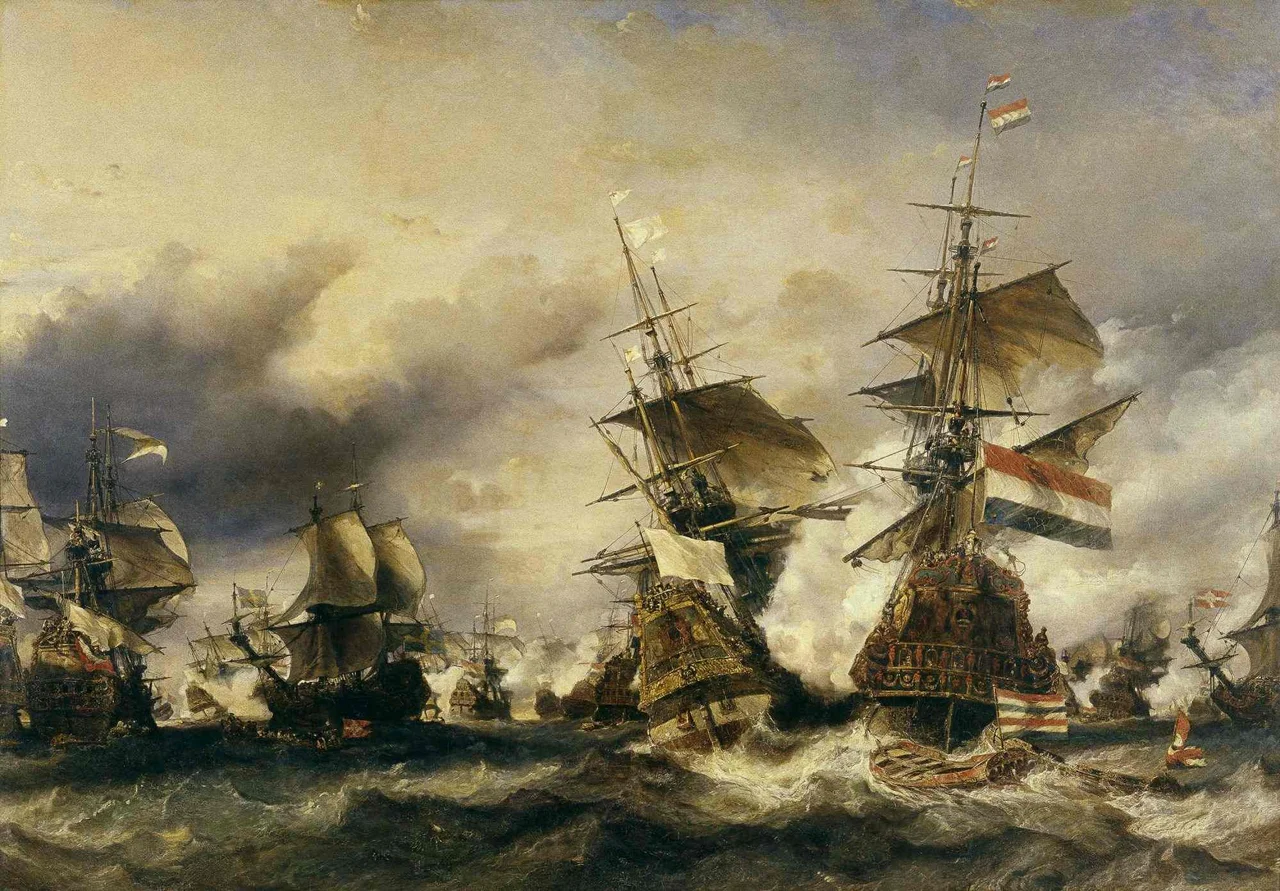

Battle of Texel (1694)
France was eating bark. In the winter of 1693 to 1694, harvest failures and a punishing war had killed perhaps two million people across the kingdom, and the survivors were turning to anything chewable. Louis XIV's solution was unromantic and desperate: buy grain from neutral countries in the north and run it past the Dutch blockade. On 29 June 1694, off the Dutch island of Texel at three in the morning, that grain - 120 ships full of it, captured days earlier by the Dutch - was floating quietly under prize crews when a Dunkirk privateer named Jean Bart appeared out of the dark. By six o'clock, the convoy was French again, and the rest of Bart's life had been written.
Not the Famous One
When people say "the Battle of Texel," they almost always mean the 1673 fight - Michiel de Ruyter against an Anglo-French fleet, the Spice Fleet saved, the Third Anglo-Dutch War effectively ended. The 1694 battle is a smaller, stranger affair fought in the same stretch of North Sea two decades later, during the Nine Years' War. The combatants have changed. The famine has changed everything else. Where 1673 was about empire and prestige, 1694 was about bread. France's grain agents had bought up 120 cargo ships' worth of rye and wheat from Poland-Lithuania, Sweden, and Denmark-Norway. The convoy sailed under three neutral warships, because no French squadron was free to escort it through the Channel. The Dutch, who knew exactly what was aboard and what it meant, intercepted the entire fleet without firing a shot.
Jean Bart Arrives Late
Jean Bart was a Dunkirk fisherman's son who had become the most feared privateer in northern Europe. The French Navy had finally commissioned him as a regular officer; the Dutch and English still treated him as a corsair. On 29 May 1694 he was ordered to sail to Norway and bring the grain home. By the time his eight-ship squadron worked north past Texel, the convoy was already gone - taken by Hidde Sjoerds de Vries, the Frisian rear-admiral of the Dutch States Navy, escorting his prize back toward the Dutch coast. Bart found the captured convoy at three in the morning, anchored in light air off Texel. He had fewer guns than de Vries. He attacked anyway. At five o'clock his flagship Maure laid alongside the Dutch flagship Prins Friso. Half an hour later the Prins Friso struck her colors. Two more Dutch warships - Statenland and Zeerijp - had also been taken by Bart's ships. The other five Dutch escorts fled for harbor.
What Half an Hour Cost
The numbers from the boarding action are stark. A hundred Dutch sailors were killed. A hundred and twenty-nine were wounded. Four hundred and fifty-five were taken prisoner. Among the wounded was de Vries himself, the Frisian admiral, hit during the close fight on the Prins Friso's quarterdeck and carried below. He survived long enough to be moved aboard a French ship as a prisoner of honor. He died of his wounds on 1 July 1694, two days after the battle. He was a respected officer caught in an unlucky engagement - outgunned not in firepower but in initiative, taken by surprise in calm air with no room to maneuver. The grain, meanwhile, was already being shepherded south by Bart's prize crews. The convoy reached Dunkirk on 3 July to crowds lining the harbor. The Maure put its anchor down in front of a city that had not seen this much bread arrive in months.
Rewards from Versailles
Two days after Dunkirk, Bart was at Versailles. Louis XIV received him in person along with his son François Cornil Bart, a teenage naval officer who had fought in the action, and his brother-in-law. The king embraced him. On 4 August 1694 Bart was formally raised into the French nobility - an extraordinary social leap for a man who had begun as a fisherman and made his name as a privateer. For France, the practical value was bigger than the symbolic one. The grain Bart brought home eased the famine in Dunkirk and the surrounding region for the rest of that year. For the Dutch, the loss was costly but not strategic. The Nine Years' War would grind on until 1697, and Texel's waters would keep accumulating fights. But the half hour off the Dutch coast on 29 June 1694 had quietly altered something: it made Jean Bart, the corsair, a legend that France has never quite stopped retelling.
From the Air
The Battle of Texel of 1694 was fought in the shallow North Sea approaches to the Dutch island of Texel, centered roughly at 53.15°N, 4.60°E - the open water just west and north of the island, off the Marsdiep tidal inlet. From cruising altitude, Texel itself is the southernmost of the Frisian island chain that strings along the Dutch and German coast. Recommended viewing altitude is 5,000 to 10,000 feet for the best view of the island and the surrounding shoals where eighteenth-century fleets fought. Nearest airfields are Texel International (EHTX) on the island itself and De Kooy (EHKD) at Den Helder on the mainland just to the south. The waters here are notoriously fickle - thick coastal haze and rapid weather changes are common, even when inland skies are clear.
Nearby Stories
- Stavoren 6.4 km away
- Battle of Callantsoog 7.4 km away
- Harlingen, Netherlands 10 km away
- Battle of Camperdown 18 km away
- De Verwachting, Hollum 24 km away
- Action of 22 September 1914 37 km away
- Ballum 62 km away
- West Sole Gas Field 205 km away