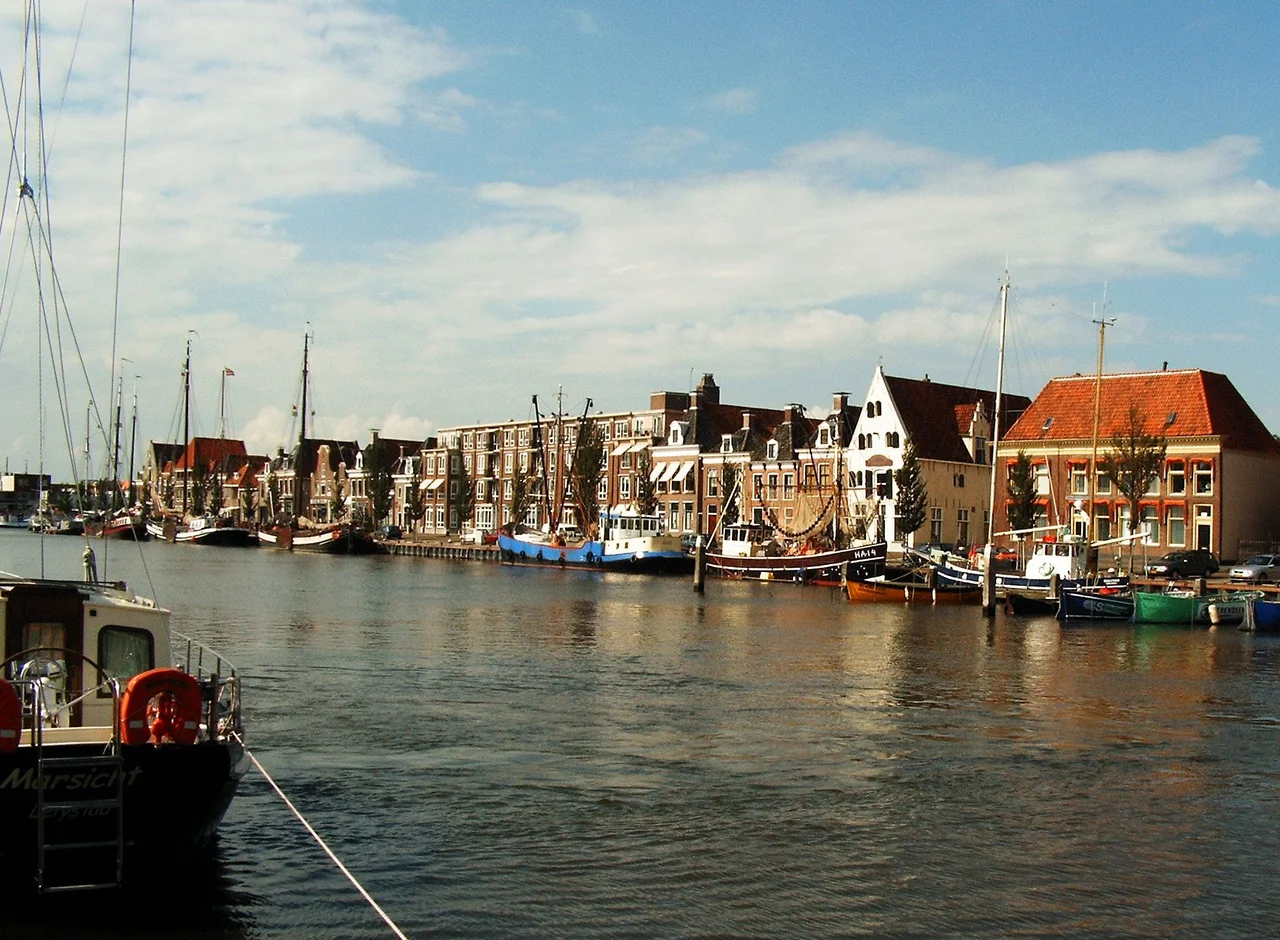

Harlingen, Netherlands
Sometime in the 1820s, a refrigerated steamer left Harlingen with a hold full of Frisian butter and pointed itself at London. By 1896 this route was one of the most profitable lines run by the General Steam Navigation Company - cattle on the hoof going one way, dairy products in cooled holds going the other. A century earlier, before the railways and the steamships, the city had been Friesland's second largest, dependent entirely on whatever the Wadden Sea would let pass through its harbor. Harlingen is the only town in Friesland that opens directly onto salt water. Everything about it - the Mennonites, the tilework, the daily packet to Amsterdam, the Texas suburb of its own name - traces back to that single geographic accident.
A Coastline Made by Disaster
The Wadden Sea came to Harlingen the hard way. On 14 December 1287, the St. Lucia's flood tore open the Frisian coast and pushed seawater up to what had been an inland village. Almenum, the old church-village on its terp just east of town, suddenly found itself on a harbor. Harlingen, with city rights granted before its walls were even built, took the opportunity. Fire destroyed most of it in 1462. The Vetkopers and Schieringers - rival factions in the Frisian civil wars - fought over it through the 1490s, with Albert III, Duke of Saxony, landing here in 1498 to back the Schieringer side and founding the first proper fortress. By the early 1500s Harlingen was a walled town with a harbor and a politics, which in the Netherlands of that century was enough.
Refuge for the Awkward Faiths
When the Eighty Years' War opened in 1566, religious refugees began arriving on the Wadden coast. Many were Mennonites, pacifists who had fled inland persecution and found a port city that was willing not to ask. They thrived. By 1580 the town had expanded a second time, pulling Almenum inside the walls. After the Reformation, Harlingen kept a confessional patchwork that would have been unimaginable elsewhere: two Protestant churches (the Dome of Harlingen in old Almenum and the smaller Wester Kerk), two Mennonite ministers, a Lutheran congregation in its own building, and Catholics quietly meeting in a clandestine church - technically illegal, discreetly tolerated. In 1645 the Admiralty of Friesland moved here from Dokkum, bringing ten councilors, a fleet, and the kind of paperwork that requires warehouses. When the Admiralty building on the Nieuwe Haven burned down in 1770, it took the surrounding warehouses with it. Twenty years later, the city still hadn't rebuilt them.
What the Harbor Carried
By the late 1700s Harlingen held about 7,500 people and ran on goods that passed through its locks. From the Baltic came cereals, timber, flax, hemp, pitch, tar - everything ships were made of. Wine arrived from further south. Out went butter, cheese, peas, beans, cattle, horses, sheep, the cattle herded onto boats bound for Holland and beyond. The town's own industries leaned on cheap peat brought in by canal: sailcloth, bombazine and Velours d'Utrecht, salt works, roof tiles, saucers and dishes, the lime kilns. The famous Delft-style tiles that decorated Dutch interiors across Europe were not all made in Delft. Many came from Harlingen. In the 1640s the city built a towpath along the Harlingertrekvaart out to Franeker and Leeuwarden, and by the eighteenth century there was a daily boat to Amsterdam in each direction. The city had become, essentially, a logistics company.
The Texan Footnote
Steam changed the calculus. From the 1820s the Amsterdamsche Stoomboot Maatschappij stopped here on its Amsterdam-Hamburg run. By 1846 the steam route to London was indispensable to the Frisian economy, with shipping companies elbowing each other for market share. The St. Petersburg Steamship Company took the lead, then was absorbed by the General Steam Navigation Company in 1876. By the late 1890s GSNC's Harlingen boats had cooling holds, and Frisian butter could reach London still firm. The Harlingen-Nieuweschans railway, finished in 1868, ran south before Leeuwarden or Groningen had their own connections - a small mystery of priorities that probably has to do with how much the harbor was worth. Among the families that left during the nineteenth century were settlers bound for the Lower Rio Grande Valley in Texas. Their new town is named for the old one. Harlingen, Texas, owes its name to people who knew what tides felt like.
Simon Vestdijk Renames It
The Dutch novelist Simon Vestdijk was born here in 1898 and spent his life trying to escape and explain his hometown in roughly equal measure. He renamed it Lahringen in his fiction and was nominated fifteen times for the Nobel Prize in Literature without ever winning. His Harlingen is recognizable on the ground: the protected stadsgezicht of the old center, the shallow-draught historical sailing vessels still moored along the quays, the harbor where the Doeksen ferries leave several times a day for Vlieland and Terschelling out in the Wadden island chain. The Brandaris lighthouse on Terschelling, built in 1594, is older than most things in Harlingen itself. From a sailing vessel coming in past the dams of the Buitenhaven, the town reveals itself as it always did - row of gables, weighhouse, working harbor, the slight lean of brick toward the water.
From the Air
Harlingen lies at 53.17°N, 5.43°E, on the Friesland coast where the mainland pokes northwest into the Wadden Sea. From altitude the city is easy to spot: a compact dark grid of brick anchored to a working harbor, with the geometric outline of its old earthen bastions still partly readable in the street pattern. The Wadden Sea spreads west - tidal mudflats striped with deepwater channels - leading toward Vlieland and Terschelling. Nearest airport is Leeuwarden Air Base (EHLW), about 23 km east. The Afsluitdijk runs south of here, the long causeway separating the Wadden Sea from the IJsselmeer. Best viewing at 2,000-4,000 feet AGL on a clear day with low tide for the mudflat patterns.
Nearby Stories
- Stavoren 6.8 km away
- Protestant church of Jistrum 7.4 km away
- Duinen van Texel National Park 8.5 km away
- De Verwachting, Hollum 12 km away
- Battle of Krabbendam 15 km away
- Drenthse Veenkolonien 17 km away
- Schiermonnikoog 18 km away
- West Sole Gas Field 251 km away