_-_Nightly_battle_between_Cornelis_Tromp_and_Eward_Spragg_(Willem_van_de_Velde_II,_1707).jpg)
Battle of Texel
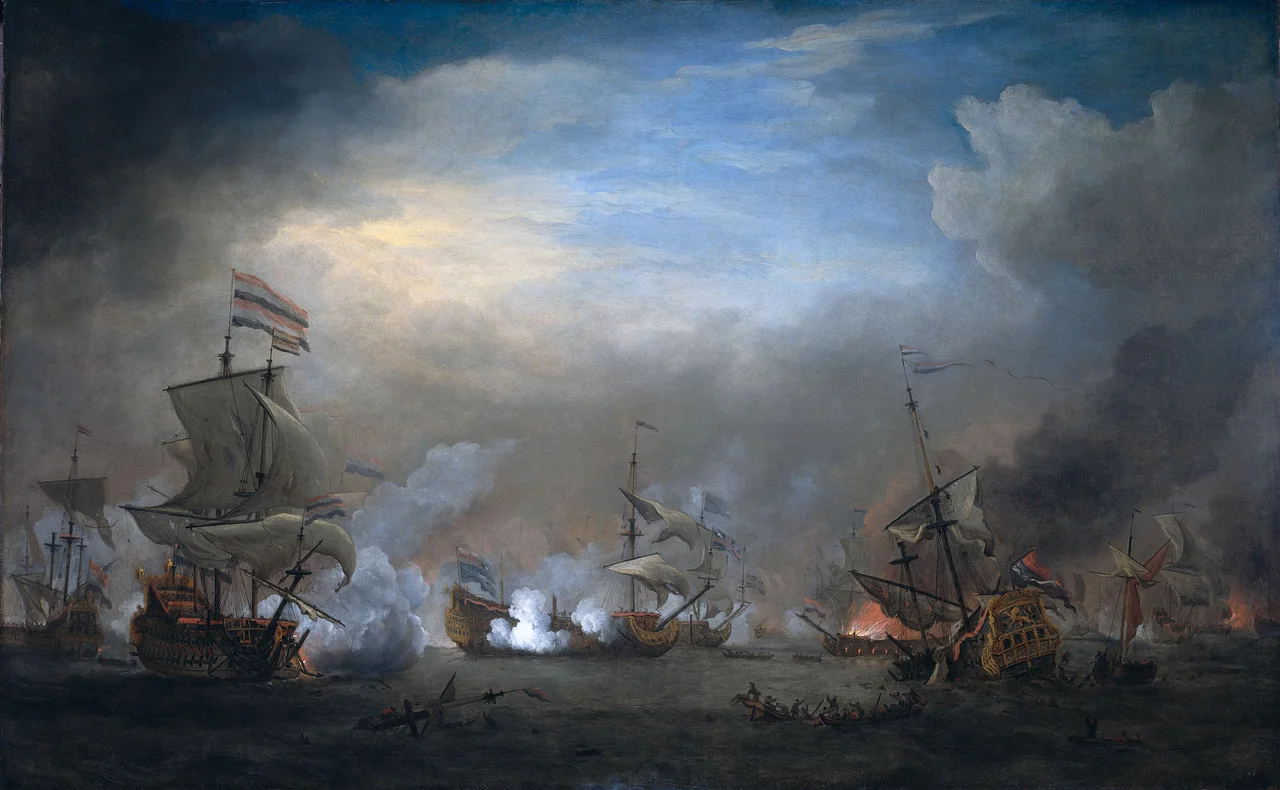
Sir Edward Spragge had publicly sworn to kill or capture Cornelis Tromp. He almost succeeded in killing himself in the attempt. On 21 August 1673, off the western coast of Texel, in what would be the final major battle of the Third Anglo-Dutch War, Spragge shifted his flag three times as English ships shot from under him. The third time, the boat carrying him between flagships went down. He drowned in the brown August sea of the southern North Sea, the obsessive duel between two admirals isolating his squadron from the rest of his fleet and helping a smaller Dutch force win one of the most consequential naval battles of the seventeenth century.
How the War Got Here
The Third Anglo-Dutch War was a war the English Parliament did not want. Charles II had concluded the Treaty of Dover with Louis XIV in secret, agreeing to attack the Dutch in support of a French invasion of the Spanish Netherlands. The Franco-Dutch War broke out in 1672. The French Sun King poured armies across the southern frontier and occupied half the Republic. The English fleet, under James, Duke of York, sailed against the Dutch coast. What none of these alliances accounted for was Michiel de Ruyter, an admiral the Duke of York would later call the greatest who had ever lived to that time. Through 1672 and 1673 De Ruyter fought a series of defensive battles in the shallow shoals off the Dutch coast, keeping the larger Anglo-French fleet from landing troops while half his country lay under French occupation.
A Treasure Fleet to Protect
By August 1673 the Dutch Republic was financially desperate. With French armies on Dutch soil and trade at a standstill, the only thing keeping the war effort solvent was the imminent return of the Spice Fleet from the East Indies, a convoy of Dutch East India Company merchantmen carrying a cargo whose value could fund another year of resistance. If the fleet was captured, the Republic would have to make peace on whatever terms its enemies demanded. Stadtholder William III ordered De Ruyter out of his defensive position at Schooneveld. The treasure fleet had to come home. To get it home, De Ruyter would have to fight Prince Rupert of the Rhine's combined force of more than a hundred warships and twenty-eight fireships with seventy-five warships and twenty-two fireships of his own. He was outnumbered. His ships were on average smaller than his opponents'. His crews, however, were better trained, more experienced, and fighting for their country's survival.
Cutting the French Loose
De Ruyter gained the weather gauge and immediately used it. He sent his van under Adriaen Banckert against the French squadron of Jean d'Estrées, attacking with such ferocity that the French were peeled away from the rest of the Allied fleet and could play no further part in the battle. The maneuver was not an accident. Louis XIV had ordered d'Estrées to preserve his ships, and d'Estrées, claiming the wind was too weak, declined to come back into the action. Whether this was treachery or caution depends on which French officer's account you trust. The effect was the same: Rupert's center and Spragge's rear had to face the entire Dutch fleet alone.
The Duel That Cost a Battle
The rear divisions clashed for hours. Spragge had vowed to take Tromp. Tromp gave him every opportunity. Each admiral lost two flagships and shifted to a third, the sea around them strewn with splinters and broken rigging and dead and dying men. When Spragge's third flagship was disabled, he was rowing across to a fourth when his boat sank under him. He drowned within sight of his own ships. About three thousand men died in the fighting that day, two-thirds of them English or French. While Spragge and Tromp were obsessed with each other, the English center under Rupert was isolated, exposed, and slowly worn down by the Dutch center under De Ruyter and Lieutenant-Admiral Aert Jansse van Nes. No major ships sank, but many of the Allied vessels were too damaged to continue. By evening the Allies withdrew.
What the Battle Bought
The Spice Fleet came home. Four ships were lost, but the bulk of the cargo arrived safely in port, and the Republic got its financial reprieve. Within months the Netherlands had formed a coalition with Spain and the Holy Roman Empire. The threat of invasion from the south and east forced Louis XIV to pull French troops out of Dutch territory. The English, with their navy bloodied and the Parliament increasingly hostile to a war they had never wanted, signed the Treaty of Westminster in 1674 and quit the alliance. The Third Anglo-Dutch War was over. Fourteen years later the Glorious Revolution would put William III on the English throne and end the Anglo-Dutch naval rivalry for nearly a century. Not until the Battle of Dogger Bank in 1781 would the two fleets fire on each other again.
De Ruyter's Hour
The Duke of York, looking back across the seventeenth century, said of De Ruyter that he was the greatest admiral ever to that time in the world. The judgment came from an enemy who knew the man's work intimately. Texel was the highest point of De Ruyter's career, a battle won against superior numbers, in poor strategic position, with the country he served literally occupied as he fought. Three years later, in 1676, De Ruyter was fatally wounded at the Battle of Augusta off Sicily and died of his injuries a week later in Syracuse. The Republic he saved at Texel would mourn him as it had mourned few of its admirals. The seventeenth-century paintings that line the walls of Dutch maritime museums, the Goulden Leeuw engaging the Royal Prince, the night battle between Tromp and Spragge, are mostly views of this single August day off the western beach of Texel.
From the Air
The battle took place at approximately 53.15 north, 4.60 east, off the western coast of Texel in the southern North Sea. From the air, the beach of Texel runs north to south at the eastern edge of the engagement zone; on a clear day you can see the dune coast, the lighthouse at the northern tip, and the protected anchorage of the Marsdiep. Texel airfield (EHTX) is on the southern end of the island; De Kooy (EHKD) at Den Helder is 15 km south across the strait. Schiphol (EHAM) is roughly 80 km south. Best viewed at 3,000 to 6,000 feet in clear coastal weather, when the open intercept water of the seventeenth-century battle and the modern offshore wind farms occupy the same sea.
Nearby Stories
- Stavoren 6.4 km away
- Battle of Callantsoog 7.4 km away
- Harlingen, Netherlands 10 km away
- Battle of Camperdown 18 km away
- De Verwachting, Hollum 24 km away
- Action of 22 September 1914 37 km away
- Ballum 62 km away
- West Sole Gas Field 205 km away