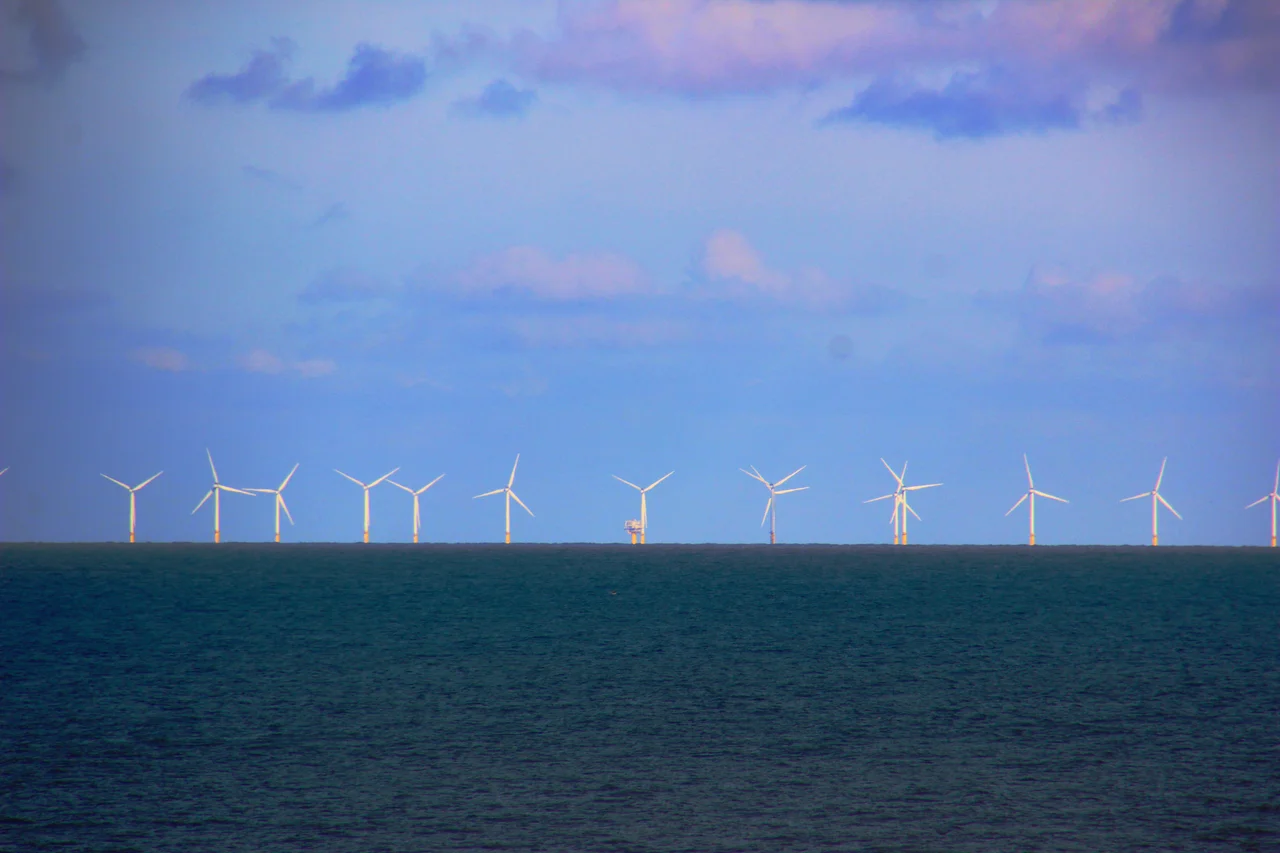

Luchterduinen Offshore Wind Farm
It started as Q10 - a placeholder name on a Dutch hydrographic chart, a numbered patch of seabed waiting for someone to do something with it. The developers at Eneco knew they wanted a better name. They held a public competition. On 15 May 2012, after sifting through 150 submissions, they settled on Luchterduinen: "the dunes of Lucht," after a long-vanished coastal manor called Huis ter Lucht that once stood between Noordwijk and Zandvoort. The manor is gone. The dunes remain. And twenty-three kilometers offshore, 43 wind turbines now bear its name.
A Modest Fleet
Luchterduinen is not a giant. Its 43 Vestas V112 turbines generate 3 megawatts each, for a total installed capacity of 129 megawatts - less than a tenth of what its neighbor Hollandse Kust Zuid produces from the surrounding waters. The array covers about 16 square kilometers, modest by modern standards. When it came online in September 2015, however, it was something significant: the third commercial offshore wind farm in the Netherlands, and the first to demonstrate that the regulatory machinery, the financing structures, and the construction logistics could all be repeated reliably. Big farms get the headlines. Mid-sized farms like Luchterduinen quietly prove that the playbook works.
The Manor That Vanished
Huis ter Lucht stood somewhere in the dune belt between Noordwijk and Zandvoort, a coastal estate built when these dunes belonged to a different kind of Holland - one of country houses, sand drift, and rabbit warrens leased to Amsterdam burghers. The exact site of the manor is now uncertain. Dune migration, war, and twentieth-century development have buried whatever foundations might have survived. The name persisted in old maps and in local memory, and when Eneco needed something more evocative than "Q10," the dunes provided. There is something quietly Dutch about choosing a wind farm name that points to a coastal house that no longer exists - the past and the future of the same shoreline, both named in one breath.
Building Smart, Building Fast
The Vestas V112 was a workhorse turbine when Luchterduinen was specified - reliable, well-understood, with a track record onshore that translated cleanly into offshore service. Eneco's engineers chose 43 of them, sized to fit the available grid connection, and built quickly. By North Sea standards the construction window was tight: foundations were installed, turbines were erected, and inter-array cables were laid in a single season. Full commercial operation arrived in September 2015. Eight years later, the same turbines are still spinning, having delivered hundreds of gigawatt-hours to the Dutch grid without major operational drama. In the wind industry, boring is a compliment.
Surrounded
Walk onto a service vessel at Luchterduinen today and the view has changed. Where in 2015 the 43 Eneco turbines stood alone in open North Sea, the array is now ringed on three sides - northwest, southwest, southeast - by the 139 much larger Siemens Gamesa machines of Hollandse Kust Zuid. The Vattenfall project was deliberately permitted to wrap around the older Eneco farm rather than displace it, sharing seabed and grid corridors. From above, the two arrays form an unlikely pairing: a compact ring of 3 MW turbines nested inside a sprawling cloud of 11 MW giants. Each generation of offshore wind sits inside the next.
The Quiet Workhorse
Luchterduinen does not break records. It is not the largest farm in the North Sea, not the furthest from shore, not the most ecologically engineered, not the first to be subsidy-free. What it is, instead, is reliable. The 43 turbines feed roughly 150,000 Dutch households' worth of electricity onto the grid in an average year. Maintenance vessels rotate out from IJmuiden on predictable schedules. The substation at the array's center quietly aggregates power and ships it back to shore via export cables that have given the operators no real trouble. Most renewable infrastructure works this way - not as a marquee project, but as a steady contribution to a grid that is gradually, turbine by turbine, decarbonizing. Twenty years from now, when the original Vestas machines are due for replacement, the dunes of Lucht will still be there, and the wind that turns them will still be free.
From the Air
Luchterduinen is centered near 52.42°N, 4.17°E, roughly 23 km west of Noordwijk and 18 km west-northwest of Zandvoort. The 43-turbine array sits inside the much larger Hollandse Kust Zuid envelope, so from altitude you'll see two textures: the compact Luchterduinen core and the sprawling outer ring. Best viewed from 4,000-8,000 ft on a clear day. Nearest airports: Amsterdam Schiphol (EHAM) 30 km east, Rotterdam The Hague (EHRD) 50 km south. Coastal haze is common; mornings and late afternoons typically offer the best contrast against the sea.
Nearby Stories
- Fort IJmuiden 0.8 km away
- HMS Prince George (1895) 4.7 km away
- Randstad 6.1 km away
- Battle of Camperdown 11 km away
- SS Elbe 12 km away
- SMS Hildebrand 19 km away
- Southern Bight 48 km away
- Battle off Texel 62 km away