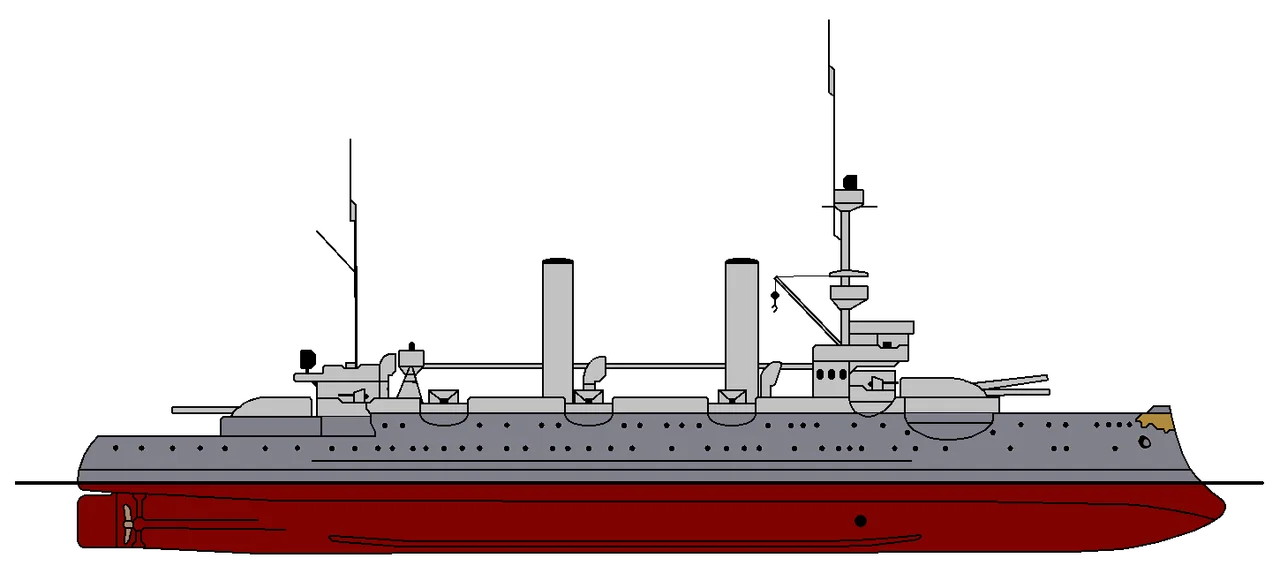

SMS Hildebrand
On 21 December 1919, a severe storm hit the Dutch coast, and a German warship - already dead - drove into the sand at Scheveningen. SMS Hildebrand had been stricken from the Imperial Navy register that summer and sold to a Dutch firm for scrap. Her six-man delivery crew was steering her up the coast toward the breaker's yard when the weather closed in. She grounded hard. The crew was successfully evacuated. The ship was not. She sat there, on the beach of The Hague's seaside district, while the Netherlands and Germany and the rest of Europe got on with the messy business of the postwar 1920s. Salvage proved impossible. Tides did what tides do. In 1933, fourteen years after she stranded, what was left of Hildebrand was finally blown up and broken up where she lay. She had served Imperial Germany for twenty-two years, fired her guns at nothing, and ended on a Dutch holiday beach.
A Ship Built to Solve a Political Problem
Hildebrand existed because the German Reichstag did not want to fund a real navy in the late 1880s. General Leo von Caprivi, the new chief of the Admiralty, knew he could not get parliament to approve heavy ocean-going battleships - but he could get them to fund modest coastal defense ships to protect the entrances of the Kaiser Wilhelm Canal, then under expensive construction. The Siegfried class was the smallest of the design proposals: 79 meters long, displacing about 3,500 tons, armed with three 24-centimeter guns in unusual single turrets. Two guns sat side by side at the bow, the third faced aft. The arrangement reflected the tactical doctrine of the day - the dream of breaking through an enemy line of battle the way the Austrians had at Lissa in 1866 and engaging targets in multiple directions at once. It was a doctrine increasingly out of date by the time the ships were built. Hildebrand was laid down at the Kaiserliche Werft Kiel on 9 December 1890, launched in 1892, and commissioned in October 1893. By the standards of the time she was already not quite what a serious navy needed.
Two Decades of Quiet Duty
For most of her career Hildebrand did what coastal defense ships do, which is mostly nothing. She served as a divisional flagship during fleet maneuvers each summer, then sat decommissioned through the winter. From 1901 to 1902 she went through an expensive reconstruction at Danzig - the hull lengthened, fire-tube boilers replaced with water-tube ones, a second funnel added, secondary armament increased - in an attempt to keep her useful. She visited Norway and the Netherlands on training cruises, stopping at Nieuwediep, Den Helder, Bergen, and Gudvangen. She was decommissioned in 1904, reactivated once in 1909 for maneuvers, then mothballed again. Imperial Germany was, in the 1900s, building the kind of dreadnought battle fleet that her designers had once been told was politically impossible. Hildebrand and her sisters were now training relics.
A War She Was Not Built For
When the First World War began in August 1914, the German Imperial Navy mobilized everything that floated. Hildebrand and her sister ships were brought out of reserve and formed into VI Battle Squadron. She became the squadron flagship on 12 August, with Rear Admiral Richard Eckermann aboard. The squadron drilled in the Baltic, then took up coastal patrol duty in the German Bight and the Jade Bay, watching the river mouths for a British Royal Navy attack that never came. The closest Hildebrand came to combat was helping her sister Hagen, which had run aground off Voslapp on 28 September 1914, get pulled free. On 9 December 1914 she tried the same trick for a stranded steamer in the outer Jade and ran herself aground in the process, badly denting her hull plating. Tugs got her loose the next day. She was repaired through the winter and returned to service in April 1915. By August 1915 the German naval command had concluded that the Royal Navy was not coming into the German Bight at all. VI Squadron was disbanded. Hildebrand was reassigned to harbor flotilla duty on the Elbe, then decommissioned in Danzig in January 1916. For the rest of the war she served as a distilling ship and a barracks hulk in Libau and Windau, on the eastern Baltic coast, her electrical generators powering harbor lights. She never fired her guns in anger.
Stranded at Scheveningen
After the German surrender in November 1918, the Imperial Navy was dismantled under the Treaty of Versailles. Hildebrand was stricken from the naval register on 17 June 1919 and sold to Dutch ship-breakers for scrap. Coastal defense ships are not designed for long open-sea voyages, and Hildebrand was already old and worn. The delivery passage from the Baltic to the Netherlands ran her along the North Sea coast in winter weather. On 21 December 1919, with a severe storm running, she grounded hard off Scheveningen - the beach district of The Hague where the Hague School painters had spent fifty years rendering exactly this kind of surf, this kind of weather, this kind of sky. The wreck was substantial and stubborn. Attempts to refloat her failed. Through the 1920s she sat in the sand a few hundred meters off one of Europe's most popular seaside resorts, photographed by tourists, slowly broken up by winters. In 1933 the remaining hulk was finally blown up with explosive charges and the steel was carted away. The longest sea voyage in her career, by some distance, was the one she failed to complete.
What the Beach Holds Now
There is nothing visible of Hildebrand at Scheveningen today. The boulevard along the beach is a long stretch of cafes, the pier reaches out into the gray North Sea, and the Kurhaus presides over a beach that fills with sun-seekers every summer. But the long, low coastline that gives The Hague its character is exactly the kind of shore that has accumulated wrecks for centuries - obsolete warships, lost merchant vessels, fishing boats caught out in the wrong wind. Hildebrand is one entry on a list. She is unusual mainly in being so recent, and in being a ship whose entire existence is a strange parable of inter-imperial engineering: built to solve a political problem, mothballed when the political problem changed, mobilized for a war she could not fight, decommissioned in an empire that no longer existed, and finally killed by a Dutch storm a few miles from the parliament of the country she was being delivered to be melted down in.
From the Air
Hildebrand grounded off Scheveningen, the beach district of The Hague, at approximately 52.103N, 4.273E. Scheveningen is part of The Hague municipality, on the North Sea coast about four kilometers northwest of the Binnenhof. The Hague is 50 km southwest of Amsterdam Schiphol (EHAM) and 18 km north of Rotterdam The Hague Airport (EHRD). From cruising altitude, the long straight beach with the prominent Scheveningen pier and the Kurhaus hotel is the easiest landmark on this stretch of coast - a visual continuation of the dunes that run northeast toward Wassenaar and southwest toward Hook of Holland.
Nearby Stories
- Woerden Train Disaster 2.5 km away
- Ransdorp 5 km away
- Barendrecht 9.6 km away
- 1973 Dutch Grand Prix 10 km away
- Dussen Castle 14 km away
- Moermond Castle 15 km away
- HMS Cressy 20 km away
- Hollandse Kust West Offshore Wind Farm 34 km away