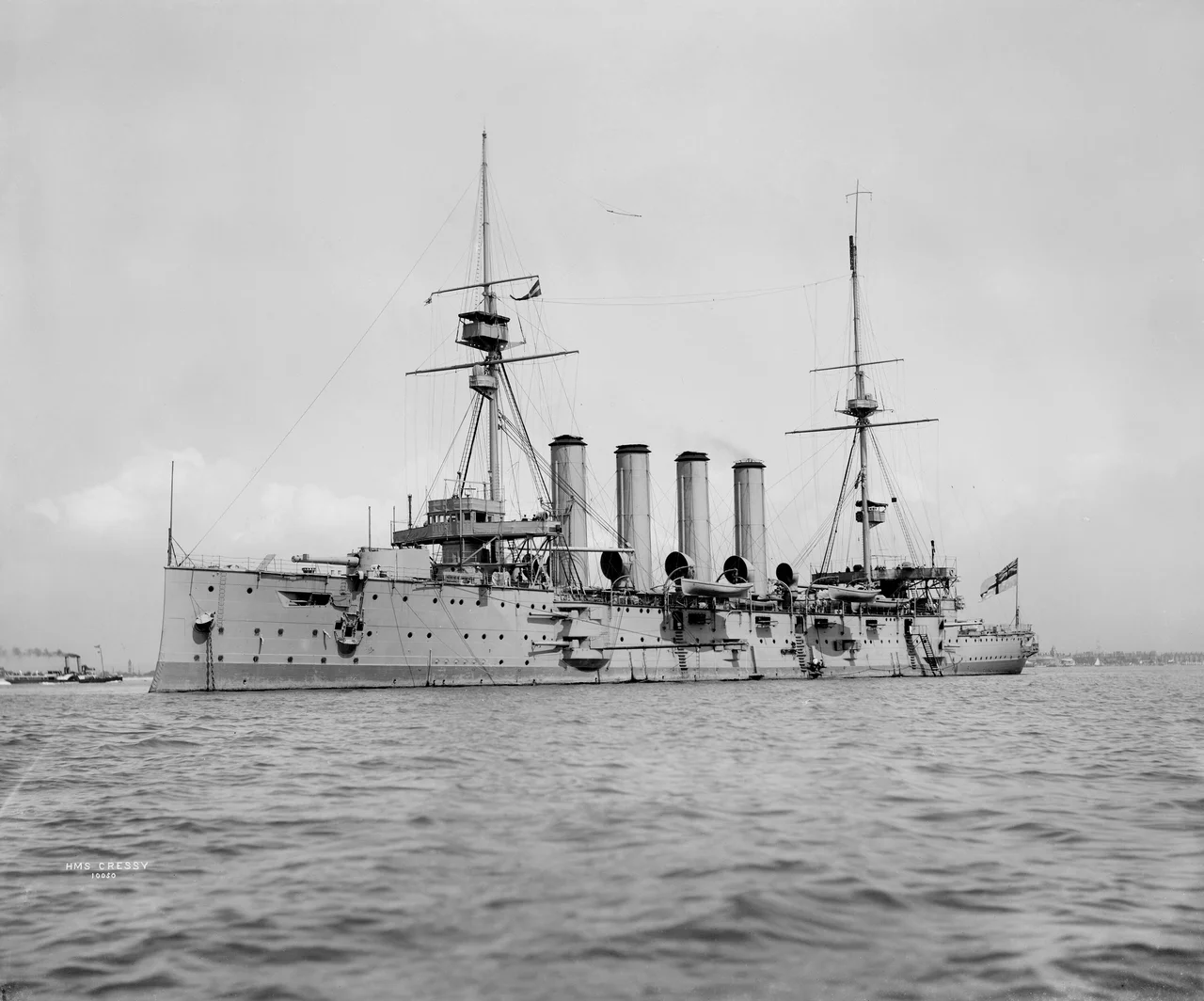

HMS Cressy
By 7:20 a.m. on 22 September 1914, HMS Cressy's crew already knew. They had watched Aboukir go over and Hogue capsize ten minutes after; they had seen U-9's bows break the surface as she fired and her gunners had even put rounds at her. Cressy had tried to ram and failed. By every rational measure, she should have run. Instead, Captain Robert Johnson kept his boats in the water and his decks full of men dragging soaked stokers out of the North Sea. When Otto Weddigen's last torpedo struck her port side at 7:30 and ruptured her boilers, scalding the men in the engine room, she had been standing still in a known killing ground for a quarter of an hour, on purpose, to save other Englishmen.
A Ship of the Old Navy
Cressy was the lead ship of her class, an armoured cruiser of twelve thousand long tons, 472 feet long and 69 in the beam, with thirty Belleville boilers feeding two four-cylinder triple-expansion engines that could push her at 20.7 knots on her sea trials - the slowest of her sisters and already a step behind the speed and efficiency of oil-fired turbines coming into service. Her main battery was a pair of breech-loading 9.2-inch Mark X guns, fore and aft, supported by twelve 6-inch guns in casemates amidships - eight of them on the main deck and only usable when the sea was kind. She was commissioned on the China Station on 28 May 1901, was assigned to North America and the West Indies from 1907 to 1909, and then went into reserve, the way old ships do, until a continent went to war.
The Live Bait Squadron
When war came in August 1914 she was recommissioned into the 7th Cruiser Squadron, set patrolling the Broad Fourteens of the southern North Sea with her sister ships. Officers in the Grand Fleet called the squadron the Live Bait Squadron with grim accuracy: three obsolete cruisers, manned in large part by Royal Naval Reservists, parading slowly back and forth in waters that any modern U-boat could reach. The orders dated from before the war had begun and assumed the enemy would come at them with destroyers, not submarines. After the Battle of Heligoland Bight on 28 August, Cressy took 165 unwounded German prisoners aboard for the trip back to the Nore. A few weeks later it was her turn to be the prey.
Twenty Minutes That Knew Better
On the morning of 22 September the destroyers that should have escorted the cruisers were sheltering from heavy weather. Cressy, Aboukir and Hogue steamed line abreast, 2,000 yards apart, at ten knots. Otto Weddigen brought U-9 to periscope depth and put a torpedo into Aboukir's starboard at 06:20. Aboukir capsized at 06:55. Her captain had thought, at first, it was a mine. As Hogue closed to rescue, Wilmot Nicholson realised the truth and signalled Cressy to watch for periscopes - then continued anyway. Hogue took two torpedoes at 06:55 and sank at 07:15. By the time Cressy came under attack, no one was guessing. She tried to ram U-9 and missed. Then her boats went over the side again.
The Last Torpedo
Weddigen fired two torpedoes from his stern tubes at 07:20; only one struck. He swung U-9 around to bring his last bow torpedo to bear. At 07:30 he fired from about 550 yards. The torpedo opened Cressy's port side and ruptured the boilers - men below boiled in steam in the same instant their ship's life ended. She listed, capsized, and floated upside-down with her keel in the air until 07:55. Of her complement, 560 went down with her. Dutch trawlers and steamers - the Flora, the Titan, and the Lowestoft smacks Coriander and J.G.C. - reached the slick first. Reginald Tyrwhitt's destroyers arrived at 10:45. From all three sister ships, 837 men were pulled from the cold water and 1,459 were not. Many of those lost were Royal Naval Reservists - fathers, fishermen, dock clerks - and the youngest were teenage cadets.
What Cressy's Boats Mean
Cressy's officers and her captain knew what they were doing when they kept lowering boats. They were not naïve. They could see U-9 surface and dive; they had even opened fire on her. They stopped anyway, because the alternative was leaving hundreds of men to drown in 50-degree water. The Admiralty's later reckoning was harsh - Captain Drummond of Aboukir was criticised by the Court of Inquiry for failing to take recommended anti-submarine precautions, and the cruiser squadrons were quietly withdrawn. But what happened on Cressy's deck between 6:55 and 7:30 that morning was something that doctrine cannot capture in a footnote: a decision, made in cold weather, that other men's lives were worth waiting for a torpedo. Today she lies upside down on the seabed of the Broad Fourteens, a protected war grave for 560 sailors, most of them very young.
From the Air
Cressy lies on the bed of the southern North Sea near 52.25 N, 3.67 E, in the Broad Fourteens about 30 miles off the Dutch coast. Cruise at FL080-FL100 for the long sea horizons. Amsterdam Schiphol (EHAM) and Rotterdam (EHRD) lie east; Norwich (EGSH) lies west. The wreck is a designated protected place under the UK Military Remains Act - keep your distance from any marine traffic working over the site.
Nearby Stories
- Mecanoo 9.5 km away
- Egmond aan Zee Offshore Wind Farm 14 km away
- Hollandse Kust West Offshore Wind Farm 15 km away
- Museum of Comic Art 16 km away
- Battle of Lowestoft 27 km away
- Toren van Goedereede 31 km away
- Four Days' Battle 59 km away
- Great Yarmouth 97 km away