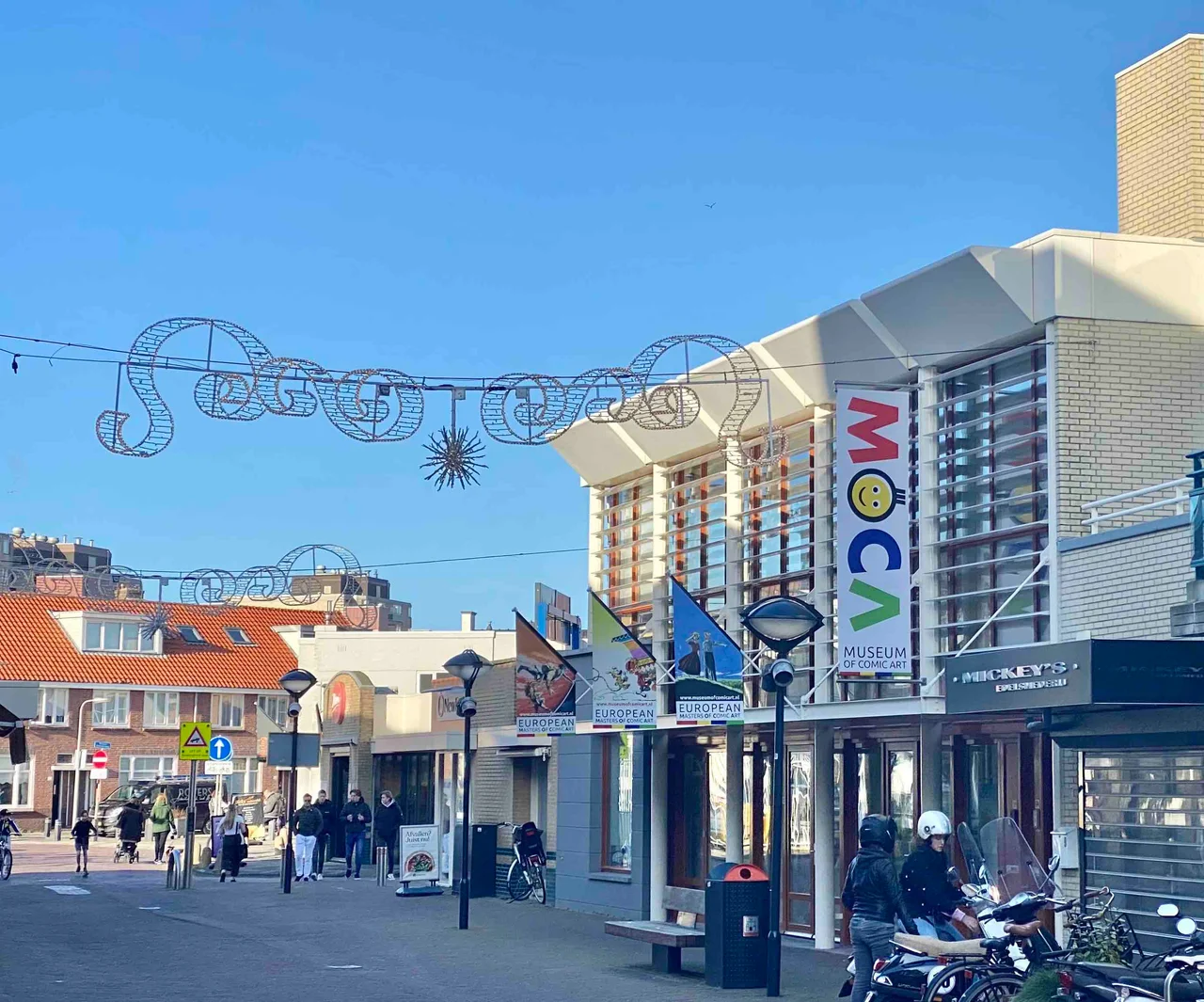

Museum of Comic Art
By 2020, two attempts at a Dutch comics museum had already failed. The Strips! museum in Rotterdam went bankrupt. The Nederlands Stripmuseum in Groningen was absorbed into a broader multimedia operation and lost its identity. So when Ger Apeldoorn and John Asselbergs, two comics historians who had spent their careers thinking about Dutch comics, decided to try again, they did something different. They moved away from the big cities. They picked Noordwijk - a North Sea beach town better known for its dunes and its space technology center than for its galleries. And they decided not to build a museum. They opened a shop.
The Architect with a Collection
What turned the idea into a building was Arie Korbee. Korbee is an architect from Noordwijk who had designed local landmarks - the cultural centre De Muze, the LAM modern art museum in nearby Lisse. He is also, separately, a serious collector of original comic art, with a personal archive that ran across Dutch, European, and American masters. The collection was the wish; the building was the way. Korbee bought a double-fronted shop in one of Noordwijk's busiest shopping streets - a building he had designed himself years before - and reworked it. He used his own collection as the founding inventory. On 16 April 2020 the Museum of Comic Art was incorporated as a foundation, mostly to make sure the work would outlast the people who started it.
The Pages That Made the Medium
What MoCA collects is original art - the actual sheets of paper that artists drew on, with the original ink and the original blue pencil lines underneath, before anything was printed. The starting roster reads like a syllabus of the medium. Winsor McCay, whose Little Nemo in Slumberland turned Sunday newspaper pages into psychedelic dreamscapes in 1905. Richard Outcault, whose Yellow Kid is one reason newspapers called themselves yellow journalism. Herge, the Belgian who drew Tintin into more than 250 million copies sold worldwide. Andre Franquin, who created Marsupilami and made Spirou into something stranger than his predecessors had imagined. Jije and Peyo, the rest of the Belgian school. Morris, who drew Lucky Luke faster than his shadow for fifty years. Each page on the wall is the page where the line was actually drawn. Reproductions are easy. Originals are not.
A Museum That Refreshes
MoCA holds only a small permanent collection, which is the whole point. A new exhibition opens twice a year - one in summer, one in winter - which means a regular comics reader can come back every six months and see something completely different. The opening show, European Masters of Comic Art, ran for friends of the museum from 28 November 2020 before COVID-19 closed everything. The public finally got in on 9 June 2021, and the Dutch press paid more attention than anyone expected. Since then the museum has put up shows on 21 innovators of Dutch comics history, on the seventy-year history of the Dutch Donald Duck magazine, and on Toonder Studios - the Marten Toonder operation that, with its long-running Tom Poes strip, more or less invented modern Dutch comics. Books get launched here too, the kind nobody else in town would launch.
The Mural by Dick Matena
On one of the museum's interior walls is a mural by Dick Matena, who is to Dutch comics roughly what Robert Crumb is to American underground comix - a master craftsman of the long form, the artist who adapted Dutch literary novels like Reve's De Avonden into graphic novels that won serious critical attention. Putting a working master's mural inside a museum dedicated to other masters is a particular Dutch move. It says, quietly, that this is not a mausoleum. The medium is still alive. Someone is still drawing. The exhibition rooms also carry contextual information - dates, biographies, technical notes on the inks and papers used - that turns each show into a small course in comics history.
A Shopping Street, a Space Town
Noordwijk's most famous institution before MoCA was Space Expo, the visitor center for the European Space Research and Technology Centre that has operated here since the 1960s. John Asselbergs had previously curated a Strips in Space exhibition there - the connection between comics and the European space program runs deeper than people realize, given Herge's Destination Moon was published two decades before Apollo 11. Now Noordwijk has a town that does space and comics, with a North Sea beach in between. The museum is small. You can walk through it in an hour. But you will leave knowing what an original Peyo page actually looks like, before it became a printed Smurf, and you will have stood close enough to see the white-out on the corrections.
From the Air
52.2436 N, 4.4318 E in central Noordwijk, South Holland, a North Sea beach town roughly 15 km north of The Hague. The museum occupies a converted storefront on a busy shopping street, not a visible landmark from the air; navigate by the Noordwijk coastline and the prominent dunes. Best viewed at 2,000-3,500 feet. Nearest airports: Amsterdam Schiphol (EHAM) 22 km east, Rotterdam The Hague (EHRD) 32 km south. Space Expo and the European Space Agency's ESTEC complex sit a few hundred meters east of the museum.
Nearby Stories
- Nexus Instituut 1.6 km away
- Delft 3.3 km away
- Egmond aan Zee Offshore Wind Farm 4.8 km away
- Dutch Language 6.4 km away
- Westfries Museum 13 km away
- HMS Cressy 14 km away
- Hollandse Kust West Offshore Wind Farm 15 km away
- Moermond Castle 34 km away