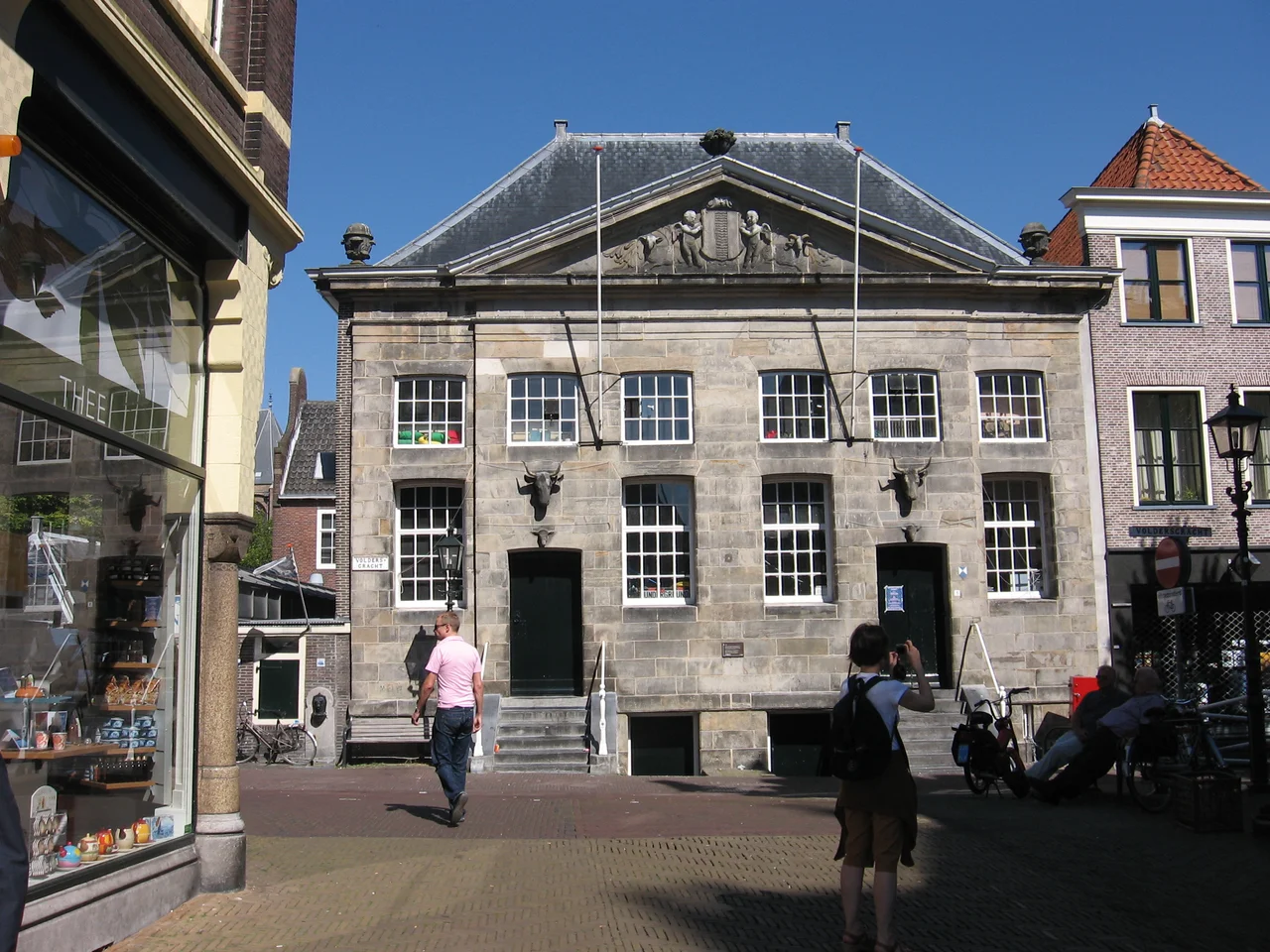

Delft
On July 10, 1584, a man with a pistol climbed the stairs of a former convent on the Oude Delft canal and shot William the Silent in the chest. The prince - leader of the Dutch revolt against Spanish rule, founder of the royal house that still reigns in the Netherlands - died in the stairwell of the Prinsenhof, where the bullet holes can still be touched today. He had wanted to be buried in Breda, but Breda was in Spanish hands. So Delft took him in. Every Dutch monarch since has been laid to rest in the Nieuwe Kerk on the Markt, two blocks from where the assassin pulled the trigger.
The Town That Dug Itself
The name says what the place is. Delft comes from the Dutch verb delven - to dig - and the Oude Delft, the city's oldest canal, was the first wound the residents opened in the peat. The town gathered itself along that ditch, then dug more: grachten branching out as lifelines, as drains, as roads for barges. Founded around 1075, granted city rights by Count William II in 1246, Delft reached its medieval extent by 1355 and then more or less stopped growing for five hundred years. The result is a city center that still fits the footprint of a walled medieval town, ringed by water and crisscrossed by canals narrow enough to leap. You can walk across it in ten minutes.
Fire, Powder, Plague
Delft has burned and exploded. In 1536, lightning struck the tower of the Nieuwe Kerk and the resulting fire destroyed 2,300 houses - most of the city. Just over a century later, on a Monday morning in October 1654, a municipal gunpowder magazine holding 36,000 kilograms of black powder detonated. Whole streets vanished. The painter Carel Fabritius, a student of Rembrandt and a teacher of Vermeer, was killed in the blast along with most of his work. The city rebuilt, but it never built the powder house inside the walls again. The replacement, the Kruithuis, was set safely outside town, on its own little island where an accident could only hurt itself.
The Painter Who Stayed Home
Johannes Vermeer was born in Delft in 1632 and died there in 1675, and in between he produced perhaps 35 paintings - quiet rooms, milkmaids, women reading letters, the famous girl with the pearl earring. He almost never left town. His View of Delft, painted from across the harbor looking north, is one of the few cityscapes he ever made, and one of the most luminous paintings in any museum anywhere. Marcel Proust called it the most beautiful picture in the world. The vantage point still exists. Stand on the Hooikade in the right slant of afternoon light and you can match the painting to the skyline, the brick gates, the spires of the two churches that still anchor the town - the Oude Kerk leaning slightly off plumb, the Nieuwe Kerk pointing straight up at the sky.
Blue and White
When Chinese porcelain arrived in Holland in the holds of Dutch East India Company ships - the VOC was headquartered partly in Delft - local potters tried to copy it. They could not match the white kaolin clay or the high firing temperatures, but they could glaze their earthenware white with tin oxide and paint cobalt blue scenes on top. Delftware was born of imitation and became its own thing. By 1750 there were 32 earthenware factories in Delft turning out tiles, plates, vases, entire fireplace surrounds. Most are gone now. A few remain, including Royal Delft (De Porceleyne Fles), founded 1653, still painting by hand. Locals will tell you to skip anything with windmills on it that says HOLLAND in English - that is not Delft, that is a souvenir.
Students and Engineers
The other thing Delft makes is engineers. In 1842 a Royal Academy was founded here to train civil engineers for the colonial empire; it has grown into Delft University of Technology, with roughly 26,500 students filling the bars and bike racks and bringing the median age of the canal-side cafes down by a decade. TU Delft is the city's largest employer and the reason Delft never quite became a museum. Students cycle through the medieval streets the way their grandparents did, the way nobody much does in American cities anymore. They mount the curb to let cars pass on the narrow canal roads, because the next day they will be the ones driving and hoping the same courtesy comes back.
From the Air
Delft sits at 52.01°N, 4.36°E in the South Holland Randstad, sandwiched between Rotterdam and The Hague along the A13 motorway. Closest airport is Rotterdam The Hague (EHRD), about 6 km southeast; Amsterdam Schiphol (EHAM) is 45 minutes by direct train. From the air, look for the tight oval of the old town moated by canals, with the dark slate roof of the Nieuwe Kerk's 109-meter tower jutting up from the Markt. The Hague and Rotterdam appear as much larger built-up areas to the north and south. Cruise at 3,000-5,000 feet for the best view of the canal pattern; in clear weather you can see the whole Randstad conurbation spread out as a horseshoe of cities around the empty Green Heart.
Nearby Stories
- European Cooperation for Space Standardization 2.2 km away
- Operation Pheasant 5.6 km away
- Dutch Language 8.3 km away
- Moerdijk 9.9 km away
- Amsterdam University Medical Center 10 km away
- Delta Works 11 km away
- HMS Cressy 14 km away
- Moermond Castle 24 km away