.jpg)
Operation Pheasant
Two weeks after the paratroopers fell at Arnhem and the headlines mourned a bridge too far, a quieter army was forming in the wet fields of southern Holland. There would be no glider armadas this time, no newsreel of paratroopers spilling out of the sky. Just British infantry, Welsh and Highland brigades, Scottish guardsmen, Polish armour, Canadian and American divisions, working west across the rivers and canals of North Brabant in cold autumn rain. Operation Pheasant has none of Market Garden's name recognition. It freed more Dutch cities.
After Arnhem
By mid-October 1944 the situation in the Low Countries was a strategic mess. Operation Market Garden had punched a long thin salient north toward Arnhem and then stalled, leaving the Allies holding a corridor that bulged dangerously into German territory. Antwerp had been captured intact in early September, but the Scheldt estuary leading to it was still in German hands, which meant Europe's third-largest port was useless to the people who needed it most. On 16 October, Field Marshal Bernard Montgomery reoriented the British Second Army to clear the German Fifteenth Army out of North Brabant, broaden the Nijmegen corridor, and support the Canadian effort to open the Scheldt. The plan that emerged was named Pheasant. It would jump off on 20 October.
Three Pincers Across Brabant
Pheasant was really three operations layered together. On the eastern flank, the 51st Highland and 15th Scottish Divisions would punch westward in Operation Colin, aiming for Tilburg through Schijndel and the woods east of the River Dommel. The 53rd Welsh Infantry and 7th Armoured would take 's-Hertogenbosch and push north toward the Meuse. To the west, I British Corps under John Crocker would drive deeper still: the Polish 1st Armoured Division would liberate Breda, the Canadian 4th Armoured would take Bergen op Zoom, the British 49th Polar Bears would strike for Willemstad and force a bridgehead over the River Mark, with the American 104th Timberwolves anchoring their flank. From Belgium, the Canadian 1st Army would launch Operation Suitcase northward. The Germans, dug in along canals and rivers and commanded by General Gustav-Adolf von Zangen, had spent weeks turning Brabant into a defensive web.
Vught, Tilburg, and a Concentration Camp
The first days went better than the planners had dared expect. RAF Typhoons and Spitfires destroyed the Fifteenth Army's headquarters at Dordrecht, killing two generals and seventy staff officers. The 53rd Welsh cleared Nuland by quarter to eight in the morning. The 152nd Brigade of the Highlanders fought through wet woods east of the Dommel against German paratroopers and reached Vught, where they liberated Herzogenbusch, the only Nazi concentration camp built on Dutch soil. Some 31,000 people had been held there during the occupation. By 27 October, after the 7th Armoured had been hung up by German guns at Loon op Zand and the Highlanders had peeled off a brigade to help, the 44th Lowland Infantry Brigade walked into a largely empty Tilburg. The Germans had withdrawn. The wool city, the textile city, was free.
Breda, Liberated by Poland
Forty-five kilometers west, the Polish 1st Armoured Division under Major General Stanislaw Maczek closed in on Breda. The Poles had fought their way across France and Belgium since landing in Normandy in August, and they took the city on 29 October in a careful house-to-house advance that the division had refined into an art form, minimizing civilian casualties in a city of nearly 50,000 people. Breda did not forget. After the war, Maczek and many of his soldiers chose not to return to a Soviet-occupied Poland. He lived out the rest of his very long life in Edinburgh, but when he died in 1994 at the age of 102, he was buried in Breda, in the Polish military cemetery, with the city that he had freed. His face is on a Dutch memorial postage stamp. The Polish flag flies every 29 October.
What Pheasant Cost and Won
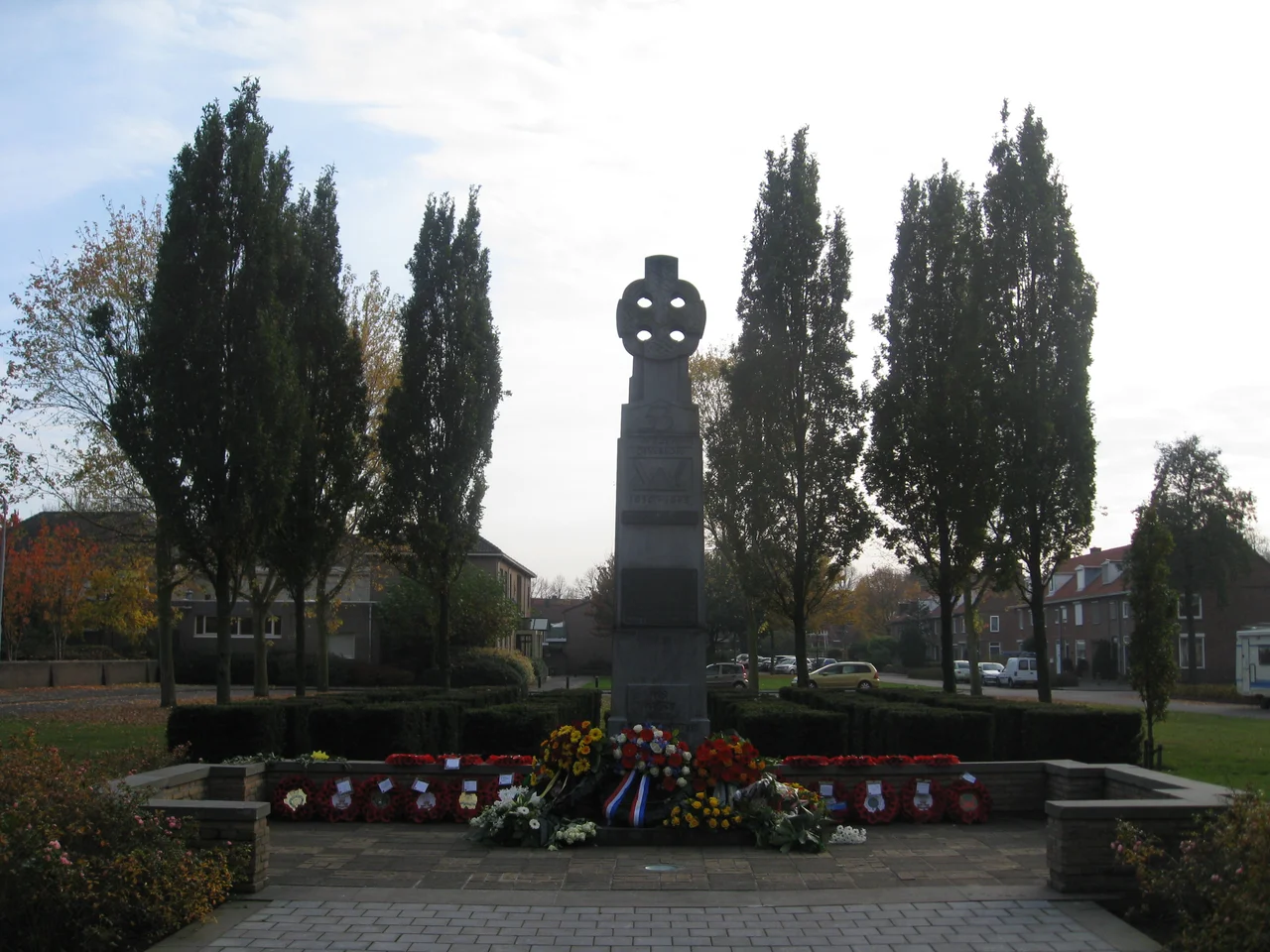
By 4 November Operation Pheasant had ended. Bergen op Zoom, Roosendaal, and Willemstad had fallen. The German Fifteenth Army had been pushed across the Maas, losing the canals and river lines it had hoped to hold through winter. Most of North Brabant was free, the front line stabilized along the river, and the way was open for the slow grinding battle that would finally open Antwerp's port. The cost was real, in British, Polish, Canadian, American, Dutch, and German lives, in shattered villages and broken bridges. Brabant has not forgotten this autumn either. In Tilburg, in Breda, in 's-Hertogenbosch and Vught, monuments mark where particular companies bled to free particular streets. Market Garden has the books and the Hollywood film. Pheasant freed the cities where most Brabanders still live.
From the Air
Operation Pheasant unfolded across most of North Brabant between 51.5 N and 51.7 N, with the main axis running west from Sint-Oedenrode through 's-Hertogenbosch (51.69 N, 5.30 E), Tilburg (51.55 N, 5.09 E), and on to Breda (51.59 N, 4.78 E) and the Mark estuary. From altitude the key terrain is still visible: the canalized rivers Dommel and Aa, the broad sweep of the Maas to the north, and the Loonse en Drunense Duinen south of Loon op Zand where the 7th Armoured were briefly held up. Nearest airports: Eindhoven (EHEH) for the eastern front, Rotterdam The Hague (EHRD) for the western. Brabant's autumn weather, wet, cold, low cloud, was a constant tactical factor in 1944 and remains the dominant flying consideration today.
Nearby Stories
- Feyenoord 5.4 km away
- Heinz Struning 6.8 km away
- Moerdijk 7.5 km away
- Neder-Betuwe 8.7 km away
- Volkel Air Base 9.3 km away
- Kapellen 9.9 km away
- Campine 12 km away
- Limburg (Netherlands) 25 km away