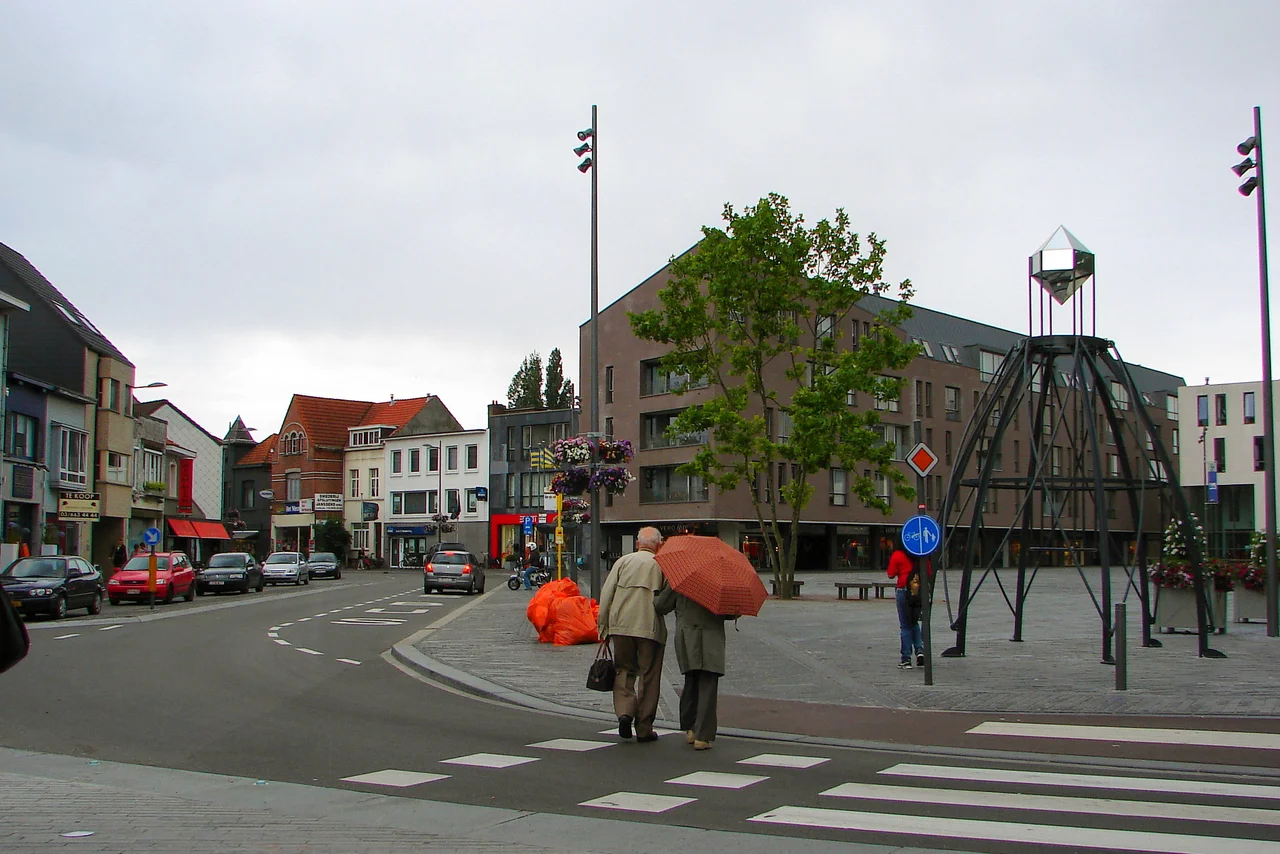

Kapellen
On 4 October 1944, a Quebec infantry battalion called Les Fusiliers Mont-Royal moved into Kapellen and the German occupation ended. The villagers, who had endured forced labour drafts, Spanish flu, an interwar depression, and five years of Nazi rule, came out of their houses. The Fusiliers were French-speaking Canadians fighting their way across northern Belgium toward the great prize of Antwerp's port. Some of them spoke a kind of French the older Kapellen residents could just about follow. They handed out chocolate and cigarettes and moved on north. A monument to the fallen still stands in the village, and on the same date every year the small town remembers a liberation that arrived in Quebecois accents.
Hoboniaand Hoghescote
Kapellen the municipality is younger than Kapellen the place. The first documentary trace of one of its neighbourhoods, Hoogboom, appears in a charter of 1267 under the name Hobonia. The current centre shows up a decade later as Hoghescote. The Zilverenhoek corner of town, only stitched into Kapellen during the 1983 municipal reorganisation, did not appear on any map until an 1844 cadastral plan. For most of its long medieval and early-modern existence, the parish was a satellite of the lordship of Ekeren, a piece of agricultural countryside in the Voorkempen, the sandy plain north of Antwerp. The oldest building still standing is the parish church, whose chancel dates from the fourteenth century and whose transept from the sixteenth. In 1714 the entire lordship of Ekeren passed into the hands of the Salm-Salm family, one of those German princely houses that collected estates across the Low Countries like other people collected porcelain. Kapellen finally became its own municipality in 1800, during the French occupation.
What the Railway Brought
The railway changed everything. In 1853 the line from Antwerp to Rotterdam was pushed through the Campine, and on its opening in 1854 the first steam train pulled into Kapellen station. The journey to Antwerp suddenly became a matter of minutes. Wealthy Antwerp merchants, doctors, diamond traders and lawyers began to look at the pine woods and heather of the Voorkempen with new interest. They bought land. They commissioned architects. They put up villas, country houses, and outright castles, each surrounded by lawns and ornamental woodlands. Whole neighbourhoods of villaparcs grew around the station, and Kapellen acquired the character it has never lost: a town of large gardens and quiet streets, beech avenues, brick-and-slate houses set well back behind hedges. The local tram arrived in 1928, the connecting line to Hoevenen in 1934. The last passenger tram rattled through the village in 1967, but by then the cars had already taken over.
Two Wars, Two Recoveries
Kapellen has been broken open by history more than once. During the Eighty Years' War, in the convulsions that followed the Fall of Antwerp in 1585, the parish was devastated. Ninety percent of the houses were destroyed and almost every important building burned. The Twelve Years' Truce after 1609 brought a brief recovery, then the plague arrived in 1623 and emptied homes a second time. Rebuilding the church in 1674 was the symbol of a slower, sustained return. The First World War cut deeper. Belgian men were conscripted into forced labour for the German army; the Spanish flu of 1918 swept the survivors; the postwar economic crisis of 1930 left little time to recover before another war began. The Second World War ended for Kapellen on that October day in 1944 when the Fusiliers Mont-Royal arrived. Recovery, this time, was sustained. The population grew from under ten thousand in 1947 to roughly twenty-seven thousand today, settled across the central village, Putte's eastern half, the wooded Kapellenbos, Hoogboom, and Zilverenhoek.
Where Mathieu van der Poel Grew Up
For a town of its size, Kapellen has produced an outsized roster of public figures. The Bettens siblings, Sam and Gert, anchor the long-running Belgian rock band K's Choice. Mathieu van der Poel, one of the great cyclists of his generation, world champion in road, cyclocross and gravel, grew up here. Thomas Vermaelen made his international name as a defender for the Belgian national football team. Rocco Granata, who wrote and sang Marina in 1959 and turned it into one of the most-played European pop songs of the twentieth century, lives in the town. Baron Paul Kronacker, the politician and businessman who served as president of the Belgian Chamber of Representatives in the 1950s, was a Kapellen man. Didier Ilunga-Mbenga, the Congolese-Belgian basketball player who won two NBA championships with the Los Angeles Lakers, came from here too. Walk through the green residential streets on a Saturday morning and you can imagine the lives that started behind these tall hedges, then took off across continents.
From the Air
Located at 51.31N, 4.43E in the Voorkempen, the sandy plain north of Antwerp. Kapellen sits about 12km north of Antwerp city centre and 5km from the Dutch border. The town's character is visible from the air as a mosaic of green villaparc neighbourhoods interspersed with woodland. Antwerp International Airport (EBAW) is 14km south; Rotterdam The Hague Airport (EHRD) is 60km north. The Antwerp-Rotterdam rail line and the A12 motorway cut north-south through the municipality.
Nearby Stories
- Roosendaal 5 km away
- Sabbinge Castle 5.7 km away
- Bouchout Castle 7.1 km away
- Campine 8.5 km away
- North Brabant 12 km away
- Egmont Castle 12 km away
- Battle of Halen 14 km away
- Reginald Warneford 22 km away