
Reginald Warneford
He had ten days. On the morning of 7 June 1915, Flight Sub-Lieutenant Reginald Alexander John Warneford, 23 years old, attacked the German Army Zeppelin LZ 37 in the air above Ghent and brought it down in flames - the first Victoria Cross awarded for the destruction of an airship in aerial combat. On the morning of 17 June, having just received the Legion d'honneur from General Joffre in Paris, he climbed into a Farman biplane at the aerodrome at Buc, southwest of Versailles, to ferry it back to his squadron. The right-hand wings collapsed during the climb. Neither he nor his passenger - an American journalist named Henry Beach Needham - was harnessed. They were thrown from the aircraft at about 200 feet. Needham died at the scene. Warneford died on the way to hospital.
From Darjeeling to Hendon
Warneford was born on 15 October 1891 in Darjeeling, in British India, into the world of colonial railway and merchant families. After his family returned to India he was educated at the English College in Simla - now Shimla, the old summer capital - then apprenticed in the Merchant Marine and joined the British-India Steam Navigation Company. When war broke out in August 1914 he was in Canada, waiting to return to India. He sailed for Britain instead, enlisted in the 24th (Service) Battalion of the Royal Fusiliers - one of the so-called Sportsman's Battalions formed for older volunteers - then transferred almost immediately to the Royal Naval Air Service for pilot training. He completed his training at Upavon in Wiltshire on 25 February 1915. His instructor, Warren Merriam, called him a gifted pilot with a discipline problem - cocky enough that he nearly washed out, skilled enough to fly his way past every objection.
Veurne and the Roving Commission
On 7 May 1915, Warneford was posted to 1 Wing of the RNAS at Veurne on the Belgian coast. The war over Flanders that spring involved low-level bombing of German troops, machine-gun attacks on guns and trenches, and the new and uncertain business of fighting other aircraft. Warneford's aggressiveness earned him his own aircraft and a roving commission - permission to hunt rather than wait for orders. On the night of 16-17 May he encountered a German Army Zeppelin, LZ 39, setting out on a raid against England. He attacked with his single machine gun, but the airship dumped ballast and climbed out of reach. The big rigid airships were strange opponents - hundreds of feet long, lifting bags of hydrogen surrounded by aluminum frames, carrying bombs but also vulnerable to a single well-placed incendiary round.
Seven June, Above Ghent
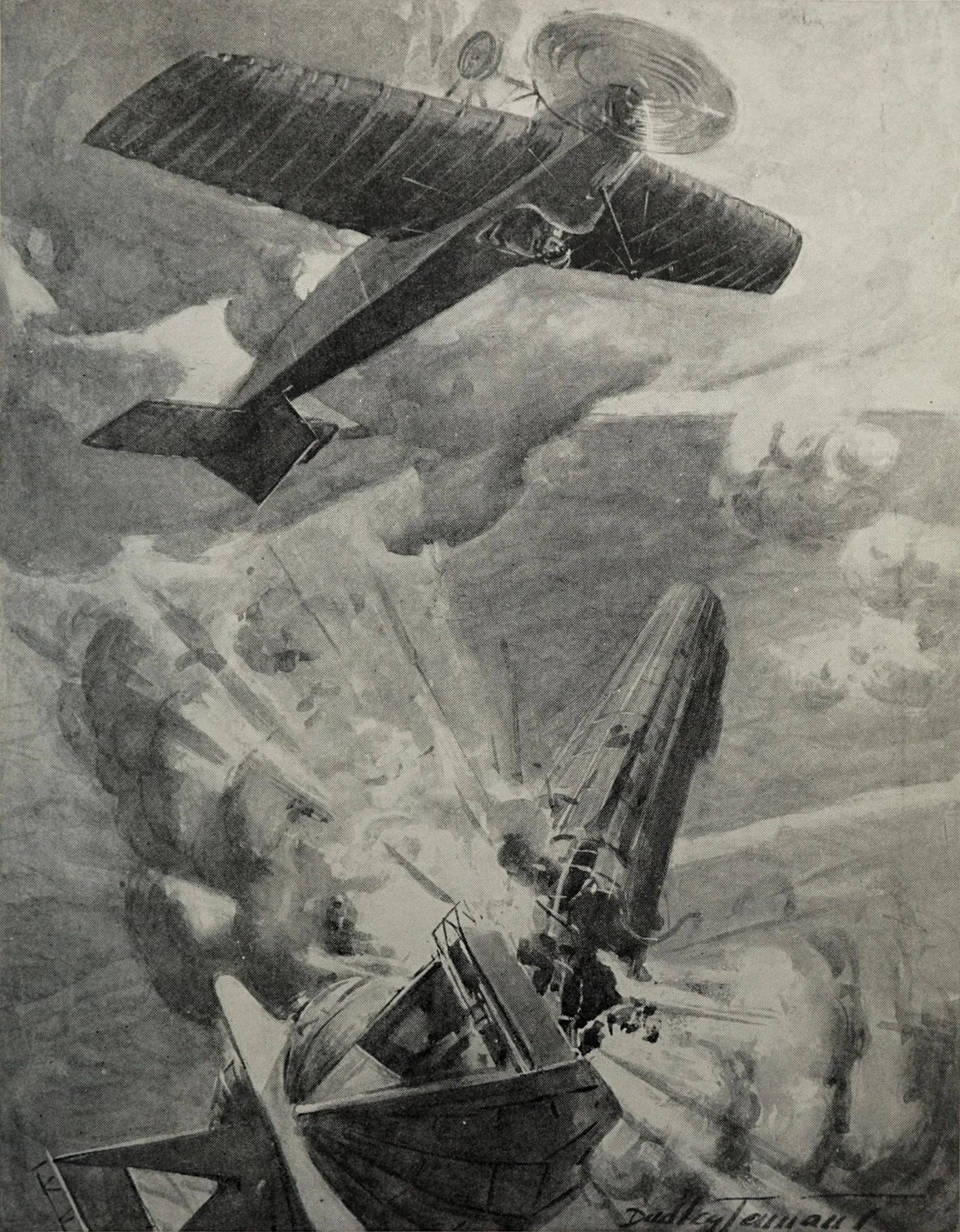
In the early hours of 7 June 1915, Warneford intercepted LZ 37 over Belgium as it returned from a raid. He climbed above the airship in his Morane-Saulnier monoplane and dropped six small bombs onto its upper surface from short range. The hydrogen ignited. The Zeppelin broke apart and fell in flames over Ghent, killing the commander, Oberleutnant Otto van der Haegen, and seven crew members. The wreckage came down on the Sint-Amandsberg convent, killing two nuns in the building below - civilian deaths that no one knew about as Warneford turned for home. The explosion overturned his own aircraft and stopped its engine. He glided down behind German lines, landed, and worked on the engine for 35 minutes - alone, in enemy territory, with the wreckage of a German airship still burning nearby. He restarted the engine, took off (he was later quoted as shouting toward the approaching Germans, "Give my regards to the Kaiser!"), and made it back to his base.
Ten Days
The Victoria Cross was gazetted within 36 hours - one of the fastest in the award's history. Newspapers carried his face. He was 23 years old, the colonial boy with the swagger, the pilot who had brought down a German monster. On 17 June, exactly ten days after the action over Ghent, he received the Legion d'honneur from General Joseph Joffre in Paris. Joffre was the French Army's commander in chief and a national figure. There was a celebratory lunch. Afterward, Warneford traveled to the aerodrome at Buc, near Versailles, to test and ferry a new Farman biplane back to Veurne. He made one short test flight in the morning. On the second flight he took up an American journalist, Henry Beach Needham, as a passenger. Climbing through 200 feet, the right wings of the Farman collapsed.
Brompton and Ghent
He was buried at Brompton Cemetery in London on 21 June 1915 in front of thousands of mourners. The grave lies in front of the eastern colonnade. His Victoria Cross is held at the Fleet Air Arm Museum at Yeovilton in Somerset. In Ghent, the street near where LZ 37 came down was renamed Reginald Warnefordstraat - a small piece of a Belgian neighborhood permanently bearing the name of an Anglo-Indian boy who lived long enough to become a hero and not much longer than that. The composer Howard Ellis Carr wrote a movement of his Three Heroes suite in his memory, with a musical depiction of a Zeppelin raid; the piece was played at the Proms in 1918, 1920, and 1924. Ten days is not a long time. Warneford filled them as completely as anyone could.
From the Air
The crash site of Zeppelin LZ 37 was at approximately 51.062 degrees north, 3.749 degrees east, on the eastern edge of Ghent at Sint-Amandsberg - Reginald Warnefordstraat marks the location. Approach from the west with Ghent's medieval triple towers (Saint Nicholas, the Belfry, Saint Bavo's) as the main landmark on your right; Sint-Amandsberg lies just beyond. Nearest airport is Brussels (EBBR) about 50 km southeast; alternates Antwerp (EBAW), Kortrijk-Wevelgem (EBKT). The 1915 RNAS base at Veurne (Furnes) lies 80 km west near the coast; Brompton Cemetery is in central London (LHR area). Visibility in the Ghent area is typically 8-15 km, with frequent low cloud cover - the kind of conditions the early Zeppelin raiders depended on for cover.
Nearby Stories
- 2017-18 Belgian Second Amateur Division 3.3 km away
- Duchy of Brabant 5.7 km away
- Wijnendale Castle 7.5 km away
- Battle of Tourcoing 7.6 km away
- Ronse 8.6 km away
- Borssele Nuclear Power Station 12 km away
- Sugar Factory Zeeland 19 km away
- HMS Wakeful (H88) 31 km away