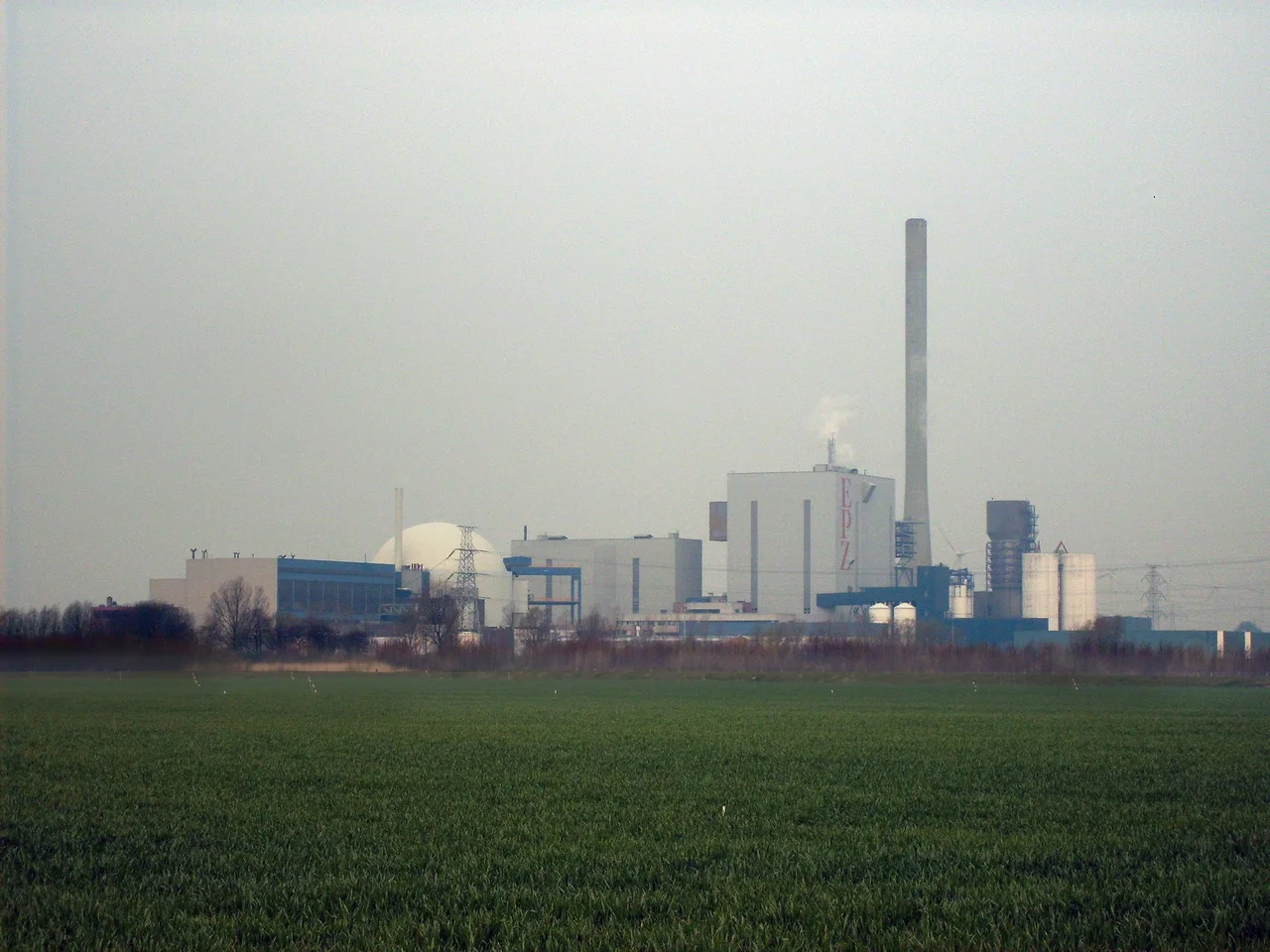

Borssele Nuclear Power Station
The Dutch built Borssele to make cheap electricity for an aluminium smelter. In 1971, the French firm Pechiney opened a smelting facility on the Westerschelde estuary; in 1973, Siemens fired up a pressurised water reactor a short distance away to feed it. For years, two-thirds of Borssele's output went directly into the smelter's pot lines. The plant was supposed to be supplemental, almost industrial - a private deal between two pieces of heavy infrastructure on the salty edge of Zeeland. Half a century later, the smelter is gone, the political consensus around nuclear power has reversed three times, and Borssele is still running. It is, somewhat improbably, the only commercial nuclear reactor still generating electricity anywhere in the Netherlands.
An Industrial Marriage on the Westerschelde
Borssele - both the village and the power plant named for it - sits on a thumb of Zuid-Beveland that pokes south into the Westerschelde, the deep tidal channel that connects Antwerp to the North Sea. The location was chosen for practical reasons: estuarine water for cooling, deep-water access for fuel and equipment, and proximity to the new Pechiney aluminium plant that had just opened on the same industrial estate. Construction began in 1969. The reactor went critical in 1973. Its design - a Siemens pressurised water reactor, originally rated at 449 megawatts and uprated to 485 megawatts after a steam turbine upgrade in 2006 - was conservative for its day. It uses two coolant loops where most modern PWRs use three or four. It is also, after fifty years of operation, one of the most extensively monitored reactors in Europe.
The Forty-Year Argument
Nuclear power has been one of the most divisive topics in modern Dutch politics, and Borssele has been at the centre of every round. The country's first commercial reactor, Dodewaard, came online in 1969 and was decommissioned in 1997 after only twenty-eight years of service - shut down against a backdrop of strong anti-nuclear public sentiment. In 1994, the government and parliament voted to close Borssele as well, with a target shutdown date of 2004. Owners and employees took legal action. Public mood shifted after the turn of the millennium. By 2002 government policy had changed; the closure was pushed to 2013, exactly the plant's original forty-year design life. Then in 2006 the Dutch government decided Borssele would keep running until 2033 - the operator Delta and partner Essent agreeing to pay 250 million euros into a renewable energy R&D fund as the price of the extension. The operating licence was later pushed again, to 2034. A plant born in the post-oil-shock 1970s has outlasted every political coalition that ever tried to close it.
The Waste Question
Every nuclear plant lives or dies on its answer to one question: what do you do with the used fuel? Borssele produces about twelve tonnes of high-level waste per year. For decades it shipped its spent fuel to La Hague in northern France for reprocessing by Areva NC, under a contract that ran until 2015. The deal was elegant on paper - France would extract reusable uranium and plutonium, and the leftover radioactive material would come back to the Netherlands - but the politics turned tangled. After 2006, changes in French law required nuclear waste to return to its country of origin within a fixed window. The Dutch had to amend their own law to receive it, and the legal review took five years. In the meantime, spent fuel rods piled up in Borssele's cooling pool. The transports finally resumed in June 2011. A few years later, Borssele received permission to burn MOX fuel - a mix of plutonium and uranium oxide - closing one part of the cycle inside the reactor itself. Down the road from the plant, the Central Organisation for Radioactive Waste (COVRA) operates the Netherlands' national surface storage facility, designed to hold the country's accumulated waste for the next hundred years.
What Comes Next
In December 2021, a new Dutch coalition government announced plans to build two new nuclear power plants somewhere in the Netherlands - the first such announcement in a generation. The site has not been chosen, but Borssele is the favourite. Rotterdam has staked its energy future on hydrogen; Groningen is politically radioactive in its own way after years of gas-extraction earthquakes; Borssele already has the infrastructure, the workforce, the cooling water, and a population that has lived next to a reactor for half a century without incident. Earlier proposals for a 'Borssele II' from the utility Delta in 2009 were shelved in 2012. The current generation of proposals is more ambitious and more politically supported than anything since the 1970s. Whether either new plant ever breaks ground depends, as always in the Netherlands, on the next coalition agreement.
The View from the Dyke
From the dyke road that runs along the Westerschelde, Borssele's containment building is a low concrete cylinder topped by a small dome - not the dramatic cooling towers of the public imagination, because PWRs of this design dissipate heat directly into the estuary. To the east, the ships of the Antwerp-bound shipping lane drift past in a steady line. To the south, across the water, lie the empty Belgian polders of Zeeuws-Vlaanderen. The 1996 INES Level 2 incident - a fault during a refuelling outage in which nobody was hurt - is the most serious event in the plant's record. For half a century, Borssele has produced about 4 terawatt-hours of electricity per year, kept the lights on across Zeeland and beyond, and survived more political near-death experiences than any other building in the province.
From the Air
Coordinates 51.4319 N, 3.7167 E - on the south coast of Zuid-Beveland, Zeeland, on the north shore of the Westerschelde estuary. Recommended viewing altitude FL050-FL090. Visual landmarks: the Westerschelde shipping channel running east-west toward Antwerp, the long Vlissingen-Antwerp shipping lane to the west, the Sloe industrial harbour on the eastern side of the peninsula, and the village of Borssele just north of the plant. Restricted airspace EHR8 surrounds the reactor - check NOTAMs and avoid overflight below 2,000 ft. Nearest airfield: Midden-Zeeland (EHMZ) on Walcheren, 10 km west. Antwerp (EBAW) 50 km southeast.
Nearby Stories
- Haamstede Castle 4 km away
- 2017-18 Belgian Second Amateur Division 7.1 km away
- Sugar Factory Zeeland 9.4 km away
- Battle of Wijnendale 9.6 km away
- Prinsenhof, Ghent 11 km away
- Volkerakdam 13 km away
- Second Ostend Raid 26 km away
- Southern Bight 48 km away