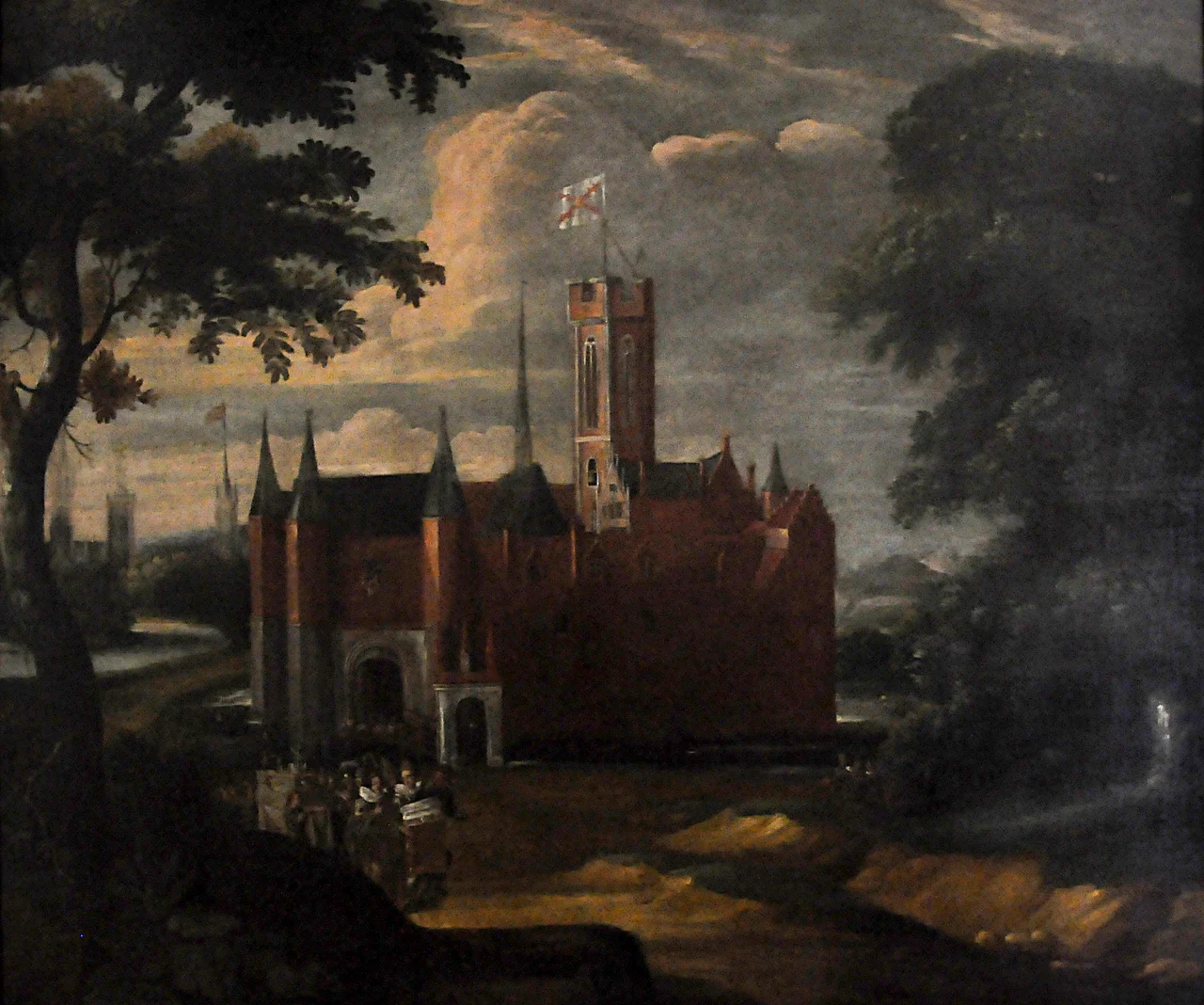

Prinsenhof, Ghent
The man who would govern Spain, the Holy Roman Empire, and most of the Americas was born on 24 February 1500 in a palace that no longer exists. Three hundred rooms. Six gates. A menagerie of lions and other wild animals roaming in gardens laid out with twenty rosemary beds. Jousts in the courtyard. Bath stoves and wine cellars and a private chapel dedicated to Saint Vitus. Today, in the neighborhood north of Ghent's medieval core, you can walk along the Bachtenwalle and find a single postern gate - two squat towers flanking a vaulted arch, locally called the Donkere Poorte, the Dark Gate. That is what is left of the Prinsenhof, the Princes' Court, birthplace of Emperor Charles V.
How a Court Becomes a Court
The site began modestly enough. A castellan of Ghent named Hugo I built a summer residence here, surrounded by walls and towers. In 1231 it was sold to one Alexander de la Lune, and acquired a local nickname - Ser-Sandershof, Sir Sander's Court. In 1324 the wealthy financier Simon de Mirabello bought it. Then in the middle of the fourteenth century Louis II, Count of Flanders, took over the property and rebuilt the main building between 1349 and 1353, gradually displacing the older Gravensteen castle as the working residence of the Counts of Flanders. By the time Philip the Handsome and Joanna of Castile, daughter of Isabella I, used it as their main home, the building had grown into a true Burgundian-Habsburg palace. Then their son was born here, and the place became permanently famous.
The Boy Born Here
Charles V was born to Joanna and Philip in this palace on 24 February 1500. Two weeks later, on 5 March, his aunt Catherine of Aragon visited - the same Catherine who would marry Henry VIII of England and become the cause of the English Reformation when he set her aside. The infant who slept in those rooms inherited, by the accidents of dynastic marriage, more territory than anyone in Europe had ruled since Charlemagne. As emperor he would return again and again to the Prinsenhof. He convened the States General of the Netherlands here in 1517 and 1521. He gave his first speech to that assembly on 16 June 1517. In July 1521 he watched a ceremonial burning of heretical books in the same courtyard where jousts were held.
The Emperor's Renovations
Charles favored the place. In 1538 he ordered major work - new gardens, new walkways. In 1545 he invested heavily again, adding bridges and stonework to a palace that already had three hundred rooms. Margaret of Austria, Duchess of Savoy, his aunt and former regent of the Netherlands, stayed here multiple times in 1507, 1508, and 1517. A four-storey corner tower called the Margaret of Austria Tower was built for her use in 1518. The consort's wing in the north had a workshop, a kitchen with its own well, a sauce room, a pouring room called the eschanconnerie, an oratory, a tapestry chamber, and a wardrobe. Lieven Laephaut laid out the gardens. In a city whose textile wealth had funded centuries of medieval autonomy, the Prinsenhof was the place where the emperor came to remind Ghent who he was.
Out of Favor
And then it fell out of favor, the way these things do. After Charles abdicated in 1556, the building's importance drained away with the imperial court itself. Christina of Lorraine lived here briefly in 1557. The Eighty Years' War, the Calvinist Republic of Ghent, and the Spanish reconquest battered the city around the palace, while the palace itself slid into neglect. In 1776 the government sold what remained, and the new owners began the slow, profitable work of demolition - selling the carved stone, dismantling the timbers, building modest houses on top of the imperial footprint. By the early nineteenth century the lions were a memory, and so was the menagerie they had lived in.
The Dark Gate
What survives is small enough to walk past without noticing. The Donkere Poorte - two stone towers flanking a low vaulted arch on Bachtenwalle - is the only fragment of a palace that once contained the equivalent of a small town. A nineteenth-century engraving from Flandria Illustrata, made in 1641, shows the Prinsenhof still intact, a tight knot of towers and courtyards inside its own walls. Walking the streets of the modern neighborhood, you can sometimes feel the old footprint underneath - blocks running on diagonals that match no surrounding grid, foundations that hint at a vanished perimeter. Charles V was emperor for forty years and died in a Spanish monastery in 1558. The room he was born in is gone. The gate is still here.
From the Air
Located at 51.06 degrees north, 3.72 degrees east in the northern part of Ghent's historic center, near the Bachtenwalle. Approach from the south, with the three medieval towers (Saint Nicholas, the Belfry, Saint Bavo's) as the main visual reference about 700 meters southeast. Nearest airport is Brussels (EBBR) approximately 50 km southeast; alternates Antwerp (EBAW), Kortrijk-Wevelgem (EBKT). The Prinsenhof site itself has no large surviving structure - look for the small Donkere Poorte gate on Bachtenwalle. Brussels-area visibility 8-15 km typical, with low stratus frequent in autumn and winter.
Nearby Stories
- 2017-18 Belgian Second Amateur Division 3.3 km away
- Duchy of Brabant 5.7 km away
- Wijnendale Castle 7.5 km away
- Battle of Tourcoing 7.6 km away
- Ronse 8.6 km away
- Borssele Nuclear Power Station 12 km away
- Sugar Factory Zeeland 19 km away
- HMS Wakeful (H88) 31 km away