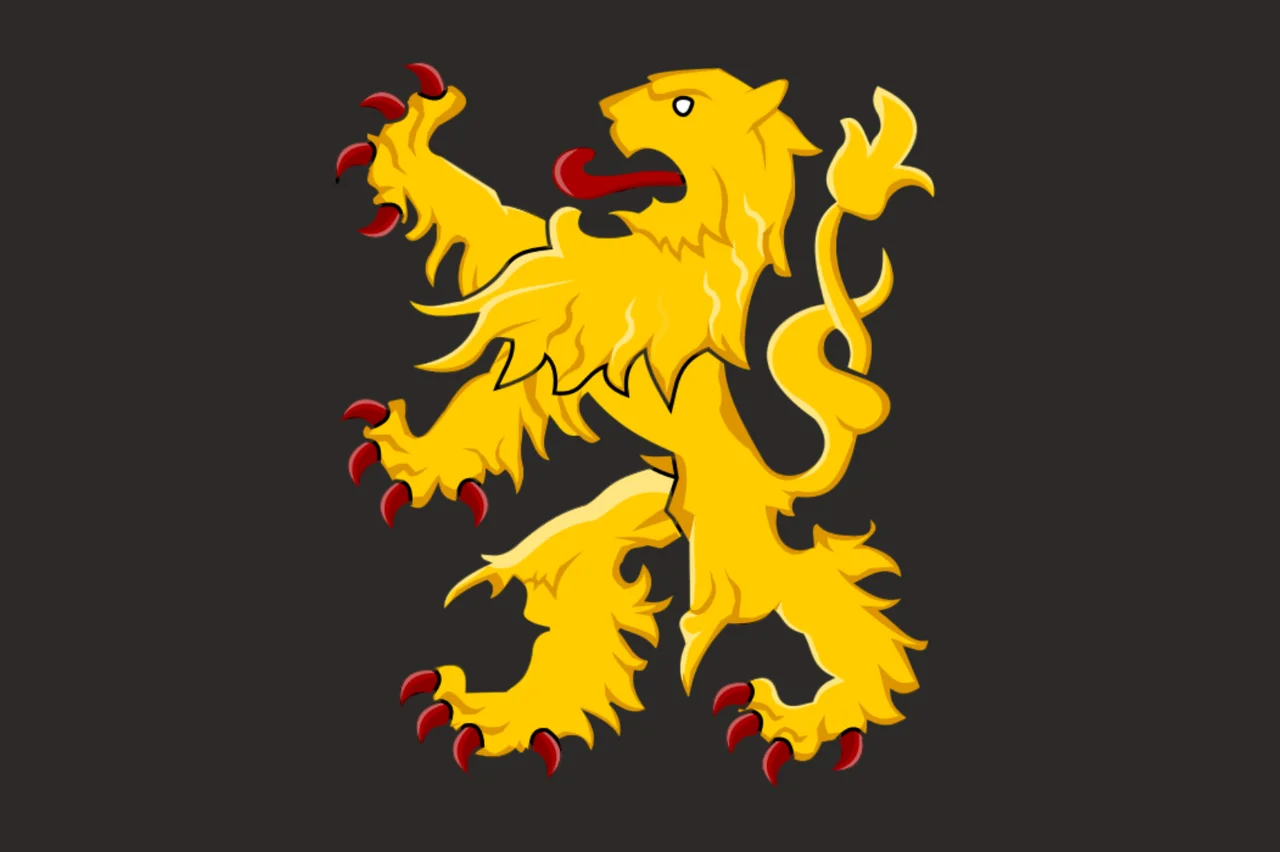

Duchy of Brabant
Look at the Belgian flag and you are looking at the Duchy of Brabant. The black, gold and red bands lifted in 1830 by the revolutionaries in Brussels were not invented for the new kingdom - they were taken straight from a coat of arms more than seven centuries old: sable a lion or armed and langued gules, a gold lion with red claws and tongue on a black field. The lion belonged first to a small county wedged between two rivers west of Brussels, then to a duchy that grew, by marriage and inheritance and the occasional well-timed battle, into the wealthiest principality in northern Europe. Brabant gave the Low Countries their first parliaments, their first universities, and most of their capital cities. When it finally died, in the chaos of the French Revolution, it had lasted just over six hundred years.
A Name from a Swamp
The name is older than the duchy. In Carolingian charters the region between the Scheldt and the Dijle appears as pagus Bracbatensis, from two Germanic roots: braec meaning marshy, and bant meaning region. The marshy region. Before the Romans came, the Belgic tribe called the Nervii lived here, considered by Julius Caesar to be among the fiercest of his Gallic enemies. The Franks took the land after Rome fell, and it passed through the hands of Carolingian counts and dukes of Lower Lorraine for two hundred years before, in 1085, the Emperor Henry IV carved out a small landgraviate west of Brussels and gave it to Henry III, Count of Leuven. That landgraviate was Brabant. A century later, in 1183 or 1184, Frederick Barbarossa upgraded the title to duke and bestowed it on Henry I of Brabant, the great-great-grandson of the count who had received the original grant. The Duchy of Brabant was born.
Four Capitals, One Lion
Brabant was unusual in having four capitals at once. Leuven came first, the original seat of the dukes, and in 1425 it became the home of the oldest Catholic university in the world that has been continuously in operation. Brussels rose in the thirteenth century as the dukes moved their court to the Coudenberg palace on the hill above the Senne. Antwerp, on the Scheldt, was the trading metropolis, and in the sixteenth century the busiest port in Europe. 's-Hertogenbosch - "the duke's wood" - was the fourth, founded by Duke Henry I in 1185 in what is now the Dutch province of North Brabant. Each quarter sent representatives to the States of Brabant, the duchy's parliament, and each was protected by the famous Joyous Entry, the charter of liberties that Duchess Joanna and her husband Wenceslaus granted in 1356. A new duke could not be crowned, in Brabant, until he had personally sworn to uphold the Joyous Entry. If he broke it, the Brabantians had a written right to refuse him their obedience. This was a startling idea for a fourteenth-century state. Some of it filtered, eventually, into other European constitutions.
Marriage, Burgundy, Habsburg
Brabant did not fall in war - it married into something larger. In 1430 Philip the Good of Burgundy inherited the duchy on the death of his childless cousin Philip of Saint-Pol, and Brabant became one of the seventeen provinces of the Burgundian Netherlands. Forty-seven years later, in 1477, the Burgundian heiress Mary of Burgundy married the Habsburg Archduke Maximilian, and Brabant passed with her dowry into the House of Habsburg. From then on the duchy's history was tangled with Spain, then Austria - ruled from Madrid by the Spanish Habsburgs from 1556 to 1714, then by their Austrian cousins from Vienna. The dukes themselves no longer lived in Brabant; they came occasionally, to be sworn in under the Joyous Entry at the Sint-Michiels in Brussels, and then they returned to whatever capital their wider empire ran from.
The Eighty Years' War and a Northern Loss
The Reformation tore Brabant in half. The Eighty Years' War, which broke out in 1568 between the Protestant northern Netherlands and their Catholic Habsburg overlord, was fought across Brabantian soil for eighty years. The Spanish held the south; the Dutch insurgents held what they could. When the Peace of Westphalia ended the war in 1648, the northern part of the duchy - the country around 's-Hertogenbosch, Eindhoven, and Breda - was formally ceded to the Dutch Republic as Staats-Brabant, governed not by a duke but by the States General in The Hague as a kind of federally administered colony. The southern part stayed Habsburg until French Revolutionary armies overran it in 1794. A year later, in 1795, the Duchy of Brabant was abolished. Its territory was reorganised into the French departements of Dyle and Deux-Nethes.
Why It Still Matters
When the Belgians threw out the Dutch in 1830 and created their kingdom, the old Brabant lion went onto the new flag, the new coat of arms, the new currency. Three modern provinces - Flemish Brabant, Walloon Brabant, and the Brussels-Capital Region - still carry the name. So does the Dutch province of North Brabant, the part that broke away in 1648. The medieval university in Leuven is still there, having survived plagues, sieges, two world wars, and a famously bitter language split in 1968 that produced a second campus thirty kilometres south in Louvain-la-Neuve. The Coudenberg palace burned down in 1731 and was never rebuilt, but you can walk through its preserved foundations beneath the Place Royale in Brussels and stand where dukes were crowned. The lion remains, gold on black, with its red tongue out, looking very much as it did when Lambert the Bearded first put it on his shield around the year 1003.
From the Air
The historic duchy spanned modern Flemish Brabant, Walloon Brabant, Antwerp and the Brussels-Capital Region in Belgium, plus the Dutch province of North Brabant - roughly the rectangle from Antwerp (51.22 N, 4.40 E) south-east to 's-Hertogenbosch (51.69 N, 5.30 E) and south to the French border. The geographic centre, near Brussels at 50.85 N, 4.35 E, is the best vantage from cruising altitude: from here you can see the medieval cores of all four historic capitals - Brussels directly below, Leuven 25 km east, Antwerp 40 km north, 's-Hertogenbosch 90 km north-east. Brussels Airport (EBBR) and Antwerp (EBAW) sit within the old duchy; Eindhoven (EHEH) marks its north-eastern corner. Recommended viewing altitude 8,000-15,000 ft.
Nearby Stories
- Basilica of Our Lady of Scherpenheuvel 4 km away
- Battle of Melle 4.9 km away
- Spanish Fury at Mechelen 6.7 km away
- Marcinelle Mining Disaster 8.4 km away
- Raffinerie Tirlemontoise 10 km away
- Egmont Castle 18 km away
- Courrieres Mine Disaster 69 km away
- Fort Jeanne d'Arc 169 km away