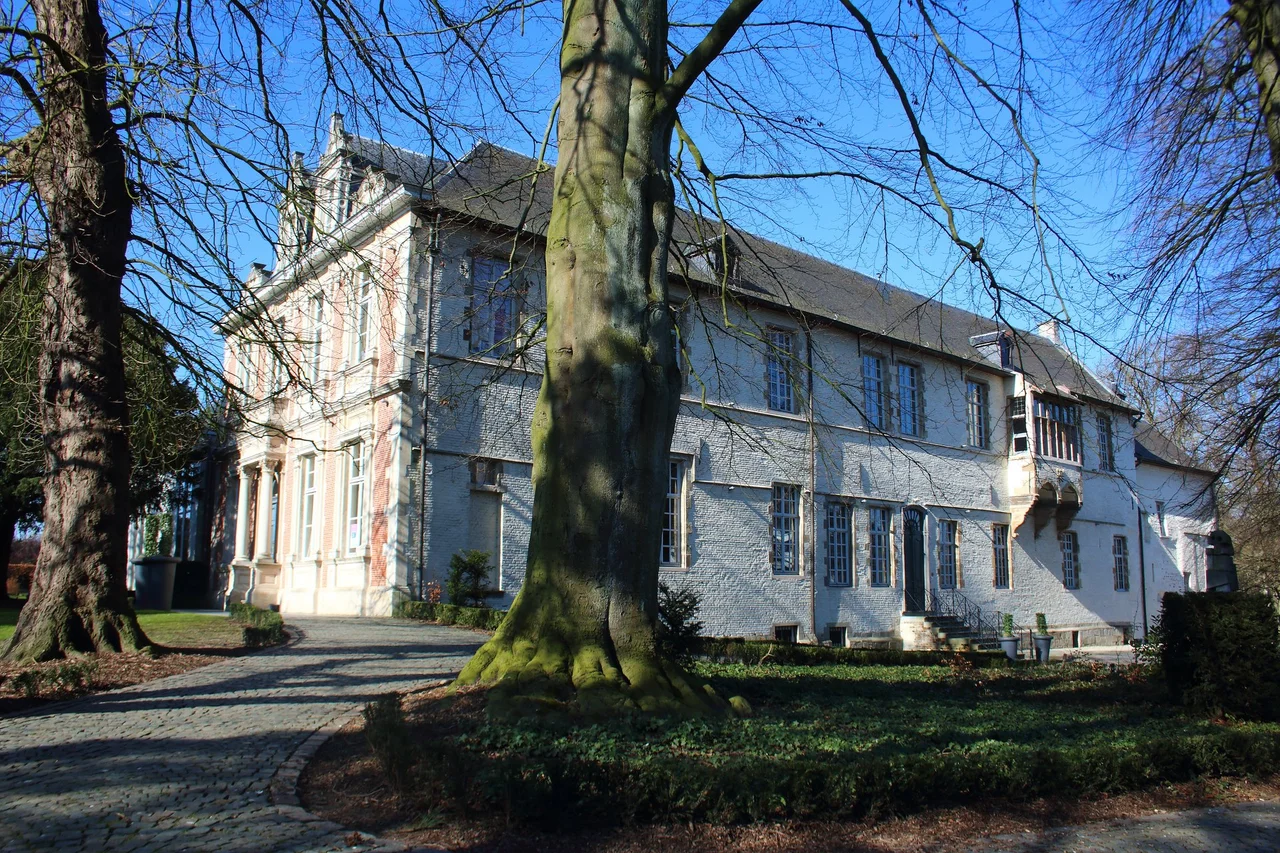

Egmont Castle
On 7 September 1566, in the Knights' Room of a castle in the small Flemish town of Zottegem, Lamoral - Count of Egmont, governor of Flanders, hero of the Battle of Saint-Quentin, godfather of the future King Philip II's son - sat down to write a letter to William of Orange. The two men were old friends and political allies, both Knights of the Golden Fleece, both alarmed by the religious crackdown the Spanish crown was preparing for the Low Countries. Lamoral was 43. He thought he could reason with Madrid. Eighteen months later he was kneeling on a black cloth in the Grand Place of Brussels while the executioner of the Duke of Alba lifted a sword over his neck.
From Motte to Mansion
The castle at Zottegem began as a motte-and-bailey - earthwork and timber - in the eleventh century, raised by a local lord called Rothardus who first turns up in a charter from 1083. Around 1150 the timber was replaced with a stone keep, with a small Romanesque parish church and graveyard tucked beside it; archaeologists uncovered the church foundations in 1994. Over the next four centuries the place changed hands through marriage and inheritance - the Houses of Antoing, Melun, and Luxembourg-Fiennes each held it in turn. Twice the Ghent militia took it during their long quarrels with their counts (1381 and 1452). On 19 May 1516, the seventeen-year-old Charles V, soon to be Holy Roman Emperor, paid a state visit. By then the keep had been rebuilt again, this time toward something more like a great house than a fortress.
Lamoral Inherits
In 1530 the castle passed to the House of Egmont, who began turning it into a Renaissance country seat. Lamoral, born in 1522, inherited it from his elder brother in 1541. He fitted out the Knights' Room (the Ridderzaal) with a Renaissance oriel window and floor tiles shipped in from Antwerp, where the kilns produced the best maiolica in northern Europe. He spent most of his life in Brussels at the family's Egmont Palace, serving the Habsburg crown brilliantly. He commanded Spanish cavalry at the Battle of Saint-Quentin in 1557 and routed the French at Gravelines in 1558. Philip II named him to the Order of the Golden Fleece, stadtholder of Flanders and Artois, and trusted him with the upbringing of the heir to the throne. Then religion intervened.
The Letter From Zottegem
The 1560s brought iconoclastic riots through the Netherlands - Calvinist mobs smashing statues, Catholic processions stoned in the streets. Philip II in Madrid was determined to crush the unrest and the heresy that fed it. Lamoral, Catholic himself but Flemish first, urged moderation. In September 1566 he retreated from Brussels to his castle at Zottegem and on 7 September wrote to William of Orange from the Knights' Room, working out how to navigate the storm. He chose to stay and trust the king. William chose to flee. Within a year Philip dispatched the Duke of Alba and ten thousand Spanish veterans north with secret orders to settle accounts. Alba's Council of Troubles - the locals called it the Council of Blood - arrested Lamoral on 9 September 1567, tried him for treason, and beheaded him in the Grand Place on 5 June 1568. His head was set on a pike for hours. The execution was the spark that converted Dutch resentment into open revolt - the Eighty Years' War had begun.
Goethe and Beethoven
Two centuries later, the German imagination claimed Lamoral as a martyr of liberty. Johann Wolfgang von Goethe wrote his tragedy Egmont in 1788 - a play that turned the Flemish count into a Romantic hero who chooses honourable death over flight. In 1809, when Napoleon's armies were occupying Vienna, Ludwig van Beethoven composed the Egmont Overture and incidental music for a production of Goethe's play. The overture is one of the most defiant pieces Beethoven ever wrote, ending in a blazing major-key Symphony of Victory that the composer meant as a hymn to political liberty. Lamoral never heard a note. But the music made him immortal.
What Survives
After Lamoral's death the castle was confiscated by the Spanish until 1577. The Eighty Years' War damaged it in 1570, 1579, and 1580. French troops occupied it during the wars of the late seventeenth century. From 1707 the Pignatelli family - relations through Lamoral's sister Marie Claire - held it. In 1815 a Baron Lefebvre from Tournai bought it and split it down the middle into two houses. The town of Zottegem bought the two halves in 1957 and 1965, restored them, and now uses the building as the local library. Behind it stretches Egmont Park, where the foundations of the medieval church and castle wall are still visible, and where Jan-Robert Calloigne's wrought-iron 1872 statue of Lamoral - hand on his sword hilt, dressed in his Knight of the Fleece chain - looks out over a small Flemish town that quietly carries one of European history's loudest names.
From the Air
Egmont Castle sits at 50.87 degrees north, 3.81 degrees east, in the centre of Zottegem in the Flemish Ardennes (East Flanders). The castle and surrounding Egmont Park appear as a green oval inside the small town's grid. Brussels (EBBR) is twenty-five nautical miles east-northeast; Ghent (closest general aviation: Ursel EBUL) is twelve nautical miles north-northwest. The Flemish Ardennes here roll gently to 100-150 metres elevation - low hills compared to most of Flanders, easily spotted from cruising altitude as a darker, more wooded zone south of the flat coastal plain.
Nearby Stories
- KOERS Museum 6.7 km away
- Heysel Stadium Disaster 8.1 km away
- National Redoubt (Belgium) 9.2 km away
- Ostend 19 km away
- Battle of Beverhoutsveld 22 km away
- Belgium 24 km away
- Courrieres Mine Disaster 30 km away
- Marcinelle Mining Disaster 60 km away