
National Redoubt (Belgium)
On 15 August 1914 a single German shell found the ammunition magazine of Fort Loncin outside Liège. The explosion killed 350 men instantly and tore the fort in half. Their bodies are still down there. The Belgian engineers who had spent half a century ringing Antwerp with what they believed were the most modern fortifications in Europe learned, in that moment, that the war had already overtaken them. Within weeks German artillery would arrive at the city's outer rim and prove it again, fort by fort, working its way through the National Redoubt with shells the defenders could neither return nor survive.
Belgium's Last Stronghold
When Belgium gained independence in 1830, military planners faced a small country with powerful neighbours and limited means. They settled on a doctrine: rather than defend everywhere, concentrate. Antwerp - already a great port, supplied from the sea, ringed by floodable polders - would be the réduit national, the national redoubt where the army would withdraw and hold until allies arrived. The Act of 8 September 1859 began the work, ordered after Napoleon III's rise made a French invasion newly plausible. Eight earthen forts went up between Wijnegem and Hoboken, designed by Henri Alexis Brialmont, the engineer whose name would become synonymous with Belgian fortification. They were called forts 1 through 8, and they ringed the city at a distance of just under three kilometers.
The Race the Forts Lost
Then the Franco-Prussian War of 1870 changed everything. German guns shelled Paris from seven kilometers away, twice the range Brialmont had planned for. The 1859 ring was now too close to the city centre. So Belgium pushed outward, building a second ring of forts further out, then a third when 21-centimeter Krupp guns arrived in the 1880s, then a fourth set after 1906 when the Russians proved a Belgian-style turret could not withstand 28-centimeter shells. By 1914 there were 28 forts arranged in two great rings, 95 kilometers of concrete, steel and earth, the proudest defensive engineering on the continent outside France. The 1906 forts used 2.5-meter concrete vaults, the heaviest guns 15-centimeter naval pieces. Belgian military leadership knew, by Trial reports in 1912, that German artillery had already moved past 28 centimeters. They built anyway, because there was nothing else to do.
September into October, 1914
The Germans came in August, swinging through neutral Belgium toward France. They reduced Liège in twelve days using 30.5-centimeter Skoda howitzers borrowed from Austria and the new 42-centimeter Big Bertha, a gun firing one-ton shells from ten kilometers away - safely outside the range of every Belgian fort. After a pause to fight on the French front, the Germans turned back toward Antwerp on 4 September. By 30 September they had destroyed the forts at Walem, Sint-Katelijne-Waver, and Koningshooikt. Fort Lier fell on 2 October. Fort Kessel on the 4th. Fort Broechem on the 6th. In total the Germans fired 590 rounds of 42-centimeter ammunition and 2,130 30.5-centimeter shells onto the rings. The Belgian garrisons crouched in their concrete and could not reach back. On 9 October the Belgian Army began blowing up its own remaining forts on the east bank and slipping away across the Scheldt. The next day Antwerp was abandoned. The army retreated 150 kilometers west to the Yser line, where it would hold for the rest of the war.
What Bertha Taught
The lesson the rings of Liège, Namur, and Antwerp taught Europe in 1914 was simple and terrible: the static fort, the high-water mark of nineteenth-century military art, had been finished off by the industrial chemistry of TNT and drawn-steel barrels. In the interwar period the Belgian forts were modified - machine guns added, gas-tight rooms installed, half-circular bunkers called Abri élémentaires bolted on - but they were no longer the defence. An anti-tank ditch ran 33 kilometers around the new perimeter, fifteen kilometers out from the city centre. None of it mattered much in 1940. On 10 May, fewer than a hundred German glider troops landed on the roof of Fort Eben-Emael - the largest fort in the world, widely declared impregnable - and silenced it in a single morning. It was the first strategic airborne operation in military history. Antwerp's forts, holding the same doctrine that had failed in 1914, fell back again. Fort Breendonk, one of the 1906 ring, became a Nazi transit camp where around 185 prisoners were executed and roughly 300 died in total from execution, torture, and disease; it is now a national memorial.
Bats and Paintball
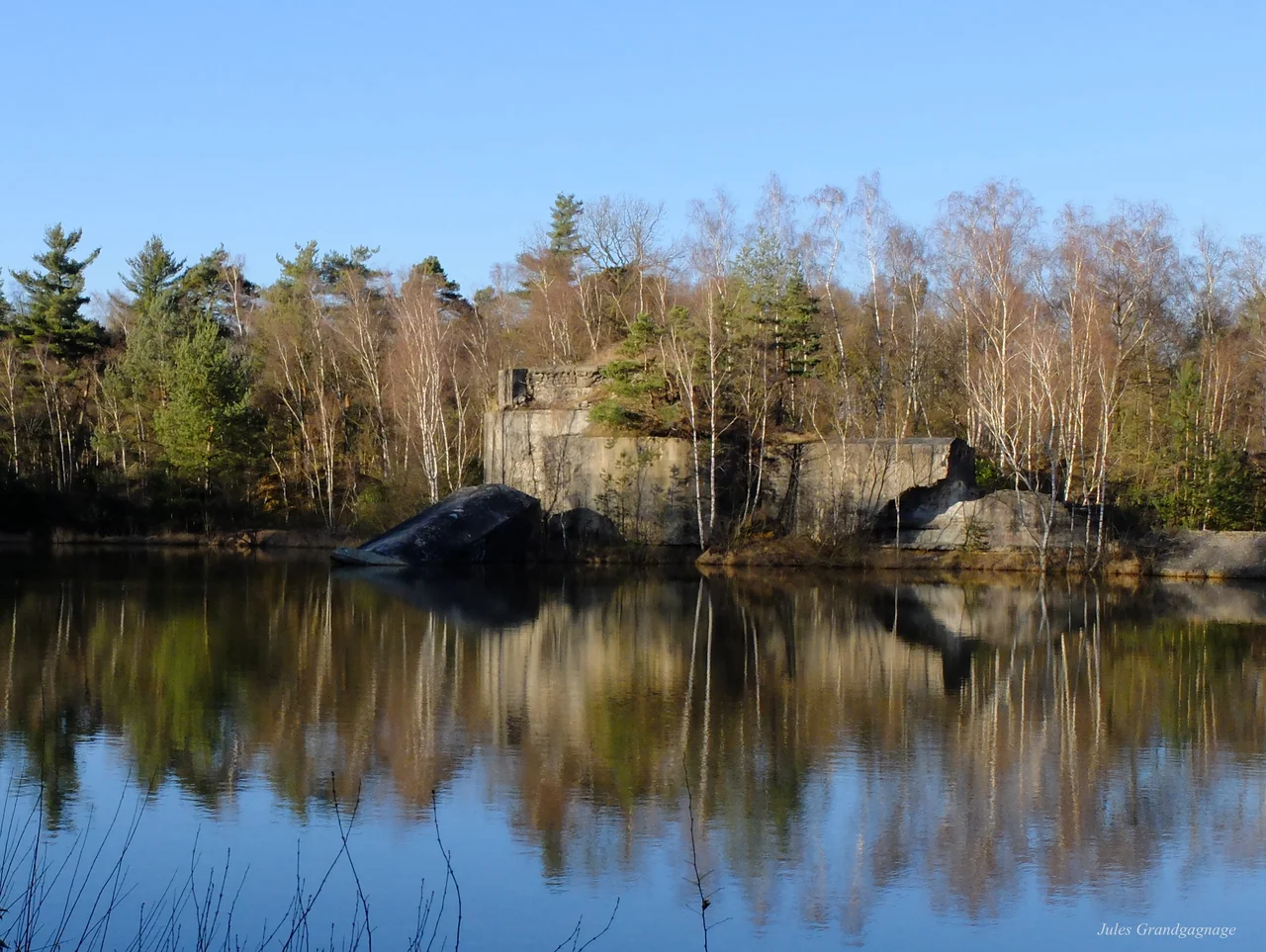
Most of the forts still stand. The Brialmont ring of 1859 lost Fort 1 to a shopping centre in 1959, but Forts 2 through 8 survive as museums, nature reserves, a recreation area, a property of the University of Antwerp. Of the 1906 ring, every fort still exists in some form. Some host bats: Fort Brasschaat shelters between 800 and 900 hibernating animals each winter, the largest such colony in Belgium. Fort van Stabroek is used for paintball. Fort Liezele is open as a small museum. Driving the R11 ring road that connects them, you cross a green belt where the city's edge once held its breath. The concrete still bulges from the trees. The shells of 1914 left their marks. The forts kept Antwerp's army alive long enough to slip away, and that turned out to be the only thing they were ever going to do.
From the Air
Centered roughly at 51.17°N, 4.35°E. The double ring of forts spans 95 km around Antwerp, with the inner Brialmont ring tight to the city (radius about 3 km) and the outer 1906 ring 12-15 km out. Visible from the air as a series of distinctive star or polygonal earthworks within green spaces, often now wooded. Nearest major airport: Antwerp International (EBAW), within the ring itself; Brussels (EBBR) 40 km south. Best identified at low altitude on a clear day - look for the regular dark green polygons in suburban Antwerp.
Nearby Stories
- Roosendaal 5 km away
- Sabbinge Castle 5.7 km away
- Bouchout Castle 7.1 km away
- Campine 8.5 km away
- North Brabant 12 km away
- Egmont Castle 12 km away
- Battle of Halen 14 km away
- Reginald Warneford 22 km away