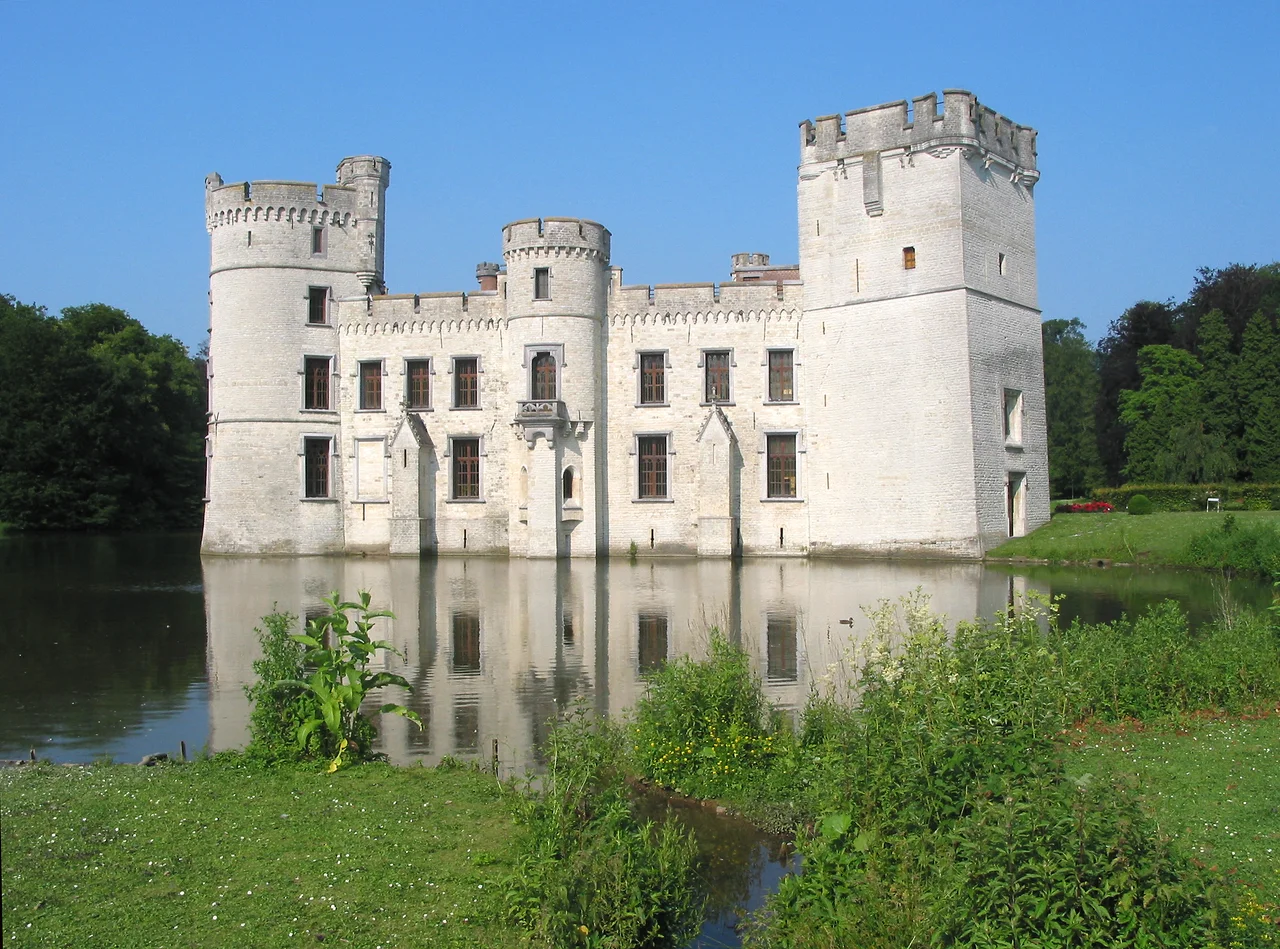

Bouchout Castle
In June 1867, news reached Europe that Maximilian, the Habsburg archduke who had spent three years calling himself Emperor of Mexico, had been stood against a wall in Querétaro and shot. His widow Charlotte was already in Europe, having crossed the Atlantic to beg Napoleon III and the Pope for the French troops that had propped up his throne. She received nothing, and then the news. She did not return to Mexico. She did not return, in any meaningful way, to public life. Twelve years later, the Belgian royal family bought a moated castle in the village of Meise, twelve kilometers north of Brussels, and gave it to her. She lived inside its walls for forty-eight years and died there in 1927.
Bouchout Castle is older than that story - it has guarded a small pond in Flemish Brabant since the late 12th century - and younger, in the sense that the neo-Gothic silhouette it presents today was finished only in the 1830s. But for nearly half a century it was, quietly, the longest residence of a woman the world had once known as Carlota of Mexico.
A Beech in the Swamp
Bouchout sounds French. It is not. In modern Dutch the name would be written Boekhout, and it simply means 'beech' - a dialectal variant of beuk. The territory was once swampy ground full of beech trees, and the name stuck. The fortress was probably begun by Wouter van Craaynem around 1170, at the end of the twenty-year Grimbergen Wars, in which the young Dukes of Brabant tried to break the powerful Berthout family that controlled the Bruges-to-Cologne trade routes from a nearby castle at Grimbergen. The Bouchout site was strategic: close enough to Berthout territory to be a thorn in their side, defensible on water.
The original keep was probably modest - a fortified house, not the storybook castle later illustrators imagined. The Donjon tower that still anchors the complex today went up around 1300 under Daniel van Bouchout, a knight who had earned glory at the Battle of Worringen in 1288 by helping capture Reinoud van Gelre for Duke Jan I of Brabant. Daniel's tower has two levels and a battlemented platform, loopholes on each floor, and a red cross - the Bouchout family arms - on the courtyard side. It is the oldest piece of the building still standing, and the only piece that gives a fair sense of how the original castle felt: heavy, watchful, low to the water.
Five Centuries of Owners
The Bouchout family line died out in the fifteenth century when Margareta van Bouchout married into the Van der Marck dynasty. The Van der Marcks held it from 1476 to 1537, then it passed to the Transylvan family, then in 1590 to Christoffel d'Assonville, a loyal minister of the Spanish crown believed to have been involved in plots against William of Orange. D'Assonville restored the medieval shape and was rewarded in 1605 when his estate was raised to a barony.
At the end of the seventeenth century, an Antwerp lawyer named Peter-Ferdinand Roose bought the castle and turned it inside out. This was the era when Louis XIV was building Versailles and Brussels was filling with wigs and silk. Roose remade Bouchout as a Renaissance chateau and laid out French ornamental gardens around it. The original five concentric canals were collapsed into one surrounding pond. Then came the French Revolution, and revolutionary armies treated the place roughly - dismantling its wooden bridge to feed campfires through the freezing winter of 1795, looting the rooms, levelling the outer defenses. By the time Belgium became independent in 1830, Bouchout was a half-ruined romantic relic on a pond, waiting for a new chapter.
Restoring an Old Country's Pedigree
That chapter came in 1832, when Count Amadeus de Beauffort hired the architect Tilman-François Suys to do something fashionable across the young Kingdom of Belgium: reinvent a medieval castle as a more medieval-looking castle. Belgium was a new country with old buildings, and its early ruling class loved the late Middle Ages because it was the era when the Low Countries had mattered most. Bouchout received Gothic battlements on its rooflines, neo-Gothic windows, an Armoury Gallery on the first floor decked out with old paintings and suits of armor, neo-Renaissance fireplaces, and a general air of having always looked exactly this way. The southern wing was demolished outright to open the structure to view.
The count's son Leopold inherited and, in a touch worthy of a Belgian gothic novel, never married and apparently lived alone in the Donjon tower. The castle that the Belgian royal family bought in 1879 was therefore not quite a medieval keep and not quite a Renaissance chateau - it was a Romantic-era idea of what a Brabantian castle ought to look like, sitting on a 92-hectare estate of mature trees and water.
The Empress at the Window
Charlotte of Belgium was the only daughter of King Leopold I. She married Maximilian of Austria in 1857 at the age of seventeen. When Napoleon III and a clique of Mexican monarchists offered Maximilian the throne of Mexico in 1864, the couple went. The empire lasted three years. After the American Civil War ended, the United States pressured Napoleon III to withdraw his French troops, and Maximilian's regime collapsed. Charlotte sailed for Europe to plead for help. While she was pleading, her mind began to give way. She received the news of her husband's execution in 1867, and after that her family kept her in seclusion, first elsewhere and then, from 1879 onward, here.
For forty-eight years the dowager Empress of Mexico lived inside the walls of Bouchout. She made no public appearances. Her court was small. During the First World War, the occupying German army respected the property because Charlotte was the sister-in-law of Kaiser Franz Joseph of Austria, and the people of Meise used the castle grounds as a refuge from the war. She died on 19 January 1927, five months short of her eighty-seventh birthday, having lived alone with whatever she remembered of Mexico for longer than she had lived everywhere else combined.
Greenhouses and a Grave
After Charlotte's death, the furnishings were moved to the Palace of Laeken and the Belgian state bought the estate. The first plantings of what would become the National Botanic Garden of Belgium went in during the 1930s. The war was not kind to Bouchout - German soldiers occupied it during the Second World War and built four fortified shelters in the grounds, and in November 1944 a German V-1 flying bomb struck the west side of the domain, blowing out most of the castle's windows. A second V-1 destroyed nearby Meise Castle entirely.
A serious restoration finally came between 1987 and 1989. Today Bouchout sits at the heart of the Meise Botanic Garden, surrounded by greenhouses where visitors walk through facsimiles of rainforest and Mediterranean climates, by old oaks and beehouses and wild roses, by a former Orangery now serving as a café. The castle itself hosts meetings, lectures and exhibitions. On 17 June 2010 the former Dutch Prime Minister Jan-Peter Balkenende threw a farewell party here for European friends including Angela Merkel - a small, modern footnote to a long line of receptions in these rooms. The Donjon still stands at the center of the silhouette, its 13th-century walls older than any name on any door.
From the Air
Bouchout Castle sits at 50.93 N, 4.33 E, in the village of Meise in Flemish Brabant - about 12 km north of central Brussels and only 7 km west of Brussels Airport's runways. The castle is set in the 92-hectare Meise Botanic Garden, recognizable from the air as a large wooded enclave with a distinctive moat-pond around the castle itself. The nearest airport is Brussels Airport (EBBR), with departures from runways 25L/25R passing nearly overhead. Charleroi (EBCI) lies about 60 km south. From altitude, look for the cluster of glasshouses east of the castle (the Plant Palace) and the dark green of the botanic garden against the lighter agricultural fields around Meise.
Nearby Stories
- Wilrijk 1.8 km away
- Egmont Castle 4.4 km away
- Geel 4.9 km away
- Raffinerie Tirlemontoise 9.9 km away
- Marcinelle Mining Disaster 27 km away
- Borssele Nuclear Power Station 33 km away
- Courrieres Mine Disaster 72 km away
- Fort Jeanne d'Arc 187 km away