
Battle of Halen
When the Belgians walked the fields after the battle on 12 August 1914, they kept finding the helmets. Polished German cuirassier helmets, the kind topped with a brass eagle and meant to glitter on parade, lay among the dead horses and the dropped sabres in the wheat south of Halen. They picked enough of them up to give the day its name. Belgians called the action the Battle of the Silver Helmets, deliberately echoing the medieval Battle of the Golden Spurs of 1302, when Flemish militiamen had stripped golden spurs from the bodies of routed French knights. Six centuries apart, in the same flat country, infantry on foot had broken the most prestigious cavalry of Europe. The battle was a Belgian victory. It changed almost nothing.
A bridge on the road to Brussels
Halen was a market town in Limburg with a couple of bridges over a small river called the Gete. In normal years no one would have cared about it. But the German Schlieffen Plan required a fast push across central Belgium to fall on Paris from the north, and Liège was holding out longer than anyone had expected. Halen sat on the line of advance between Hasselt and Diest, the gateway to a road that would have driven a wedge between the northern and southern halves of the Belgian field army. General Georg von der Marwitz was sent west with the German II Cavalry Corps to find and break the Belgian flank. General Léon de Witte, commanding the Belgian Cavalry Division, was sent to stop him at Halen. On the night of 11 August, on the recommendation of two young officers named Tasnier and Van Overstraeten, de Witte made the decision that decided the battle. His lancers and scouts would fight the next day on foot, with carbines.
The bridge they could not blow
The fighting began at dawn. German Jäger infantry, supported by field artillery, drove the Belgian cyclists guarding the bridge until the position became untenable. The defenders tried to blow the bridge and only partly succeeded; the powder was bad. The German command was euphoric. Cavalry units poured into Halen. A pontoon bridge went up nearby at Donk to feed more troops across the river. Then the Belgian artillery opened up from the Mettenberg, a small hill the German officers had not properly scouted, and dropped shells into the packed center of town. The Germans at first thought the fire was coming from a different hill entirely. By noon the carabineer-cyclists had pulled back through the wheat fields to take up positions along the railway dam, a tourist cycle path today, and a sunken north-south road called the Betserbaan.
Charge after charge
In the early afternoon, two squadrons of the 17th Dragoon Regiment came up the Diestersteenweg toward the Bokkenberg hill. The road was lined with hedges and strung with barbed wire. Forced into a frontal charge, the dragoons were cut down. Over the next two hours, regiments of dragoons, cuirassiers, and uhlans appeared in the order they had crossed the river and rode at the Belgian line with lance and sabre. The sunken road in front of them broke the cavalry's momentum. The Belgian artillery dispersed each new wave. The carabineer-cyclists were eventually overrun in the open fields, and captains Van Damme and Panquin died there, but every charge against the guns on the Mettenberg failed. The German infantry finally took the IJzerwinning farm with artillery support. Then the Belgian 4th Mixed Brigade arrived from Tienen, and Belgian guns went into action from the Molenberg. The German commander broke off the attack at dusk and pulled back across the river.
A victory that mattered very little
Marwitz's cavalry had failed to penetrate the Belgian front line and had not learned anything new about the dispositions behind it. The German 4th Cavalry Division suffered casualty rates of 16 and 28 percent in its two regiments. Belgian losses were lower. King Albert had been advised at the height of the fighting to leave Leuven immediately, the situation seeming so desperate. By the evening the news had reversed itself, and a telegram from de Witte announced the German withdrawal. And yet the Germans went on to besiege and capture Namur and the rest of the Liège forts, then Antwerp, then most of Belgium. The Belgian government fell back to the Yser. The Battle of Halen delayed nothing important. It mattered for what it told the Belgian people and the world: that a small country, ambushed by an empire, could choose to fight.
Forty-four helmets in concrete
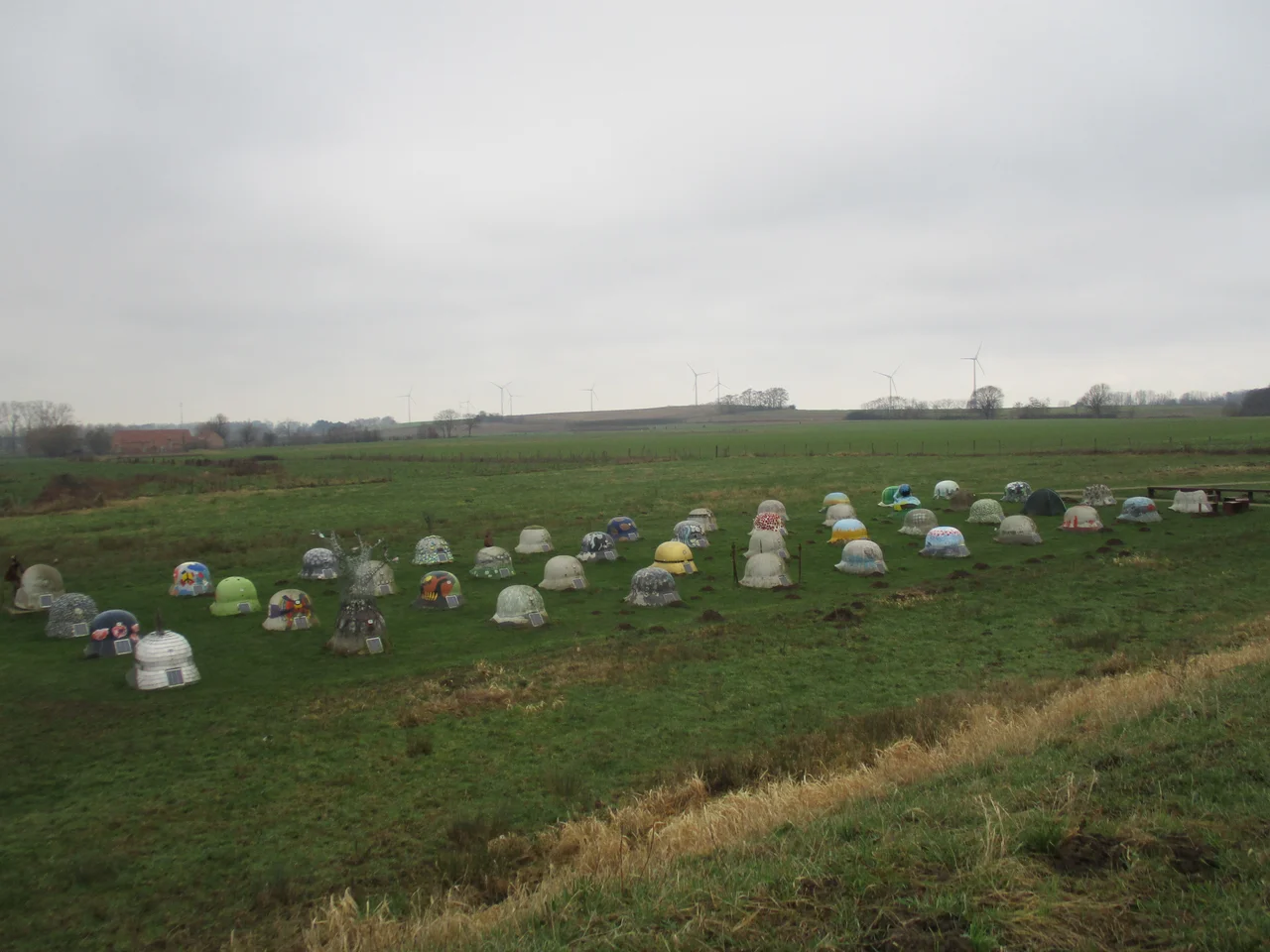
On the hundredth anniversary of the war, the town of Halen placed forty-four concrete sculptures shaped like German cuirassier helmets in fields and parks around the battlefield. Each represents one of the towns of Belgian Limburg, and together they mark the four years of occupation that followed the brief Belgian victory of 1914. The old Halen train station, which the German infantry shelled and the Belgian gunners answered, is gone. The railway dam where the carabineer-cyclists fired their carbines is a cycle path. The sunken Betserbaan still threads the fields. And visitors who know where to look can still trace the route the dragoons took, hedges on one side, barbed wire on the other, into massed rifle fire from a sunken road they could not see.
From the Air
The battlefield lies at 50.95 N, 5.11 E, on the river Gete in Belgian Limburg, roughly between Hasselt and Diest. Best viewed from 2,000 to 4,000 feet, where the railway-dam cycle path, the modern town of Halen, and the small hills of the Mettenberg and Bokkenberg are clearly visible. Nearest airports are Brussels Airport (EBBR) 60 km west, Liège (EBLG) 45 km south, and Maastricht Aachen (EHBK) 40 km east. Look for the concrete helmet sculptures placed in fields around the town to commemorate the 1914 action.
Nearby Stories
- Capture of Maastricht 4.8 km away
- Sfinks Festival 5.5 km away
- Brussels Airport Diamond Heist 6.2 km away
- SCK CEN 7.4 km away
- Wessem-Nederweert Canal 19 km away
- Marcinelle Mining Disaster 29 km away
- Courrieres Mine Disaster 157 km away
- Fort Jeanne d'Arc 171 km away