_-_Aerial_photograph.jpg)
Roosendaal
Every April, a few hundred fans of a Swedish pop group gather in a railway town in the southern Netherlands and spend a weekend listening to Dancing Queen, swapping memorabilia, and queuing for autographs from people who once shared a stage with Agnetha and Bjorn. The town is Roosendaal. The event is called International ABBA Day. The reason it happens here at all is that ABBA's official fan club, founded in 1986 and still recognised by the band, has been headquartered in Roosendaal for almost forty years - which is the kind of small, peculiar civic fact you can only really get away with if your town is also home to the Dutch commando regiment and was a regional rail junction back when the Belgian border still meant border guards.
The Valley of Roses
The name first appears in a document in 1268 as Rosendaele - the valley of roses. By the Middle Ages the place was prospering on the peat trade, the back-breaking business of digging up Brabant's bogs and shipping the dried turf out as fuel. Then came the Eighty Years' War. From 1568 to 1648 itinerant troops on both sides marched through Roosendaal looting and burning, and for decades the countryside around the town was simply abandoned - too dangerous to farm, too contested to settle. Recovery was slow. City rights, when they finally arrived in 1809, came not from a Dutch sovereign but from Louis Bonaparte, brother of Napoleon, who ruled the brief Kingdom of Holland from a palace in Amsterdam and handed out municipal charters as a way of binding the country to French rule. The charter outlived the king.
The Junction
Roosendaal's modern identity was built by the railway. From the mid-nineteenth century onward, the town sat at the meeting point of lines running east to Antwerp, north to Dordrecht and Rotterdam, and inland toward Zwolle. The international Amsterdam-Brussels Intercity stopped here for decades, and the station became one of the last places on Dutch territory where passengers actually had to show passports to Marechaussee officers before continuing across the border. The Schengen agreement ended the document checks. The Brussels Intercity was rerouted via Breda and the high-speed HSL-Zuid line in 2018, taking some of the air out of the station's old role. But Roosendaal remains a regional hub: the Zwolle-Roosendaal Intercity begins and ends here, the Amsterdam-Vlissingen line passes through, and hourly stop-trains still rattle across the border to Antwerp for anyone who still wants to feel like they are travelling between countries.
Commandos and Soldiers
The Korps Commandotroepen - the Dutch army's special-forces regiment - has its headquarters and main garrison in Roosendaal, at the Engelbrecht van Nassaukazerne. The town has worn a military uniform for a long time. The Royal Marechaussee first stationed a brigade here on 16 July 1818, two years after the Marechaussee was founded; the brigade was disbanded under occupation in 1943, restored after liberation, and disbanded again in 1989 as the border softened. A small Marechaussee office stayed on at the station for as long as cross-border trains needed watching. During the German occupation in the Second World War, the occupiers ran a subcamp of Herzogenbusch concentration camp in Roosendaal for Jewish prisoners - a fact the town's quieter monuments still mark, and one of the dark inflexion points in a civic history that otherwise reads as a procession of factories, fairs, and football clubs.
The Carnival, the Race, and the Fan Club
Roosendaal does Carnaval the proper southern Brabant way, with elected princes and weeks of build-up. It hosts the Draai van de Kaai, a criterium-style cycling race that snakes through the city centre and pulls riders from across the Low Countries. And then there is International ABBA Day, the event no other Dutch town has, which exists because the band's official fan club happened to settle here in 1986 and never left. The list of people who have lived here is similarly eclectic: Ben van Beurden, who ran Royal Dutch Shell as its CEO; Jesse Klaver, the political leader of GroenLinks; Ronny Moorings of the dark-wave band Clan of Xymox; the schlager singer Frans Bauer, who fills Dutch arenas with songs about ordinary life. Tim van Rijthoven, who reached the Wimbledon round of sixteen in 2022 after beating Daniil Medvedev at 's-Hertogenbosch earlier that summer, also grew up here. The Roosendaal Sportsman of the Year for 2017 was Niek van der Velden, a teenage snowboarder - which says something about how a town this size handles its own minor celebrities.
After the Frontier
Roosendaal sits about twenty kilometres west of Breda and the same distance north of Antwerp, on the flat country where the Brabant farms slide down toward the Scheldt estuary. The 1997 municipal merger absorbed the smaller centres of Wouw, Heerle, Nispen, Wouwse Plantage, and Moerstraten into the larger civic body, but the core city still feels like what it has always been: a railway crossroads with churches, a market, a hospital, and a slightly outsized military footprint. The roses in the name are mostly metaphorical now. The valley is more practical than romantic. But on the right April weekend, you can stand on the platform at Roosendaal station and watch ABBA fans dragging luggage past Marechaussee posters about smuggling, with a commando barracks down the road and a fan club office somewhere in the city centre, and decide that it is, on balance, exactly the kind of town the southern Netherlands quietly produces.
From the Air
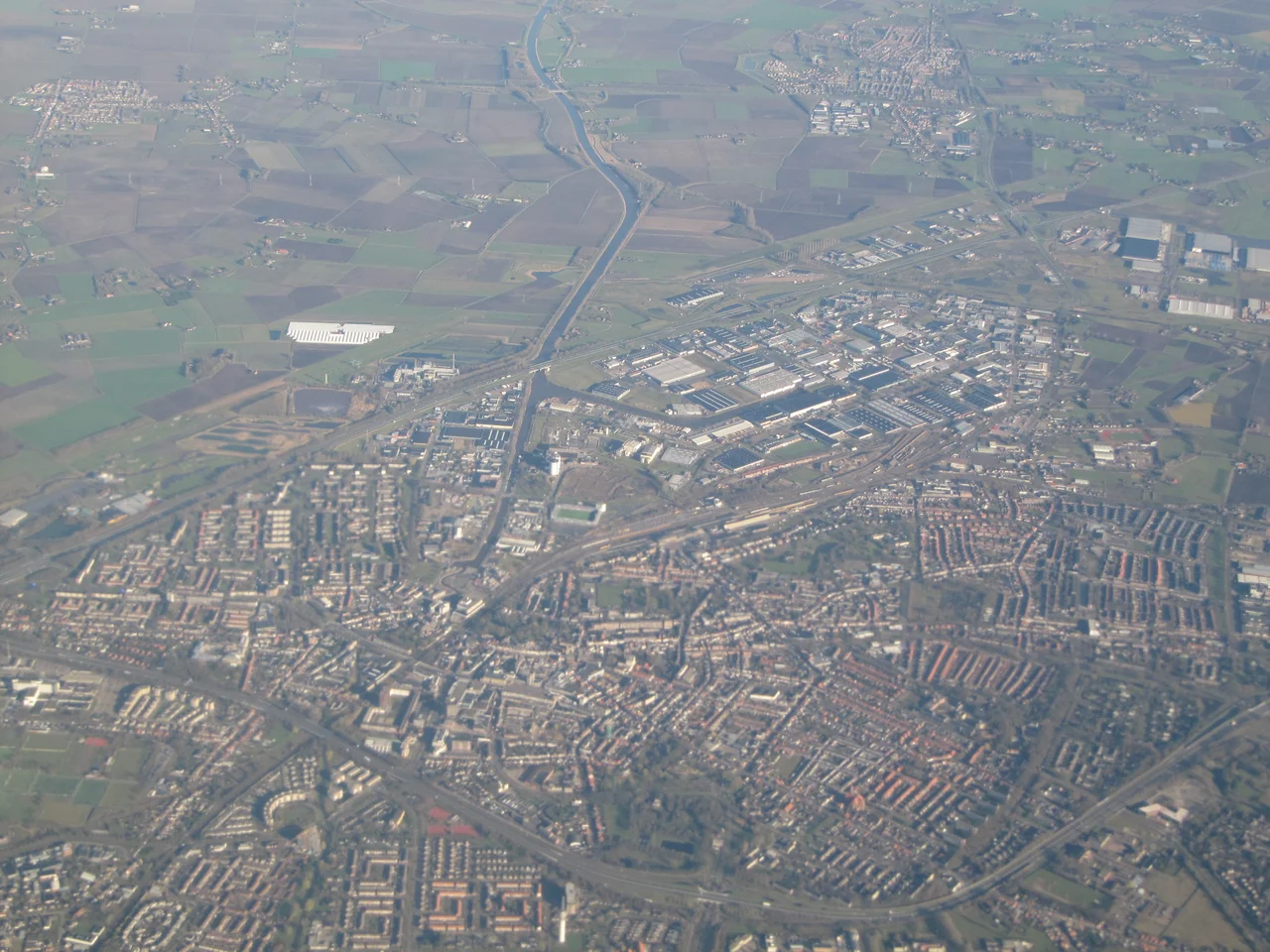
Located at 51.53 N, 4.45 E in the southwest of North Brabant, the Netherlands, about 20 km north of Antwerp and 20 km west of Breda. From altitude the city reads as a compact urban core with the railway hub clearly visible on the south side and converging rail lines fanning out east, north, and toward Belgium. Best viewing 2,000 to 4,000 feet AGL. Nearest airports: Antwerp-Deurne (EBAW) about 18 nm south, Woensdrecht (EHWO) about 13 nm west, Breda-Seppe (EHSE) about 12 nm east. Watch for Antwerp TMA and Woensdrecht military activity.
Nearby Stories
- Campine 1.5 km away
- Kapellen 2.8 km away
- Wilton-Fijenoord 5.1 km away
- North Brabant 5.5 km away
- Sabbinge Castle 8.1 km away
- Heinz Struning 14 km away
- Reginald Warneford 31 km away
- HMS Cressy 46 km away