.jpg)
Wilton-Fijenoord
In 1929 two Dutch shipyards merged under one roof in Schiedam and the new company immediately had to survive the Great Depression. It barely did. By 1930 the workforce had been cut in half, from 7,790 employees at the end of 1929 to 3,849 a year later. A government-backed loan in 1936 kept the doors open. Over the next half century Wilton-Fijenoord would build cruisers, tankers, submarines, ferries, even pieces of a Dutch warship that the German occupiers requisitioned and renamed during the war. None of it would be enough. The yard's last independent year was 1998. The graving docks still operate today, but as part of Damen Shiprepair Rotterdam, a footnote to the company that built half the modern Dutch merchant fleet.
Two Cultures Under One Name
The 1929 merger combined Wilton's Dok- en Werf Maatschappij, the biggest ship repairer in the country, with the older Fijenoord shipyard, which had the lead in naval construction. The shares traded at a ratio of 15.5 to 3, and the new board had seven members, three of them Wiltons. The companies kept their separate legal identities for years, which mattered because they had very different cultures. The Wilton men thought the Fijenoord men were precise and arrogant. The Fijenoord men thought the Wilton men were disorganized, improvising, and rude. Both groups were probably right about each other, and the merger took a decade to settle into something resembling a single company.
The Tankers That Kept the Lights On
When civilian shipbuilding collapsed in the 1930s, tankers kept the yard alive. Shell's Anglo-Saxon Petroleum subsidiary ordered the 12,000-ton Rapana in 1933, and in 1935 Shell's Bataafse Petroleum subsidiary ordered six more tankers. Wilton-Fijenoord built two of them, the 9,100-ton Eulota launched in January 1936 and Elusa in April. Eulima followed in November. In 1936 the Standard Oil of California subsidiary in the Dutch East Indies ordered another 12,000-ton tanker, named Nederland, launched in 1937. None of this was glamorous work. It was, however, the difference between continuing to exist and not.
The Cruiser, the Submarine, and a Difficult Choice
In 1939 the yard laid down the cruiser that would eventually be named De Zeven Provinciën. She was not launched in time to escape the German invasion of May 1940. With Wilton-Fijenoord's board reduced to three men under occupation, including the absent Mr. Kanter, the remaining directors faced an impossible situation. The yard built warships. It had floating drydocks capable of repairing major German vessels. It employed 4,200 people whose livelihoods depended on continued operation. The board chose a policy of cooperation undermined by sabotage. During the war, Wilton-Fijenoord completed the submarine O 25, which had been launched just days before the invasion. She served in the Kriegsmarine and sank an Allied ship. De Zeven Provinciën was launched during the occupation under the name KH 1, Kreuzer Holland 1. Allied bombing damaged the yard's largest drydocks. In late 1943 the occupiers began stripping the machinery and shipping it to Germany. In November 1944 many workers were taken to Germany themselves as forced laborers. After the war four directors faced charges of collaboration. The trials dragged on through 1949, with sentences first imposed, then reduced on appeal. The court said the accused had not resisted enough.
The Long Boom and the Long Decline
The 1950s and 1960s were the company's confident years. Doxford Diesel engines under license, the Holland America Line ships Rijndam and Maasdam launched in 1951 and 1952, drydocks rebuilt to handle 38,000-deadweight-ton vessels, two giant new graving docks completed in 1955 and 1956 to handle the postwar surge in tanker size. Then the supertankers came. In 1959 the Universe Apollo at 104,500 deadweight tons set a scale that smaller Dutch yards could not match without enormous new investment. Wilton-Fijenoord merged with the machine factory Bronswerk in 1964, was torn apart by Stork and the Rijn-Schelde Groep in 1968, became part of the Rijn-Schelde-Verolme conglomerate in 1971, and watched that conglomerate squander government money on projects that never built the mammoth drydock the supertanker era required.
What Damen Inherited
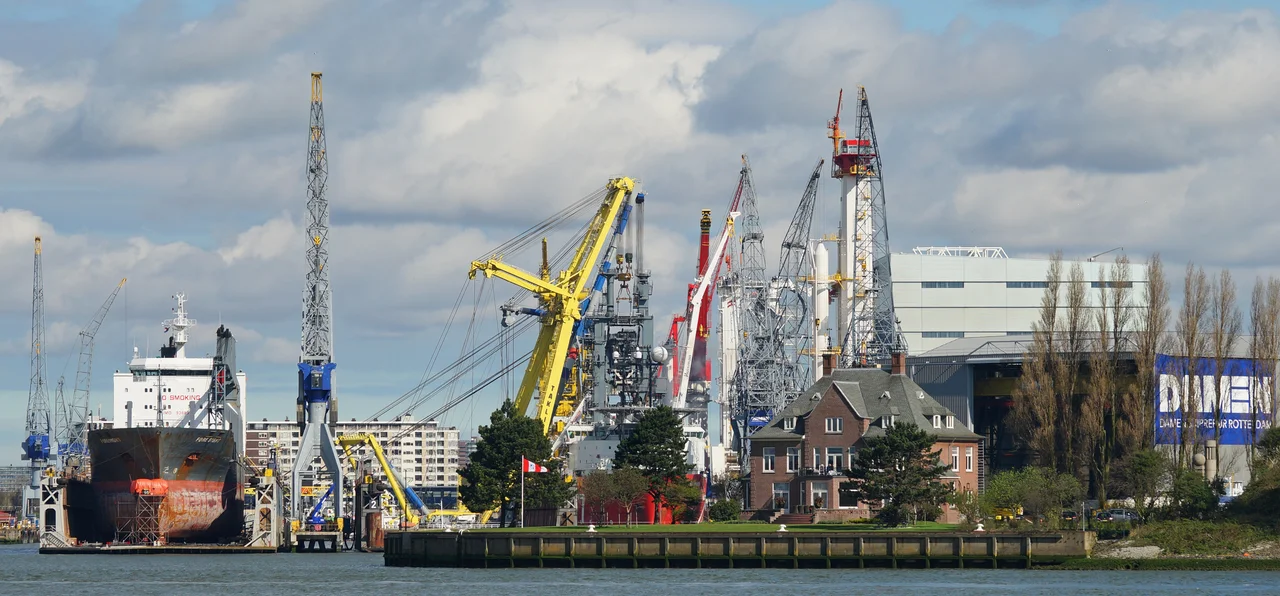
Wilton-Fijenoord became independent again in 1983. The Schiedam municipality bought the yard's land for 42 million guilders and leased it back to keep the company alive. For a few years repair work made money. But the early 1990s brought competition from East German and Polish yards producing at about half the price, and a failed attempt to re-enter shipbuilding finished the story. By 1998 the company needed 40 million guilders just to restore its capital. RDM Technology Holding bought the holding company for one guilder, agreed to put the 40 million in, and almost immediately transferred Wilton-Fijenoord to another buyer. The renamed Rotterdam United Shipyards never became profitable. Layoffs came in 2001, then more layoffs, then more. In late 2001 the Damen Group acquired what remained. Three of the old graving docks are still in use. The rest of the vast terrain has been parceled out to companies like Huisman Equipment and Mammoet. The shipbuilding industry that built modern Dutch maritime power did not collapse in a single famous moment. It receded the way most heavy industries do, through one merger, one layoff, and one foreign competitor at a time.
From the Air
The former Wilton-Fijenoord site sits at roughly 51.90N, 4.38E, on the south bank of the Nieuwe Maas in Schiedam just west of Rotterdam. From altitude the cluster of long graving docks along the river is the giveaway, surrounded by the larger Rotterdam port complex. Rotterdam The Hague Airport (EHRD) is about 8 km north. Amsterdam Schiphol (EHAM) is roughly 60 km north.
Nearby Stories
- European Cooperation for Space Standardization 2.2 km away
- Operation Pheasant 5.6 km away
- Dutch Language 8.3 km away
- Moerdijk 9.9 km away
- Amsterdam University Medical Center 10 km away
- Delta Works 11 km away
- HMS Cressy 14 km away
- Moermond Castle 24 km away