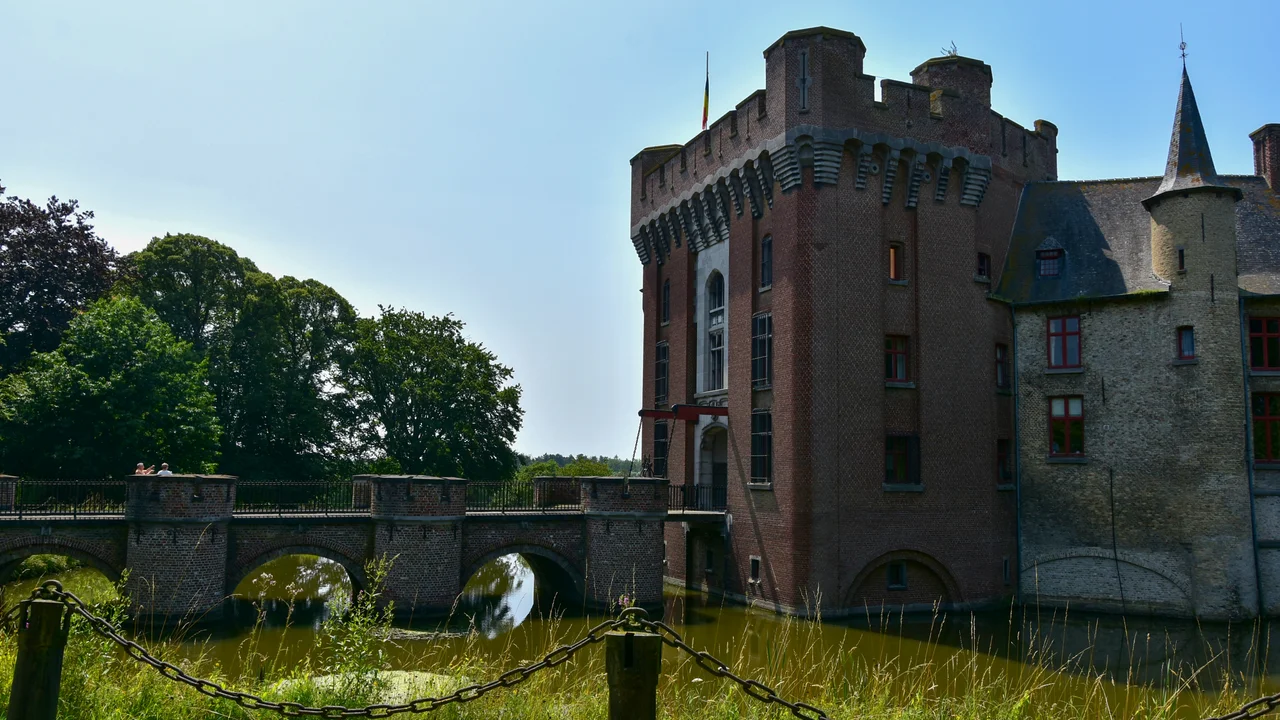

Wijnendale Castle
On a March morning in 1482, the Duchess of Burgundy went hawking in the woods around Wijnendale. She was twenty-five years old, ruler in her own right of one of the richest territorial blocks in Europe, mother of a four-year-old son named Philip, and pregnant again. Her horse stumbled in a ditch. The fall broke something inside her that the doctors of the age could not repair, and Mary of Burgundy died at the castle a few weeks later. Her widower Maximilian of Habsburg held what she had left him with both hands and did not let go. Three hundred years of Habsburg rule over the Low Countries began in the corridors of Wijnendale, because a saddle slipped in a Flemish wood.
A Count's Outpost
Robert I, Count of Flanders, raised the first castle at Wijnendale at the end of the 11th century as a military base, planted on a low rise in the West Flemish forests near what is now Torhout. By the 12th and 13th centuries it had softened into a residence, a place where the Counts could hawk and hunt and conduct the kind of business that needed thick walls but not necessarily a siege engine. In 1297, Guy of Dampierre signed a treaty here with the English king Edward I, an alliance against France that would help drag Flanders into the Battle of the Golden Spurs five years later. The Counts of Namur inherited the place in 1298, and Blanche of Namur is believed to have grown up at Wijnendale - and to have met Magnus IV of Sweden here in 1334, before becoming his queen.
Burgundy's Shadow
In 1407, after a period of neglect, John III of Namur sold Wijnendale to John the Fearless, Duke of Burgundy, who promptly handed it to his son-in-law Adolph of Cleves as part of a dowry. The Burgundian dukes were the wealthiest court in Europe, and their tastes seeped into Wijnendale's stones. Adolph of Cleves, Lord of Ravenstein, and his son Philip transformed the medieval fortress into something closer to a beautiful mansion. When Charles the Bold was killed at the Battle of Nancy in 1477, his body was reputedly brought back through these woods on its long, sad procession north. His daughter Mary, who had just inherited everything, sometimes stayed at Wijnendale with her young son Philip the Handsome, the boy who would one day marry Joanna of Castile and produce an emperor.
The Hawking Accident
Mary of Burgundy was, by all accounts, fond of falconry. On 27 March 1482 she rode out with her birds. The fall - either from her horse, or with it - is recorded only in the dry medieval shorthand of chroniclers who did not yet understand what had just happened. She died on 27 March 1482, leaving Philip and her unborn child to a husband most of Flanders distrusted. Maximilian was authoritarian, foreign, and held the Habsburg lands of Austria. He used Mary's death to fold her inheritance into his own, and within a generation Charles V would rule a domain on which the sun never set, much of it inherited through a young woman who never lived to see her thirtieth year.
Wars Rolling Through
After Mary's death, Wijnendale kept changing hands the way Flemish castles do - by treaty, inheritance, and gunpowder. The Dukes of Cleves held it. Then, after the War of the Jülich Succession, it passed to the Counts Palatine of Neuburg. Louis XIV's armies blew up part of the castle in 1690. The owners patiently rebuilt. In 1708, during the War of Spanish Succession, an allied army fought a French force in the fields outside the gates and won - the castle itself was untouched, an old beneficiary of the strange wartime courtesy that sometimes preserves the most important target. French Revolutionary troops were less polite. In 1811 they damaged the building so thoroughly that only ruins remained, and the Dutch period sold it off to industrialists who cut down all the trees and went bankrupt.
May 1940
The castle was rebuilt in romanticised medieval style by the Matthieu family between 1837 and 1877, and it stands in that form today. Its last great historical moment came on 25 May 1940. With the German army closing in and Belgium days away from capitulation, King Leopold III met four of his cabinet ministers - Pierlot, Spaak, Vanderpoorten, and Denis - in a room at Wijnendale. The ministers begged him to flee to Britain and lead a government in exile. Leopold refused. As commander-in-chief he would stay with his troops and go into captivity. The decision split the country, ended his reign in 1951, and made Wijnendale - this old castle of weddings and inheritances and quiet medieval treaties - a name in the long, sad book of Belgian wartime arguments. The Matthieu family still lives in one wing. The other is open to the public.
From the Air
51.079°N, 3.059°E, near Torhout in West Flanders. Wijnendale sits in a small wooded park about 1 km north of the village. Cruise at 2,000-2,500 ft for a clear view of the moated grounds and the square keep silhouette. Nearest airports: Ostend-Bruges (EBOS, ~22 km north) and Kortrijk-Wevelgem (EBKT, ~32 km south). Surrounding terrain is gentle West Flemish farmland with scattered woodlots.
Nearby Stories
- Fort des Dunes 1.6 km away
- Battle of Messines (1914) 7.3 km away
- Castle of Ronse 8.1 km away
- Vinkt Massacre 8.7 km away
- Battle of Schooneveld 12 km away
- Arques, Pas-de-Calais 13 km away
- Zeebrugge Raid 15 km away
- MV Tricolor 19 km away