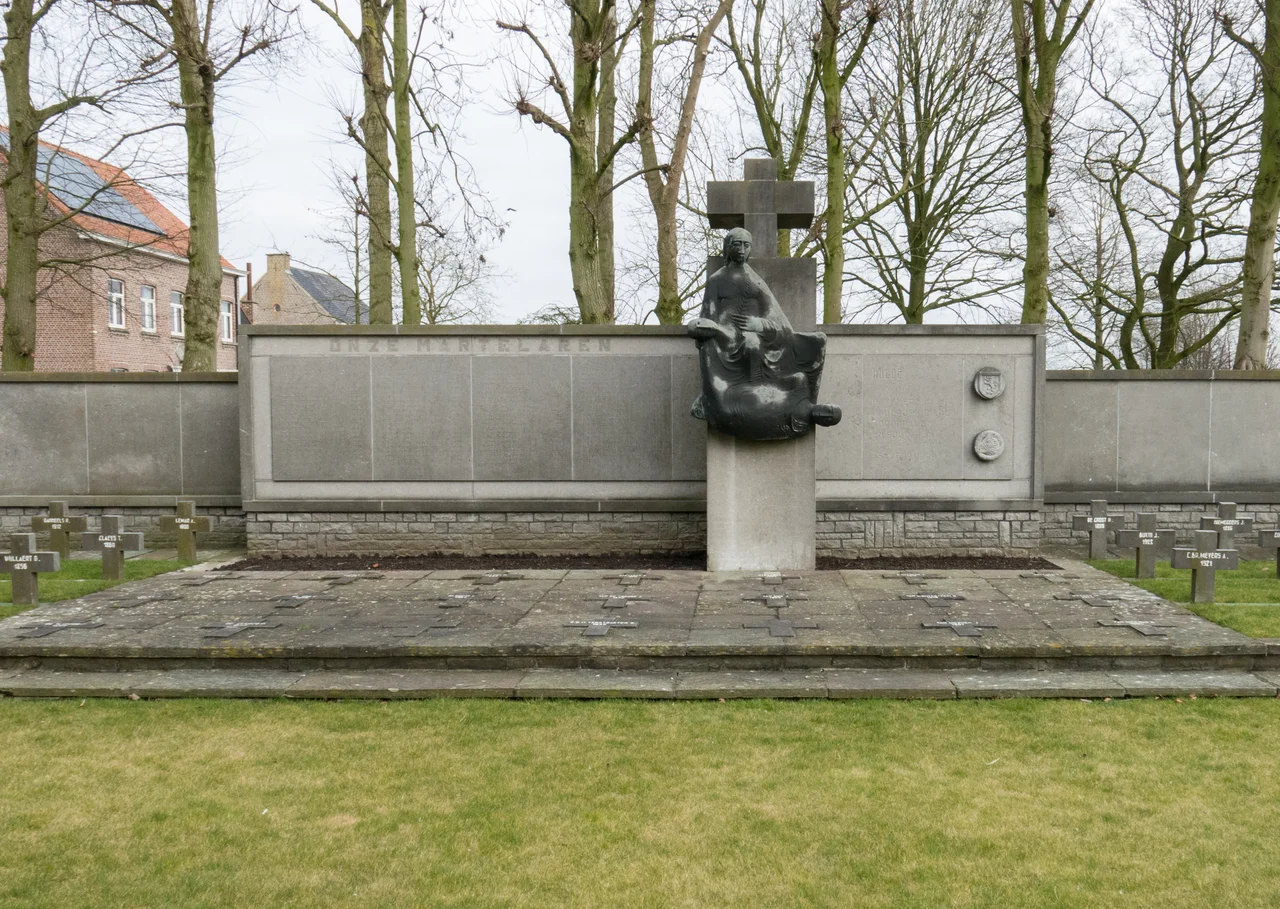

Vinkt Massacre
The last five had to dig the hole themselves. On the morning of 28 May 1940, King Leopold III of Belgium signed his country's surrender at four in the morning - five o'clock German time. The war in Belgium was, formally, over. In the village of Vinkt, in the polder country southwest of Ghent, nine more civilians were shot after the capitulation. Among the very last killings, five men were forced to dig their own grave before the soldiers of the German 225th Infantry Division ended their lives. The men had names. They had families waiting at home. They were neither soldiers nor partisans. They were neighbors who had been pulled out of farmhouses and churches by an army that had decided to make somebody pay for the embarrassment of being held up at a small bridge over a small canal.
A Bridge and a Pause
The bridge mattered for a few hours, then it didn't. The Schipdonk Canal cut west of Vinkt, blocking the German advance toward Lille. The road from Ghent to Lille ran through the village. The 1st Belgian Division of the Chasseurs Ardennais - normally elite light infantry, here mostly cyclists and motor riders - was guarding the crossing. By 25 May 1940, the Battle of France was effectively decided; the French Army had collapsed, and the Belgian Army was prolonging the war for one reason - to buy time for the British Expeditionary Force to reach Dunkirk and evacuate. The Belgian commanders chose not to destroy the bridge. They needed it for British stragglers heading west and for Belgian refugees heading south. By that point more than a million Belgians were on the roads, mostly on foot, their cars and horses long since requisitioned.
Twenty-Seven at a Time
The German 225th Infantry Division reached the bridge on 25 May and found it impossible to cross under fire. The division was poorly trained, drawn mainly from the Itzehoe region north of Hamburg. They took 140 civilians from the surrounding farms and used them as human shields against the Belgian fire. A grenade exploded among the hostages and killed 27 of them at the bridge. On Sunday 26 May, soldiers seized more hostages at the churches of Vinkt and Meigem and at farms in the surrounding fields. Some were killed where they were found. At the Meigem church, an explosion killed another 27 hostages - all of them men, because the women hostages had been pulled out of the church only minutes before. The cause of that explosion remains disputed, but several survivors said later they had seen German officers throw hand grenades inside.
Twenty-Seven May
On 27 May, Adolf Hitler took to German radio to demand Belgium's immediate and unconditional surrender. King Leopold III informed his government that he would lay down arms in his role as commander in chief. The Chasseurs Ardennais at the bridge, cut off and unaware, kept fighting. Inside Vinkt, for reasons that have never been fully explained, the 225th Division began systematically executing the hostages it still held. Refugees walking south on the roads were pulled out of the columns at random and shot. Only four people are known to have escaped that day. One was a priest who survived by lying still beneath the bodies of two dead colleagues, buried alive in the pile until the soldiers moved on. He later described seeing the corpses of women and children, even babies. Belgian historians believe most of these refugee deaths were the result of crossfire rather than direct execution - but the cleanup, and the disputed numbers, mean the full toll may never be known.
The Hours After Surrender
When Leopold III surrendered before dawn on 28 May, the German Army in Vinkt had no operational need to continue. They continued anyway. Nine more civilians were shot during the day after the capitulation. The five who were forced to dig their own graves were the last. The recorded count of those deliberately executed at Vinkt is 86. Total estimates including the hostage explosions and refugee killings run up to 140, possibly higher. Each number stands for a person - a farmer, a shopkeeper, a child, a priest's neighbor. The German press initially denied the killings or claimed the victims had been Belgian civilians disguised as soldiers, the same propaganda framework Germany had used after the atrocities of 1914. British newspapers knew what had happened but stayed quiet, anxious about appearing to recycle the inflated propaganda of the First World War's Rape of Belgium narrative.
After the War
The officers of the 225th Division were tried after the war. The trial took place in 1947 in Belgium. The Vinkt killings remained, for decades afterward, less remembered abroad than the comparable massacres of British and French prisoners at Le Paradis and Wormhoudt during those same days of May 1940 - perhaps because the victims were Belgian civilians rather than Allied soldiers, perhaps because the village was small and the country was small and the larger war kept producing larger horrors. The Belgian novelist Xavier Hanotte has written about the absence of conspicuous commemoration. A memorial stands at Vinkt. The names are on it. Walking past it, on a quiet afternoon in the polder country southwest of Ghent, you can read them one at a time. That is what they need from us. That, and not to forget what happened in the hours after surrender, when no military purpose remained, and the killing continued anyway.
From the Air
Vinkt lies at approximately 50.987 degrees north, 3.521 degrees east, in the East Flanders polder country about 18 km southwest of Ghent, in the modern municipality of Deinze. Approach from the northeast with Ghent's three medieval towers as the main reference, then southwest along the line of the Schipdonk Canal - the canal that German forces could not cross on 25 May 1940 is still there, threading through farmland. The village itself is small; the war memorial sits near the church. Nearest airport is Brussels (EBBR) about 60 km east-southeast; alternates Kortrijk-Wevelgem (EBKT) 30 km southwest and Ostend-Bruges (EBOS) 50 km west. The flat Flemish landscape gives long sightlines on clear days; morning fog over the canals is common.
Nearby Stories
- 2017-18 Belgian Second Amateur Division 3.3 km away
- Duchy of Brabant 5.7 km away
- Wijnendale Castle 7.5 km away
- Battle of Tourcoing 7.6 km away
- Ronse 8.6 km away
- Borssele Nuclear Power Station 12 km away
- Sugar Factory Zeeland 19 km away
- HMS Wakeful (H88) 31 km away