_-_The_Second_Battle_of_Schooneveld,_4_June_1673_-_BHC0306_-_Royal_Museums_Greenwich.jpg)
Battle of Schooneveld
The Dutch admirals had a private nickname for their own fleet that summer. They called it Little Hope. Against the combined Anglo-French armada of Prince Rupert of the Rhine, they were outmatched in every measurable dimension: eighty-six ships against sixty-four, twenty-four thousand men against fifteen thousand, almost five thousand cannon against barely three thousand. Behind them, the Dutch Republic was already half-drowned by the Holland Water Line, its own emergency flooding intended to stop a French army that had walked through the country the previous summer. The plan for Schooneveld was simple and grim: fight in water shallow enough that numbers stopped mattering, and trust that Granddad knew what he was doing.
A Country Cornered
By the spring of 1673, the Dutch Republic was fighting for its existence. Louis XIV's armies had invaded by land in 1672 from France, Munster, and Cologne. England's navy under King Charles II had attacked Dutch shipping and threatened a seaborne invasion that would put six thousand English soldiers ashore on the Dutch coast and end the Republic forever. The French advance had been stopped only by deliberately flooding huge swaths of farmland; the Dutch had drained guns and sailors from their fleet to reinforce the army of young William III of Orange. Domestic politics was a mess. The Orangist party had taken power and falsely accused both former leading statesman Johan de Witt and Lieutenant-Admiral Michiel de Ruyter of treason. De Witt and his brother had been lynched the previous summer by an Orangist mob. De Ruyter, somehow, kept his command.
Granddad on the Quarterdeck
Michiel de Ruyter was sixty-six years old and the most respected sailor in Europe. His own crews called him Bestevaer, Granddad, with an affection that was earned. He had quietly refused William's order to purge the fleet of officers loyal to the old States regime, and he distrusted the recently readmitted Lieutenant-Admiral Cornelis Tromp, an Orangist firebrand who had spent years gunning for de Ruyter's job. The Dutch fleet that gathered behind the Walcheren shoals in May 1673 mixed admiralties that had been bickering for decades. De Ruyter held them together with his reputation and the stadtholder's blunt warning to any officer who failed: the least safe place for cowards will be the ports of the State, where they shall escape neither the severe hand of Justice nor the curse and hatred of their compatriots. The crews repeated those words to themselves for days.
The First Battle
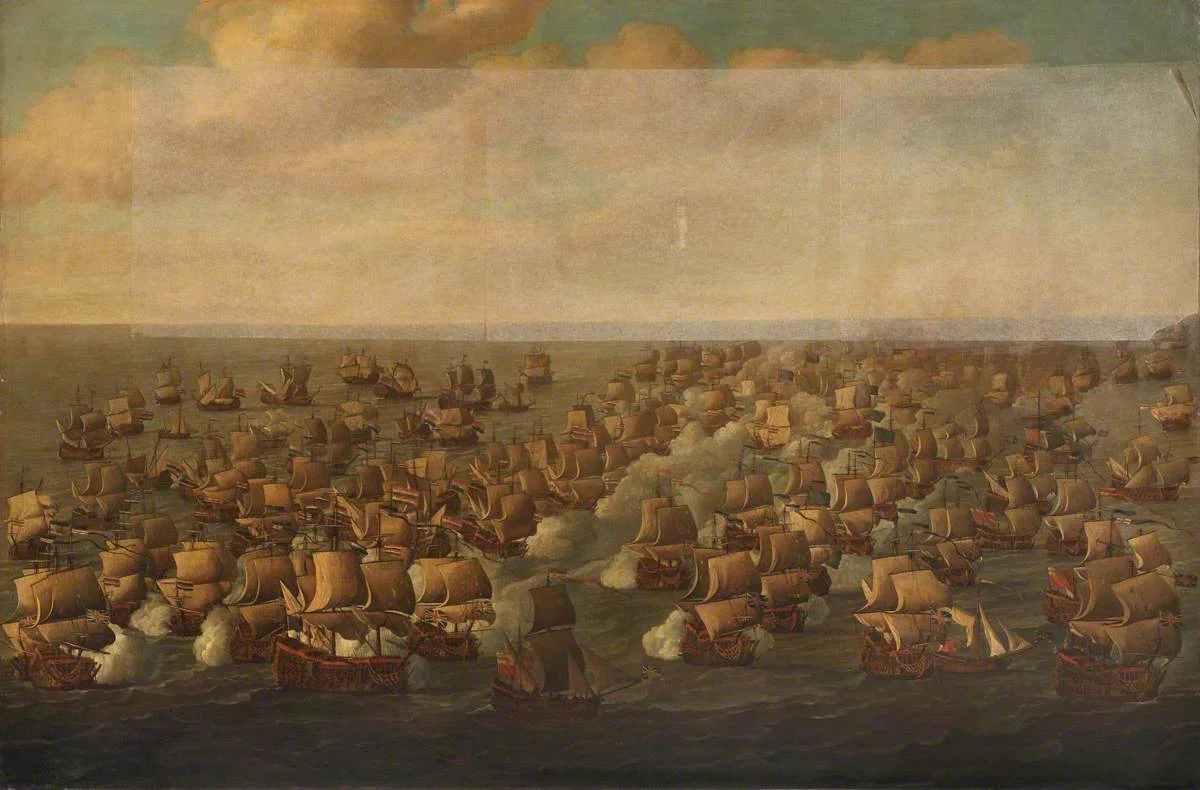
On 7 June 1673, after a false start the previous week, Prince Rupert tried to lever de Ruyter out of the Schooneveld basin between two shoals at the mouth of the Schelde. He detached a fast squadron to cut off the Dutch retreat north. De Ruyter did not retreat. He sailed instead toward the enemy, and the battle began at noon and burned for nine hours. De Ruyter used his knowledge of the shallows to anchor his fleet so close to the shoals that Rupert's heavier English ships could not engage without grounding. When de Ruyter spotted a gap opening between the French center under d'Estrees and Spragge's English rear, he tacked through it and split the allied fleet into four uncoordinated pieces. The French disengaged. Tromp, isolated for hours with the Dutch van, kept up the fiction of signal contact with the rest of the fleet to steady his crews. When de Ruyter finally tacked back to reinforce him, Tromp shouted to his men, There's Granddad. He's coming to help us. I in return shall never abandon him, as long as I can breathe. The old rivalry was, for an afternoon, gone.
The Second Battle
The allies cruised off the Dutch coast for a week recriminating. Spragge wrote that the first battle was as ill fought on our side, as ever yet I saw. Captain George Legge of the Royal Katherine wrote home, that hole is too little and the sands too dangerous for us to venture among them again. They hoped to lure the Dutch out. Instead, on 14 June, de Ruyter came out at them with the wind behind him and they were caught off balance: Spragge had been visiting Rupert's flagship at the moment the Dutch attacked. The allied line dissolved into confusion. Rupert raised the blood flag and lowered it again, unable to organize a coordinated attack. De Ruyter watched in disbelief and shouted, What is wrong with this man? Has he gone mad or what? He stood off and methodically shot away the masts and rigging of Rupert's squadron. The French, attacked by Banckert, disengaged at once. Only Tromp closed with his old enemy Spragge and traded broadsides until darkness.
What the Republic Bought
The French lost two ships in the first battle, and both sides suffered heavy damage, but the damage was severe enough that the allied fleet limped into the Thames for repairs and abandoned the blockade. The Dutch lost one ship, the seventy-gun Deventer, which grounded and sank the night after the first battle. Vice-Admiral Volckhard Schram and Rear-Admiral David Vlugh died in the fighting. What the Republic bought with those lives was a summer. The invasion army of six thousand English soldiers waiting at Yarmouth never sailed. Two months later, de Ruyter fought the same allies at the Battle of the Texel and won again. England, exhausted by a war that was costing it everything and gaining it nothing, withdrew in 1674. Granddad de Ruyter died in 1676 of wounds taken fighting the French off Sicily. A national hero in life, he became a national myth almost before his body was carried home to be buried with state honors in Amsterdam's New Church.
From the Air
Located at 51.43 degrees north, 3.53 degrees east, in the coastal waters of the Schooneveld basin at the mouth of the Schelde estuary, off the southwest coast of Walcheren. The basin lies between the Walcheren shoals and the open North Sea; modern shipping lanes for Antwerp run through what was de Ruyter's battle space. Best viewed from 5,000 to 8,000 feet. Nearest airports: Midden-Zeeland (EHMZ) 12 km east on Walcheren, Antwerp (EBAW) 75 km east, Ostend-Bruges (EBOS) 40 km southwest. North Sea visibility is best on northeasterly winds; westerlies bring frequent low cloud and the same wind direction de Ruyter sailed with on 14 June 1673.
Nearby Stories
- Haamstede Castle 4 km away
- 2017-18 Belgian Second Amateur Division 7.1 km away
- Sugar Factory Zeeland 9.4 km away
- Battle of Wijnendale 9.6 km away
- Prinsenhof, Ghent 11 km away
- Volkerakdam 13 km away
- Second Ostend Raid 26 km away
- Southern Bight 48 km away