
Battle of Wijnendale
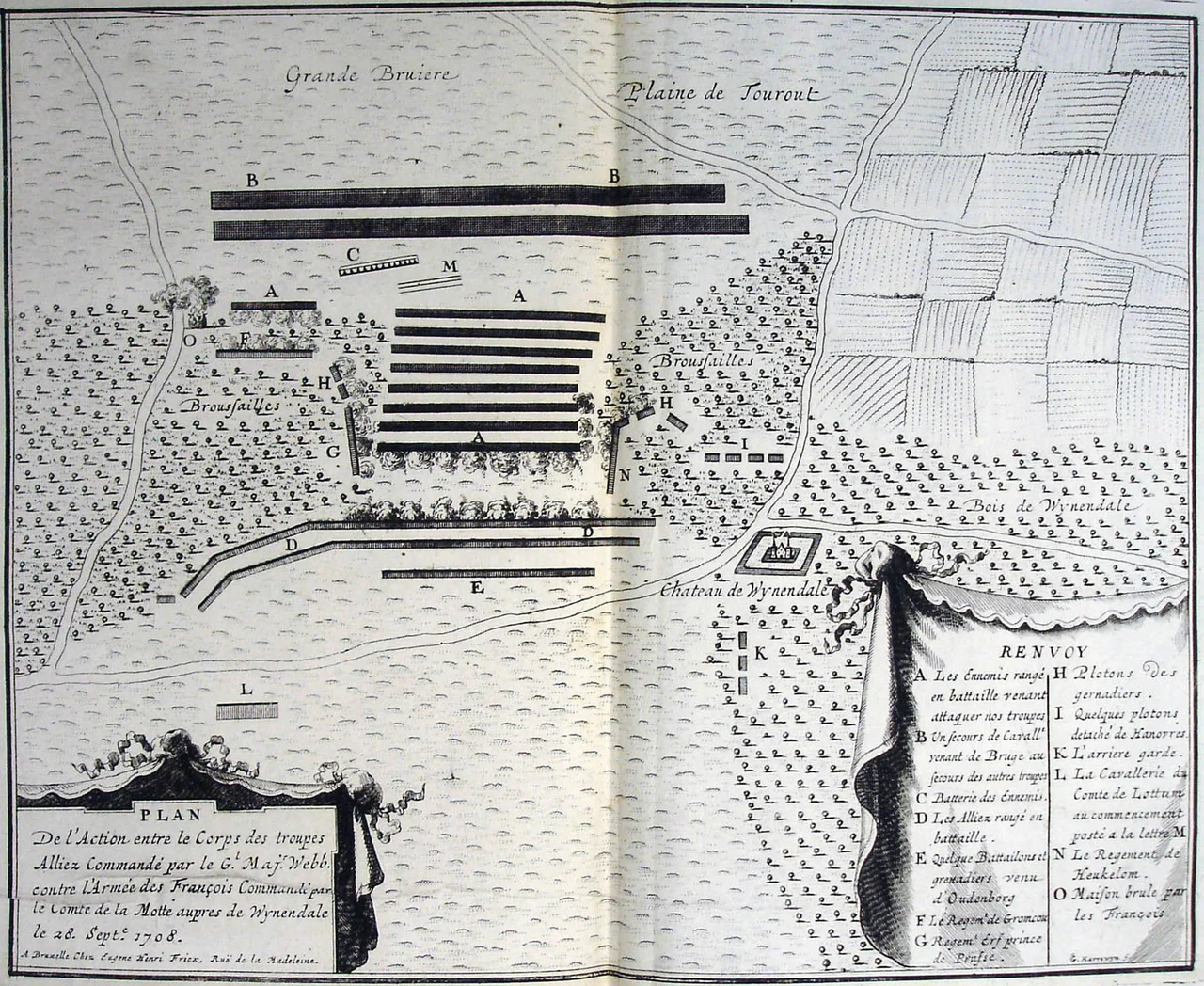
The most important thing on the field at Wijnendale on the afternoon of 28 September 1708 was not the soldiers. It was the wagons - 700 of them, slow and unwieldy, carrying powder and shot and bread, creaking south through the Flemish woods toward the siege of Lille. They had to get through. Marlborough's army, the most successful military instrument in Europe, would otherwise have to lift its siege and admit failure for the only time in a decade of victories. The men who held the bottleneck open were 7,500 British, Dutch, Prussian and Hanoverian troops drawn up among hedges and oaks near the village of Wijnendale, against 22,000 to 24,000 French and Spanish coming up to crush them. Their commander was John Richmond Webb. He had two hours.
The Siege That Was Running Out of Powder
After Oudenarde in July 1708 - the field where Marlborough and Prince Eugene had broken the French in open battle - the Allied generals settled down to besiege Lille. It looked straightforward on a map. Lille was, however, defended by 16,000 men and by the fortifications of Vauban himself, the greatest military engineer of his century, whose star-shaped bastions were designed to soak up siege guns the way blotting paper soaks up ink. The siege went slowly. Worse, the French moved to cut Allied supply lines from the east. With every magazine emptying, only one route remained: ships from England to Ostend on the Channel, then 75 kilometres overland through hostile country to Lille. Marlborough ordered the powder shipped. Seven hundred wagons rolled out of Ostend on slow oxen and slower horses, with 6,000 infantry and 1,500 cavalry as escort. Their commander was Major-General John Richmond Webb, an English Tory of long service and short temper, with Brigadier Cornelis van Nassau-Woudenberg - Lord Overkirk's son - as his second.
Webb's Ground
The French commander in Bruges was the Comte de la Mothe, and he was no fool. Informed of the convoy, he gathered between 22,000 and 24,000 men - three times Webb's force - and marched south to intercept it at the bottleneck around Wijnendale. Webb knew they were coming. He could not outrun them; the wagons saw to that. He could not outnumber them; nobody in Flanders could. So he picked his ground. The country south-east of Ostend was wooded in 1708: oak coppice, hawthorn hedges, narrow open spaces between dense thickets. Webb chose one of those open spaces, flanked left and right by trees so thick that no large force could move through them. He drew up his troops in two long lines across the open ground, closing it like a door. Then he hid Prussian, Hanoverian and Dutch regiments in the woods on both flanks, out of sight of any enemy coming up the road. While he did this, the wagons trundled past behind his lines, southward, slowly, slowly.
150 Cavalry Buying Time
The hard part was time. Webb needed hours to deploy and to let the convoy clear his rear. He got those hours from a small Prussian named Carl von Lottum, who took 150 horsemen and rode out to harass the head of the French column. With nothing but speed and effrontery, Lottum's troopers darted at French patrols, drew off scouts, and prevented La Mothe from getting any clear picture of the ground he was about to fight on. By the time the French commander arrived at the clearing Webb had chosen, he saw what Webb wanted him to see: two thin lines of red and blue infantry across an open field, no flanks visible. La Mothe, expecting an easy victory, deployed his army in the standard fashion and prepared to walk through what looked like a thin and outnumbered screen.
The Two Hours
The French guns opened between four and five o'clock. They did less damage than expected. La Mothe ordered his infantry forward. The huge French force, funnelled by the woods into the narrow open space, met the steady musketry of Webb's first line - and then, at point-blank range, the volley fire of the hidden Prussian, Hanoverian and Dutch battalions on both flanks. Men in tall mitres and tricornes died by the hundreds in the space of minutes. La Mothe attacked a second time. This second wave was stronger, and it bent Webb's first line back. The reserves stiffened, the flanking fire continued, and after two hours the French had taken roughly 3,000 to 4,000 casualties and lost the will to keep coming. They drew off the field. Webb's losses were around 900, most of them from the early artillery. As the smoke cleared, William Cadogan rode up at the head of allied cavalry, sent from Lille by an anxious Marlborough. The fight was already won. The convoy reached Lille intact on 29 September. Three weeks later, on 22 October, the city fell.
Webb and the Whigs
Wijnendale should have been Webb's moment. Instead it became the start of his lifelong grievance. The initial dispatch in the London Gazette credited the victory to Cadogan, who had arrived only at the end. Marlborough's letters to Godolphin, the Lord Treasurer, did praise Webb directly - "chiefly to your good conduct and resolution" - and the Duke included him in promotion lists. Webb still felt slighted. He believed Marlborough had favoured Cadogan, a fellow Whig, over himself, a Tory. Parliament thanked him; Queen Anne wrote him kind words; he was promoted to lieutenant-general the next year. None of it was enough. Webb spent the rest of his career as a centrepiece of Tory agitation against the Marlborough establishment, and his fellow Tory the Duke of Argyll once remarked, after Webb was wounded in the leg at Malplaquet, that the wound had unfortunately been to the wrong limb. The wagons, the powder, the loaves of bread had reached Lille. The city had fallen. And John Richmond Webb, victor of Wijnendale, never quite forgave anyone for not saying so loudly enough.
From the Air
Coordinates 51.09 N, 3.07 E - the wooded country south-east of Ostend, in the municipality of Torhout. Nearest airports: Ostend-Bruges (EBOS) 18 km north-west, Kortrijk-Wevelgem (EBKT) 35 km south, Lille-Lesquin (LFQQ) 65 km south-west. The wooded ridge that Webb defended is still there, though much of it is now farmland. Wijnendale Castle - which existed in 1708 but did not feature in the battle - is the most visible landmark from the air. Best viewed in clear weather from 4,000-10,000 feet.
Nearby Stories
- Fort des Dunes 1.6 km away
- Battle of Messines (1914) 7.3 km away
- Castle of Ronse 8.1 km away
- Vinkt Massacre 8.7 km away
- Battle of Schooneveld 12 km away
- Arques, Pas-de-Calais 13 km away
- Zeebrugge Raid 15 km away
- MV Tricolor 19 km away