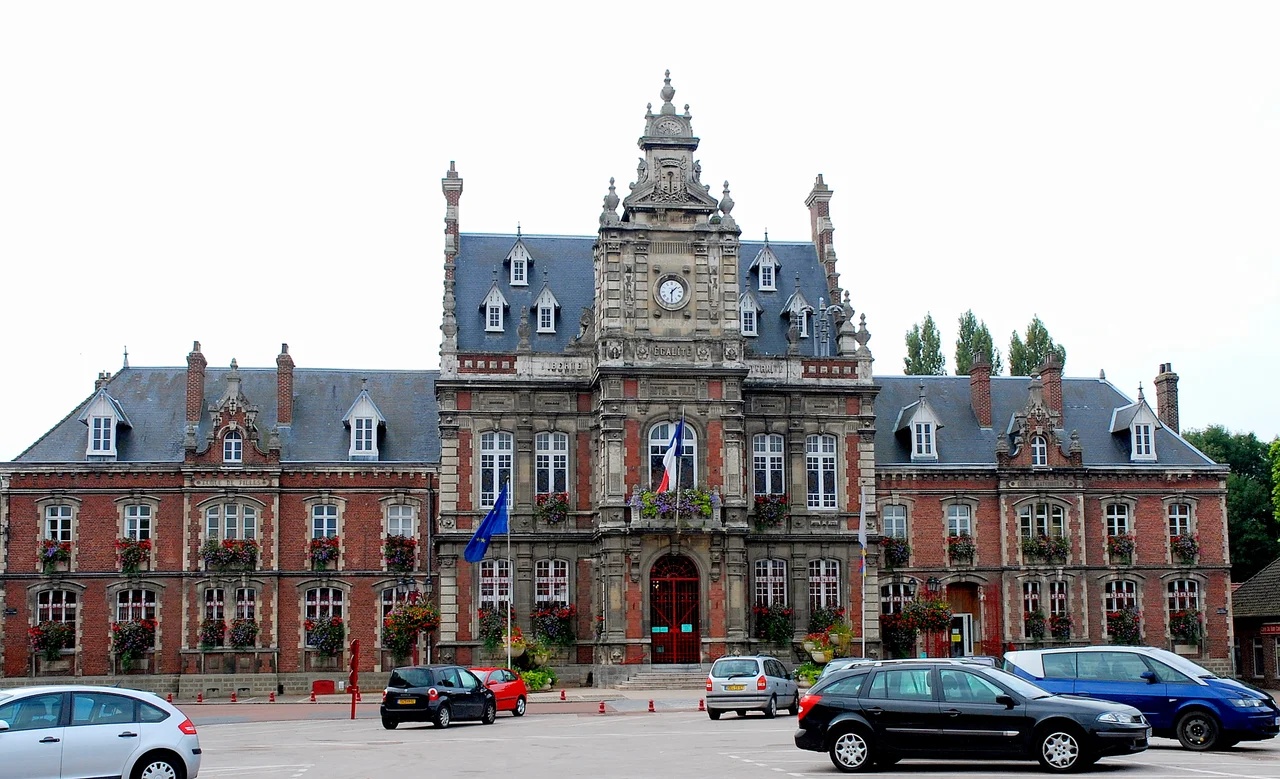

Arques, Pas-de-Calais
Two great machines define Arques. One is the Fontinettes Boat Lift, a hydraulic monster built in 1888 to hoist canal barges thirteen meters up the Neufosse Canal in a few minutes - replacing a chain of five locks that had taken half a day. It worked until 1967, when an even larger lock made it obsolete, and now its iron caisson sits silent in a park, gigantic and orphaned. The other machine is Arc International, headquartered here since the nineteenth century - the largest glassware manufacturer in the world, turning out the tumblers, wine glasses, and dessert plates that probably sit in the cupboards of your relatives. Arques is a small commune squeezed against Saint-Omer, but it has been making things, moving things, and lifting things on an industrial scale for one hundred and fifty years.
The Lift That Carried Barges to the Sky
When the Neufosse Canal was cut in the 1820s to link the Aa to the Lys, engineers had to solve a problem: the land rose more than thirteen meters between Saint-Omer and Aire-sur-la-Lys, and a staircase of five conventional locks at Fontinettes was so slow that barges waited a full day to pass. In 1888, the French built a hydraulic boat lift - effectively a giant elevator for boats. A barge floated into a steel caisson full of water; the caisson was lifted on a single hydraulic ram counterbalanced by another caisson descending. In three minutes a boat climbed thirteen meters. It was a marvel of Belle Epoque engineering, similar in principle to the surviving lifts on the Canal du Centre in Belgium. The Fontinettes lift operated until 1967, when a new lock replaced it. The lift itself remains, preserved as a monument, its caisson empty and its great iron gears still.
The Glass Town
If you have eaten in a French restaurant, you have probably drunk from Arques. Arc International - originally Verrerie Cristallerie d'Arques - was founded in 1825 and turned the town into one of Europe's great industrial centres. At its mid-twentieth-century peak the company employed more than ten thousand people, melting silica and soda ash into the Luminarc and Cristal d'Arques lines shipped across the world. The town's center even features a glass-themed roundabout, and a brewery, La Goudale, has relocated here from Douai to brew alongside the glass furnaces. Arques is a working town where one industry sets the rhythm - shift changes, ovens running through the night, the orange glow of molten glass visible from kilometers away when the wind tilts the steam plume the right way.
A Battle Nobody Remembers
In April 1303, in the angry aftermath of the Battle of the Golden Spurs - when Flemish weavers had butchered the flower of French chivalry at Courtrai - another battle was fought here. The Flemish won again, briefly. Then, in July 1340, the English commander Robert III of Artois razed Arques to the ground on his way to besiege Saint-Omer. The town was rebuilt. Two hundred and ninety-eight years later, in 1638, the French would capture Arques as the first move in a Thirty Years' War siege of Saint-Omer they would ultimately lose. The town sat on the wrong corner of every northern war for five centuries. The lift and the glassworks tell only the calmest layer of its history; under that is medieval blood, and under that, possibly, a Roman harbour that vanished when sea levels dropped.
Marshes and the Audomarois
North-east of the town, the Audomarois marshes spread out across the flatlands of French Flanders - a maze of canals, drainage ditches, and floating market gardens that has been worked since the Middle Ages. The Parc Naturel Regional des Caps et Marais d'Opale stretches from these wetlands all the way to the Channel cliffs. Arques sits at the junction of two worlds: industrial canal, with the lift; rural canal, with the cabbage farmers of the marsh, who until very recently still poled flat-bottomed boats called bacoves through the reeds to bring their produce to market in Saint-Omer. The town is a ville fleurie rated with three flowers, and there is a town walk - the Circuit du Pave - that ties the lift, the chateau, the church, and the canal locks into a single afternoon.
From the Air
50.7356 N, 2.3025 E, immediately east of Saint-Omer. The Fontinettes Boat Lift is the obvious landmark from the air - look for the long, straight Neufosse Canal cutting through the town with the steep grade change at the lift site. The Arc International factory complex is visible by its industrial scale and large flat roofs north of the town centre. Recommended viewing altitude: 1,500 to 4,000 feet. Nearest airport: Calais-Dunkerque (LFAC), 40 km north. Saint-Omer Air Base (LFQN) is 3 km west.
Nearby Stories
- Battle of Armentières 5.6 km away
- Yser Towers 6.8 km away
- Courrieres Mine Disaster 7.1 km away
- Battle of Dunkirk 9.1 km away
- Chateau de Boulogne-sur-Mer 10 km away
- Battle of Dover Strait (1916) 14 km away
- Cléon 136 km away
- Royaumont Abbey 145 km away