_Thames_Estuary_1994.jpg)
MV Tricolor
By 4 January 2003, three different ships had hit the same shipwreck in three weeks, and the world's most heavily policed stretch of saltwater had run out of excuses. The wreck was the Norwegian car carrier MV Tricolor, sunk on 14 December 2002 some 32 kilometres off Dunkirk after a collision with a Bahamian container ship called the Kariba. The Tricolor lay just under the surface in thirty metres of water, in the seam where two lanes of the Dover Strait Traffic Separation Scheme merged. Three guard ships circled her. Lighted buoys marked her ends. Marine radio carried hourly warnings in English, French, Dutch, and German. None of it kept the next ships from running into her.
Two Ships on a Collision Course
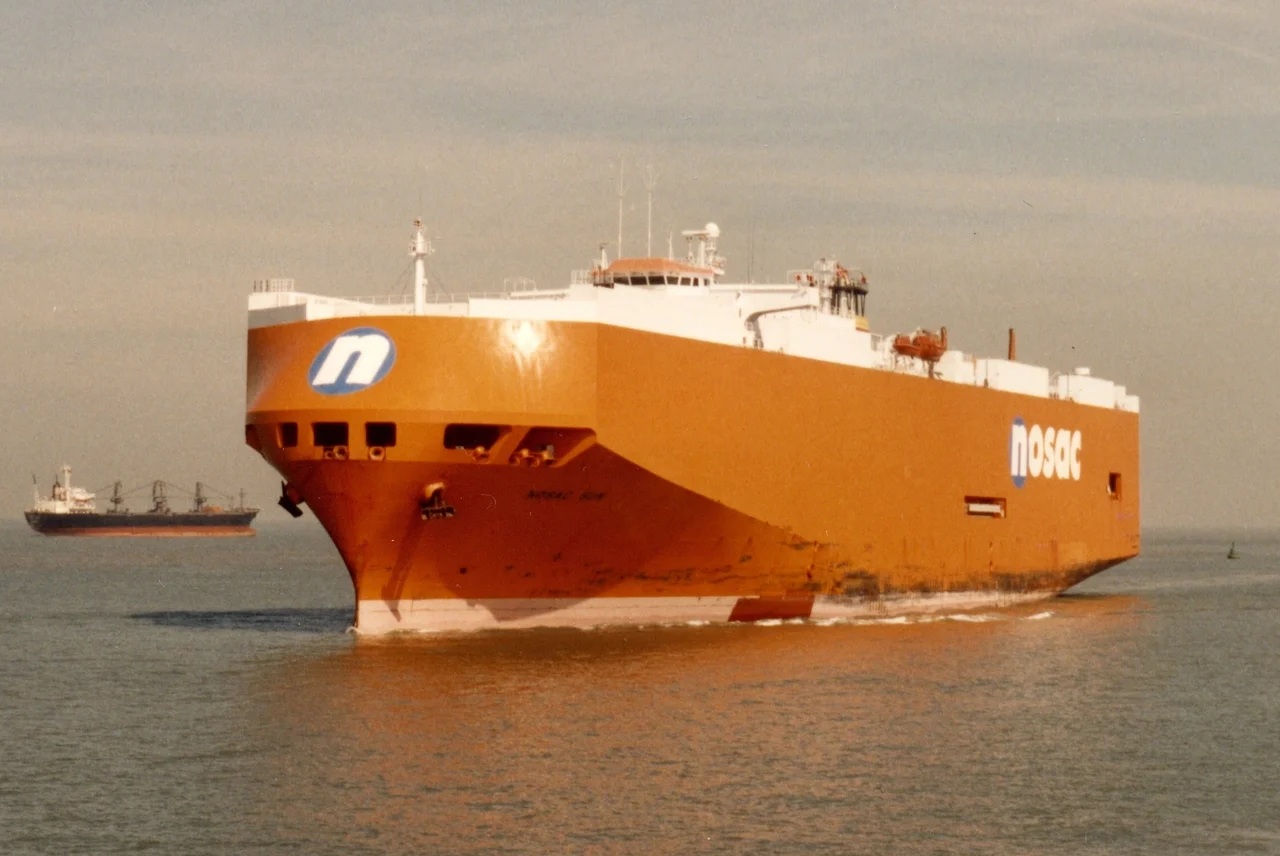
MV Tricolor had launched in 1987 in Fukuyama, Hiroshima Prefecture as Nosac Sun, a 190-metre pure car carrier built to move thousands of vehicles in one trip. By December 2002 she was operated by Wilh. Wilhelmsen of Norway. Just after midnight on 14 December she was heading from Zeebrugge to Southampton with 2,871 brand-new cars in her decks, mostly BMWs, Volvos, and Saabs destined for North American showrooms. Visibility was poor but lawful. Around 02:30, in waters off Dunkirk inside the French exclusive economic zone, the Bahamian-flagged container ship Kariba and the Cypriot bulk carrier Clary were both trying to overtake the Tricolor on opposite sides at the same time. The Kariba, the larger of the two, cut sharply across Tricolor's bow and struck her amidships on the port side. The Tricolor heeled over, took water through her cargo decks, and capsized. She sank where she lay, the top of her hull just under the chop. All twenty-four crew were rescued. The cars were not.
Strike One: The Nicola
French authorities marked the wreck with a guard ship and a buoy and broadcast warnings. Less than twenty-four hours after the sinking, on the night of 15 December, the Dutch coaster Nicola was heading southbound in the same lane. Despite the radio calls and the lighted buoy, she struck the submerged Tricolor and stuck fast on top of her, hull on hull. The Nicola had to be towed clear. The wreck remained where she was. French authorities added two more patrol ships and six more buoys, including one with a radar-reflecting Racon transponder that would show up clearly on the bridge display of any approaching vessel.
Strike Two: The Vicky
On 1 January 2003, eighteen days after the sinking, with three guard vessels on station and seven buoys around her, the Turkish-flagged fuel carrier Vicky struck the wreck. The Vicky was loaded with light oil. She rode up over the submerged hull and grounded on top. The rising tide eventually floated her clear. Investigators afterward could not work out how any officer of the watch on Vicky's bridge had failed to see the multi-buoy warning array, the patrol ship pinging her by VHF, or the radar-transponder return. The answer, it turned out, was a combination of fatigue, miscommunication, and a chart that had not yet been updated with the new hazard. Three ships had now hit a wreck in a stretch of water where 400 vessels pass every day, in some of the most thoroughly monitored shipping lanes on the planet.
A New Buoy for the World
The Tricolor case forced the International Association of Marine Aids to Navigation and Lighthouse Authorities, IALA, to invent something it had been deferring for years: a standardised emergency wreck buoy. The new buoy was alternating blue and yellow, with vertical stripes that no other floating object on the sea would match, flashing in a pattern unique to it. It could be deployed and operational within hours of a sinking, long before chart updates or permanent buoyage could be installed. The Emergency Wreck Marking Buoy, ratified in 2006, is now standard worldwide. The next ship that runs into a wreck despite seeing a blue-and-yellow buoy will have a harder time blaming the marker.
Slicing Up a Car Carrier
The Dutch salvage firm Smit International led the consortium that lifted the Tricolor in pieces. The operation began in July 2003 and finished on 27 October 2004. The technique involved a long carbide-encrusted cutting wire dragged through the steel hull like cheese-wire through a brick, slicing the wreck into nine sections of around 3,000 tonnes each. Smit had used a similar method to recover the Russian nuclear submarine K-141 Kursk from the Barents Sea three years earlier. The cars were beyond saving. Nearly three thousand BMWs, Volvos, and Saabs, crushed and saltwater-soaked, were sent to metal recycling. About 540 tonnes of oil escaped during the salvage, none of it catastrophic but enough to streak the Dunkirk beaches. By the end of 2004 the Strait of Dover was, in theory, back to a normal seabed. The Tricolor became a case study taught in every maritime safety college on earth, and a permanent line in every officer's training: even an obvious wreck, even with three patrol ships and a Racon buoy and four radio frequencies of warning, will still get hit if someone is not watching.
From the Air
Sinking location 51.37N 2.20E, about 32km north of Dunkirk in the French EEZ, at the junction of two Traffic Separation Scheme lanes between the Strait of Dover and the southern North Sea. One of the busiest waterways in the world; hundreds of merchant ships pass per day. Nearest airfields: Calais-Dunkerque (LFAC), Lille (LFQQ), Ostend-Bruges (EBOS). From altitude the shipping lanes are visible as files of moving vessels on the water.
Nearby Stories
- Ten Putte Abbey 8 km away
- Action of 18 February 1639 9.3 km away
- St James's Day Battle 12 km away
- Battle of Dover Strait (1916) 16 km away
- Second Ostend Raid 21 km away
- Battle of the Gabbard 30 km away
- Southern Bight 43 km away
- Maunsell Forts 60 km away