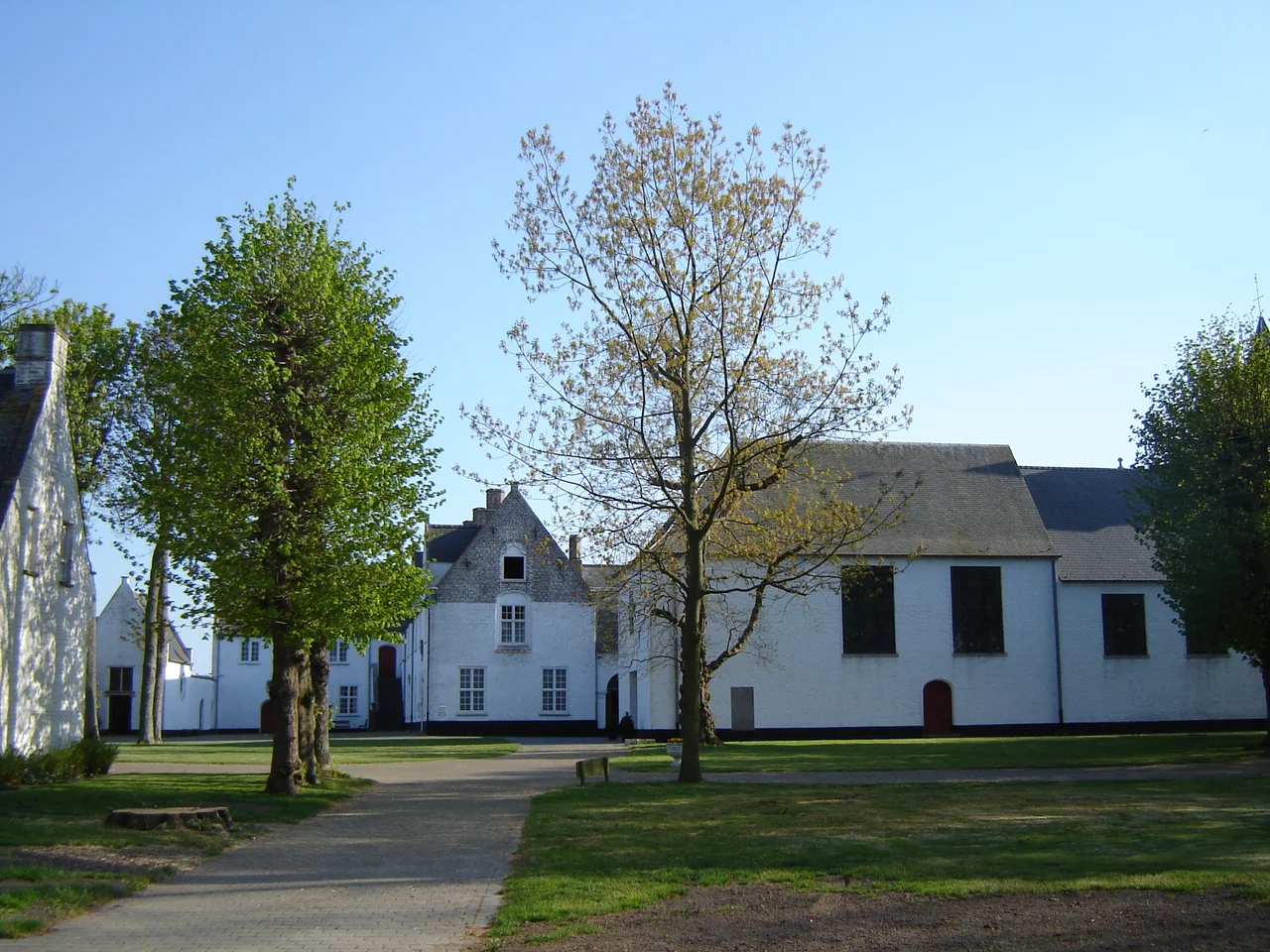

Ten Putte Abbey
Walk into the courtyard of Ten Putte Abbey, eight kilometres south of Ostend, and the first thing you see is a well. It used to be a pond. On a summer night in 1070, two servants of a nobleman named Bertulf of Gistel led his young wife to that pond at the edge of his estate, choked her to death, and threw her body into the water. Her name was Godelieve. She was perhaps twenty-five years old, married against her will to a man who hated her on sight, and she had spent the four years of her marriage in conditions that today we would describe as captivity. The well in the courtyard marks the spot. The monastery around it has stood, in one form or another, for nine hundred years. The women who still come on pilgrimage every July do not all come as tourists.
Godelieve
What is known of Godelieve - the Flemish form of Godelina, sometimes Godeleva - comes mostly from a Latin life written by a monk named Drogo, perhaps thirty years after her death. The outline is brutal and consistent. She was the daughter of a French nobleman, raised piously, married off to Bertulf of Gistel as a political arrangement. From the wedding day onward Bertulf rejected her. His mother is described as despising her. Godelieve was confined, starved, beaten; she eventually fled home to her father; the bishop and the count of Flanders intervened and ordered Bertulf to take her back. He did, formally. He had no intention of changing. On the night of 6 July 1070, while Bertulf made sure he was elsewhere with witnesses, his two servants Lantbert and Hacca took Godelieve to a pond, drowned her - some accounts add strangulation with her own girdle - and laid her body back in her bed to make it look as if she had died in her sleep. The medieval church recognised what it was almost immediately. She was venerated as a martyr within a generation, formally canonised in 1084, fourteen years after her death.
Edith and the Pond
The first abbey was founded sometime between 1137 and 1171 to mark the place where Godelieve died. The traditional story is that the founder was Edith, said to be Godelieve's daughter by Bertulf's later second marriage - born blind, the legend goes, until she washed her eyes with water from the pond where her stepmother (or, in some versions, her mother) had been killed. Edith became the first abbess. The story has problems: there is also a tradition that Godelieve's marriage to Bertulf was never consummated, which would leave no daughter to be a founder. The monastic records simply confirm that a Benedictine community of nuns was established at Ten Putte in the twelfth century. The pond, walled in as a well, has been a pilgrimage site ever since. Pilgrims still draw water from it. Mothers still bring children with eye troubles. The well is unspectacular up close - a stone enclosure, an iron ring, a cool damp smell - but the path of feet around it has been worn for nine hundred years.
Ruin and Return
Ten Putte's history after that is mostly a history of survival. On 12 October 1578, during the religious wars of the late sixteenth century, a band of irregulars - probably Calvinist Geuzen - attacked the abbey and left it in ruins. Only the fourteenth-century tower was left standing. The nuns fled to Bruges, eventually founding a new house there in 1623 in the Boeveriestraat. The Gistel site fell quiet. The abbey church was rebuilt in 1614 and 1615 and became, as it had always been, a pilgrimage destination - especially in early July around St Godelieve's day - but the rest of the buildings sat in ruins through the Eighty Years' War. The French Revolution confiscated what remained. It was not until 1889 that the polymath architect Jean-Baptiste Bethune bought the site and drew up the neo-Gothic plans for a new monastery. On 2 July 1891 the bishop of Bruges consecrated the rebuilt abbey, and twelve nuns moved back in after a 313-year absence. The status of abbey was formally restored in November 1934.
Patroness of Women in Hard Marriages
Godelieve's iconography is unusual. She is shown, almost always, with a rope around her neck - the instrument of her own murder. Her feast day, 6 July, is observed in West Flanders with processions and pilgrimages of women, many of them not casual visitors. Over centuries she has become, quietly, the patron saint of women in difficult marriages and of those fleeing domestic violence. The medieval church understood her death as martyrdom for the faith because, the hagiographers said, her piety was what her husband most hated. The modern reading is simpler and harder: she was killed because she had no power to leave, and the men around her thought they could get away with it. They did, briefly. Bertulf went on a pilgrimage to atone, and is said to have ended his life in a monastery. Lantbert and Hacca disappear from the record. Godelieve became a saint.
What the Visitor Sees
Ten Putte is open to visitors at posted hours. You can see the pond turned well in the courtyard, the small dungeon where the saint is said to have been kept, the chapel of the miracle in which Edith - blind from birth, the story still insists - first opened her eyes. There is a renovated museum about Godelieve's life. The 1891 abbey buildings are Bethune neo-Gothic, dark brick and steep slate. Since 2007 the community has not been Benedictine nuns but brothers and sisters of the Mother of Peace community, a Marian-Christian order founded in 1992 and wearing blue habits. They keep the place quiet, the well clean, the pilgrim paths walkable. Outside the gate the Flemish farmland runs flat to the polders and the North Sea is only an hour's walk away. Inside, every July, women come to a pond where another woman, nine hundred and fifty-five years ago, was killed for being inconvenient. They light candles. They draw water. They go home.
From the Air
Coordinates 51.15 N, 2.93 E - Gistel, in West Flanders, 8 km south of Ostend. Nearest airports: Ostend-Bruges (EBOS) 8 km north, Kortrijk-Wevelgem (EBKT) 50 km south-east. The abbey complex is a clear neo-Gothic cluster of dark brick and slate roofs, immediately south of the village of Gistel; the fourteenth-century tower is the oldest visible element. The polders run flat in all directions; the North Sea coast is just over the horizon to the north-west. Best viewed in clear weather from 3,000-8,000 feet.
Nearby Stories
- Fort des Dunes 1.6 km away
- Battle of Messines (1914) 7.3 km away
- Castle of Ronse 8.1 km away
- Vinkt Massacre 8.7 km away
- Battle of Schooneveld 12 km away
- Arques, Pas-de-Calais 13 km away
- Zeebrugge Raid 15 km away
- MV Tricolor 19 km away