.jpg)
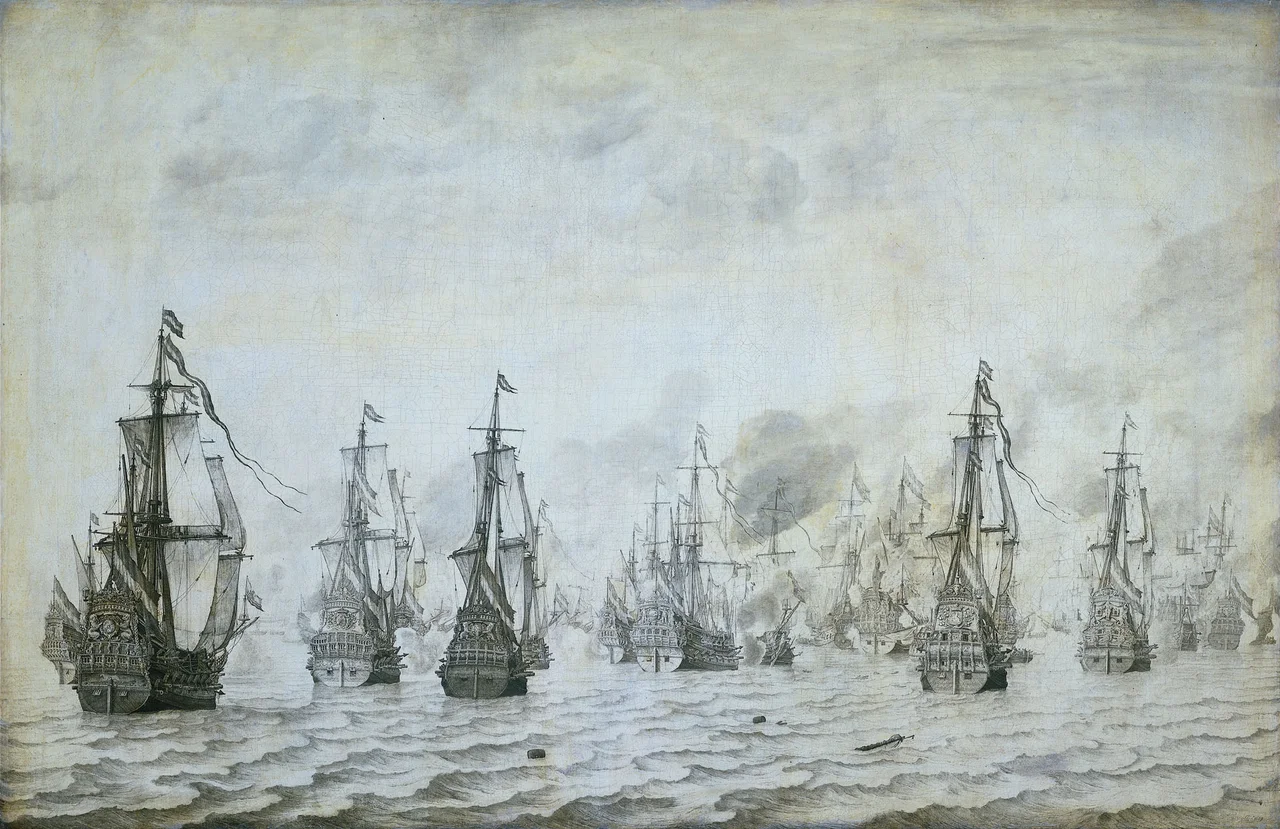
Action of 18 February 1639
Maarten Tromp will win the battle and lose the year. On the morning of 18 February 1639, the Dutch admiral has twelve warships off Dunkirk and orders to keep the Spanish Dunkirk Squadron bottled up in port. By the time the fighting ends four hours later, he has captured two Spanish galleons, run a third aground, and inflicted heavy casualties on the squadron of Miguel de Horna. But his own ships are battered beyond what the blockade can absorb. He has to pull off, regroup, repair. While the Dutch sails recede, De Horna - imprisoned briefly by his own superiors for the loss, then quietly reinstated - patches up the rest of his squadron in Dunkirk harbour. Within months he is sailing those galleons south to join Admiral Antonio de Oquendo at A Coruña. The mission Tromp was supposed to stop will be accomplished on schedule. The tactical victor goes home. The strategic victor leaves port.
Why a Convoy Was Trying to Leave
By 1639, the Eighty Years' War between Habsburg Spain and the Dutch Republic had been running for nearly seven decades. Spain's naval position had worsened steadily. Most of the Armada del Mar Océano had been peeled off to support the Armada de Pernambuco under don Fernando de Mascarenhas, and the Treasure fleets that funded the Spanish war effort were being throttled at Havana and Veracruz by privateers of the Dutch West India Company under Cornelis Jol. Spain badly needed to reinforce its Iberian fleet. Dunkirk - then a Spanish-held port at the centre of the Southern Netherlands - was home to a squadron of *Dunkirkers*: fast, hard-fighting commerce raiders and frigate-galleons that had been a thorn in Dutch shipping for half a century. Miguel de Horna, commanding the squadron, had two tasks. Join Oquendo's fleet at A Coruña; and escort a convoy carrying 2,000 Walloon soldiers south to Spain, where they were needed. The first task required leaving harbour. The second required leaving harbour with a convoy in tow.
The Dutch Squadron Appears
Word of De Horna's plans reached the States-General of the Dutch Republic, which sent Maarten Tromp with twelve warships to intercept him. Tromp arrived off Dunkirk on 17 February. The Spanish attempt to break out came the next day. According to contemporary Spanish accounts, a large number of De Horna's ships ran aground on the shoals at Mardyck, just west of Dunkirk. The Spanish admiral found himself alone in open water with six galleons and two frigates. He set sail anyway and ran westward between the channels - between the sandbanks known as the Brakes and the Splinter - intercepting his own remaining convoy somewhere between Mardyck and Gravelines. Tromp's squadron closed.
Four Hours Between the Sandbanks
The battle that followed lasted about four hours. The terrain favoured neither side: shallow water, narrow channels, the constant risk of running aground in unfamiliar shoals. Tromp's gunnery was effective. Two of De Horna's galleons were captured outright, their decks taken with about 250 prisoners aboard them. A third ran aground while trying to disengage. The remaining Spanish ships cut their way clear and fell back toward Dunkirk. On paper, the Dutch had won handsomely - three enemy vessels lost or out of action, the convoy stopped, the Spanish admiral forced back into port. In practice, many of Tromp's ships had taken heavy damage. The blockading squadron could not be maintained at fighting strength. Tromp pulled off and headed home for repairs.
Punishment and Reinstatement
The Marquis of Fuentes, the Spanish governor responsible for the squadron, blamed De Horna and his vice-admiral Matthys Rombout for the disaster and had both imprisoned. The imprisonment did not last. With Spanish forces stretched thin and competent commanders rarer than punishable ones, Fuentes soon restored De Horna and Rombout to their posts. De Horna repaired the squadron in Dunkirk's harbour, took on what was left of the convoy, and sailed for A Coruña. He added seven galleons to Oquendo's growing fleet: *San José*, *San Vicente*, *San Gedeón*, *Salvador*, *San Juan Evangelista*, *San Martín*, and *San Carlos*. Those reinforcements would matter. Oquendo was preparing for what would become the Battle of the Downs later that year - the major Spanish defeat off the English coast in October 1639, where Tromp would burn or capture most of the Spanish fleet and effectively end Habsburg sea power in the North Sea.
A Footnote With Consequences
The action of 18 February 1639 occupies a small space in most accounts of the Eighty Years' War, overshadowed by the Downs eight months later. But it is worth looking at on its own terms. It is a battle in which both commanders did their jobs well, and in which the rules of the war they were fighting were unsentimental about results. Tromp won the engagement and could not stop the strategic outcome. De Horna lost ships and men, was disgraced briefly, was reinstated when the system needed him, and accomplished the mission anyway. Beneath the Dutch ships sailing home and the Spanish convoy sailing south, the sandbanks off Dunkirk - the brakes, the Splinter, the Braak Sands that would still be there to entangle a British raid 161 years later - waited unchanged. The shoals do not care about strategy. The convoys, the frigates, the Dunkirkers and their pursuers all eventually leave. The harbour goes on.
From the Air
The action took place at sea between Mardyck and Gravelines, west of Dunkirk, in the shallow approaches off the Flemish coast at roughly 51.10°N, 2.39°E. From the air at low altitude the shoal pattern is still visible at low tide - pale banks running parallel to the coast. Nearest airfields today: Calais-Dunkerque (LFAC) 25 km west; Ostend-Bruges (EBOS) 55 km northeast. Recommended viewing altitude 2,000-3,500 ft offshore on a clear day with a low sun to bring out the sandbanks underwater.
Nearby Stories
- Mines in the Battle of Messines (1917) 4 km away
- Yser Towers 4.6 km away
- Abbey of Saint Bertin 5.8 km away
- MV Tricolor 7.2 km away
- Battle of Dover Strait (1916) 11 km away
- St James's Day Battle 12 km away
- Chateau de Boulogne-sur-Mer 13 km away
- Zeebrugge Raid 27 km away