
Mines in the Battle of Messines (1917)
At ten past three on the morning of 7 June 1917, the British artillery went quiet. The bombardment that had hammered Messines Ridge for days simply stopped, and in the silence that followed, men in the British trenches heard a nightingale. Then the world below the German front line came apart. Nineteen mines, packed and tamped over two years by British, Canadian and Australian tunnellers, fired within the space of twenty seconds along a fourteen-kilometre arc south of Ypres. The blast was heard in London. The shock wave registered as an earthquake at the Lille University geology department, sixty kilometres away. Beneath the soft Flanders clay, in the moment before the fuses reached their charges, thousands of young German soldiers were standing their watch.
Two Years in the Blue Clay
The scheme began on a piece of paper in September 1915. Brigadier George Fowke, the British Expeditionary Force's engineer-in-chief, proposed to dig under the Messines roads and detonate the ridge from below, an idea inspired by the civilian tunnelling engineer John Norton-Griffiths. Approval came on 6 January 1916, and the sappers went down into a layer of blue clay that lay below the Flanders water table, where the spoil could be hidden in sandbags painted to match the trench parapets. The galleries belonged to the 171st, 175th and 250th Tunnelling Companies of the Royal Engineers, the 1st and 3rd Canadian Tunnelling Companies, and the 1st Australian Tunnelling Company. Military geologist Edgeworth David, the same Edgeworth David who had reached the South Magnetic Pole with Shackleton in 1909, planned the underground geometry. The tunnellers worked in candlelight, listening with stethoscopes for German counter-miners coming the other way. Sometimes the two sides came within a few metres of each other in the dark.
The Boys at Their Watch
Above the chambers, the men of the German XIX (2nd Royal Saxon) Corps held a front-line system that their own officers had begun to suspect was doomed. Oberstleutnant Füßlein, the German mining commander, reported on 10 May 1917 that the British had probably loaded large mines at Hill 60, Caterpillar, St Eloi, Spanbroekmolen and Kruisstraat. Colonel Fritz von Lossberg, the Western Front's most experienced defensive tactician, urged Berlin to pull the troops back before the offensive began. Army Group Headquarters told him the decision rested with the local commanders, and the local commanders chose to hold. The Saxons who manned the trenches that night were conscripts, farm boys from the villages east of Dresden and clerks from Leipzig, mostly in their late teens and early twenties. They had been told that the British mine danger was a remote possibility. They were sleeping, brewing coffee, writing letters home, standing sentry duty in the cold dawn.
Twenty Seconds
General Sir Charles Harington, Plumer's chief of staff, told the press on the evening of 6 June: "Gentlemen, we may not make history tomorrow, but we shall certainly change the geography." At 3:10 a.m. the fuses reached the charges. The Spanbroekmolen mine, ninety-one thousand pounds of ammonal at the end of a gallery 1,710 feet long, opened the Lone Tree Crater, seventy-six metres across and twelve metres deep. At Hill 60 and Caterpillar, two charges of 53,300 and 70,000 pounds tore the railway-cutting spoil heaps apart. Witnesses described pillars of fire rising into the dawn. Strange acoustic effects added to the panic: German troops on Hill 60 thought the explosions were happening behind them, under Messines village. The historian Simon Jones, working from primary sources, has estimated the immediate dead at no more than 500 German soldiers, with 7,344 taken prisoner in the hours that followed. Whatever the exact figure, an entire generation of village families across Saxony received the same letter that summer.
What the Earth Kept
Twenty-one mines had been charged in total. Two were abandoned: La Petite Douve Farm, found by German counter-miners in August 1916, and Peckham 2, lost to a tunnel collapse. Four more, the Birdcage group near Le Pelerin, were not fired on 7 June because the Germans on that section had quietly withdrawn the day before. The British command saw no reason to set them off, and the war moved on. One of the Birdcage charges detonated on 17 June 1955, when lightning struck a power-line pylon above the field. A cow was killed; no one else was hurt. The last unexploded mine, somewhere between 22,000 and 50,000 pounds of ammonal under what is now a Belgian cow pasture, remains live. The Belgian authorities know roughly where it is. They have decided to leave it alone.
Standing on the Craters
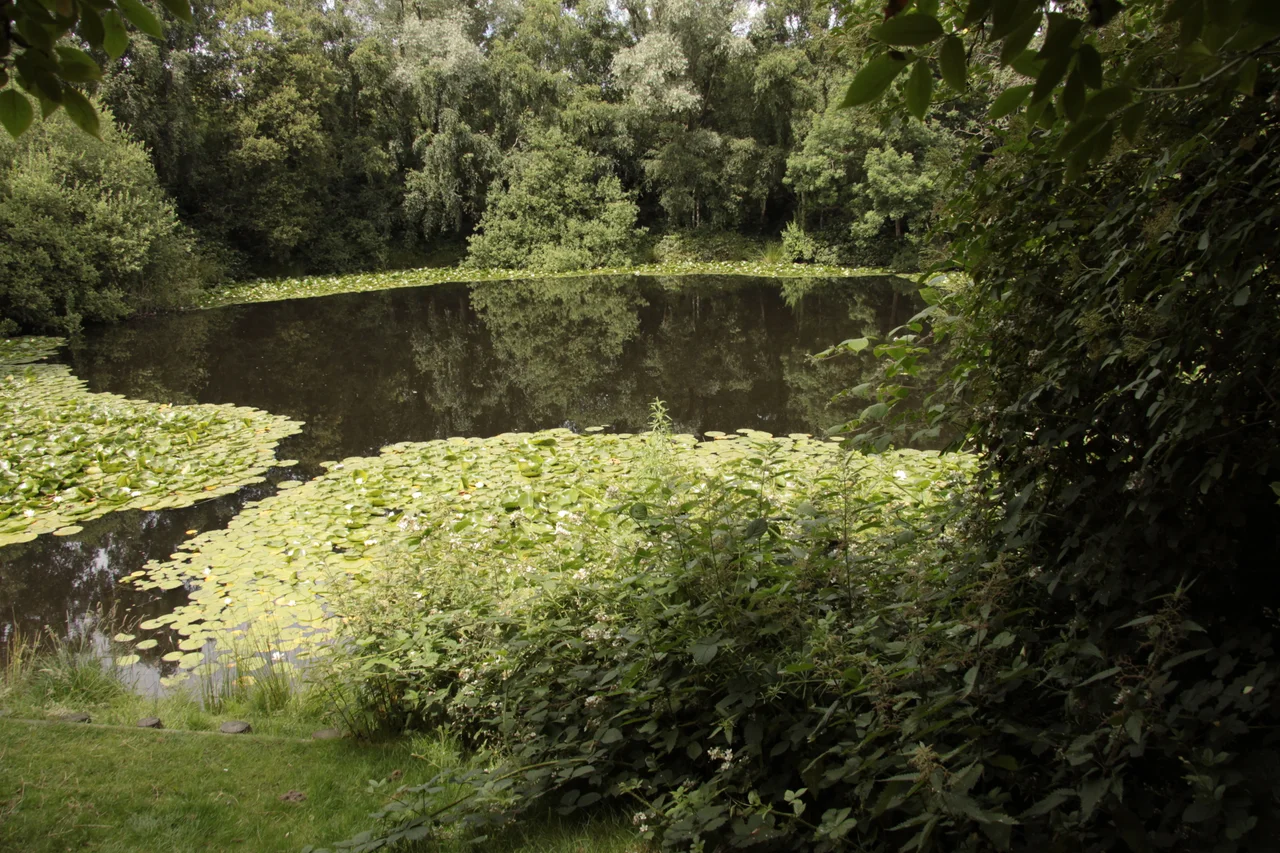
Two days after the battle, General Maximilian von Laffert, commander of Gruppe Wijtschate, was sacked. He died of a heart attack eleven days later. The German official history later placed the Messines mines second in its list of reasons for the defeat. In 1929, Hermann von Kuhl, who had argued for a pre-emptive withdrawal, called the decision to stand and fight "one of the worst tragedies of the war." Today the craters are quiet. The Lone Tree Crater at Spanbroekmolen is a pond fringed by hawthorn. Walking the rim, you can see Wytschaete on the ridge and the spire at Mesen beyond. The flat green fields between are exactly what changed geography looks like a hundred years later, with the bones of Saxon teenagers folded into the clay below.
From the Air
Located at 50.79N, 2.87E, on the low ridge between Mesen (Messines) and Wijtschate (Wytschaete) in West Flanders, Belgium. View from 3,000-4,000 ft AGL: the chain of mine craters runs roughly north-south, with the Lone Tree Crater at Spanbroekmolen the largest visible water-filled depression. Nearest airport is Wevelgem (EBKT), 18 km north-east. Kortrijk-Wevelgem and Lille-Lesquin (LFQQ, 30 km south) handle most regional traffic. Open agricultural terrain, low ridge tops the area at 80 m. Often hazy in summer; clearest views in winter low light.
Nearby Stories
- Museum van Deinze en de Leiestreek 0.9 km away
- Castle of Ronse 6.7 km away
- Hooglede German War Cemetery 7.4 km away
- Courrieres Mine Disaster 7.4 km away
- Dunkirk Memorial 7.8 km away
- Arques, Pas-de-Calais 11 km away
- Marcinelle Mining Disaster 66 km away
- Royaumont Abbey 145 km away