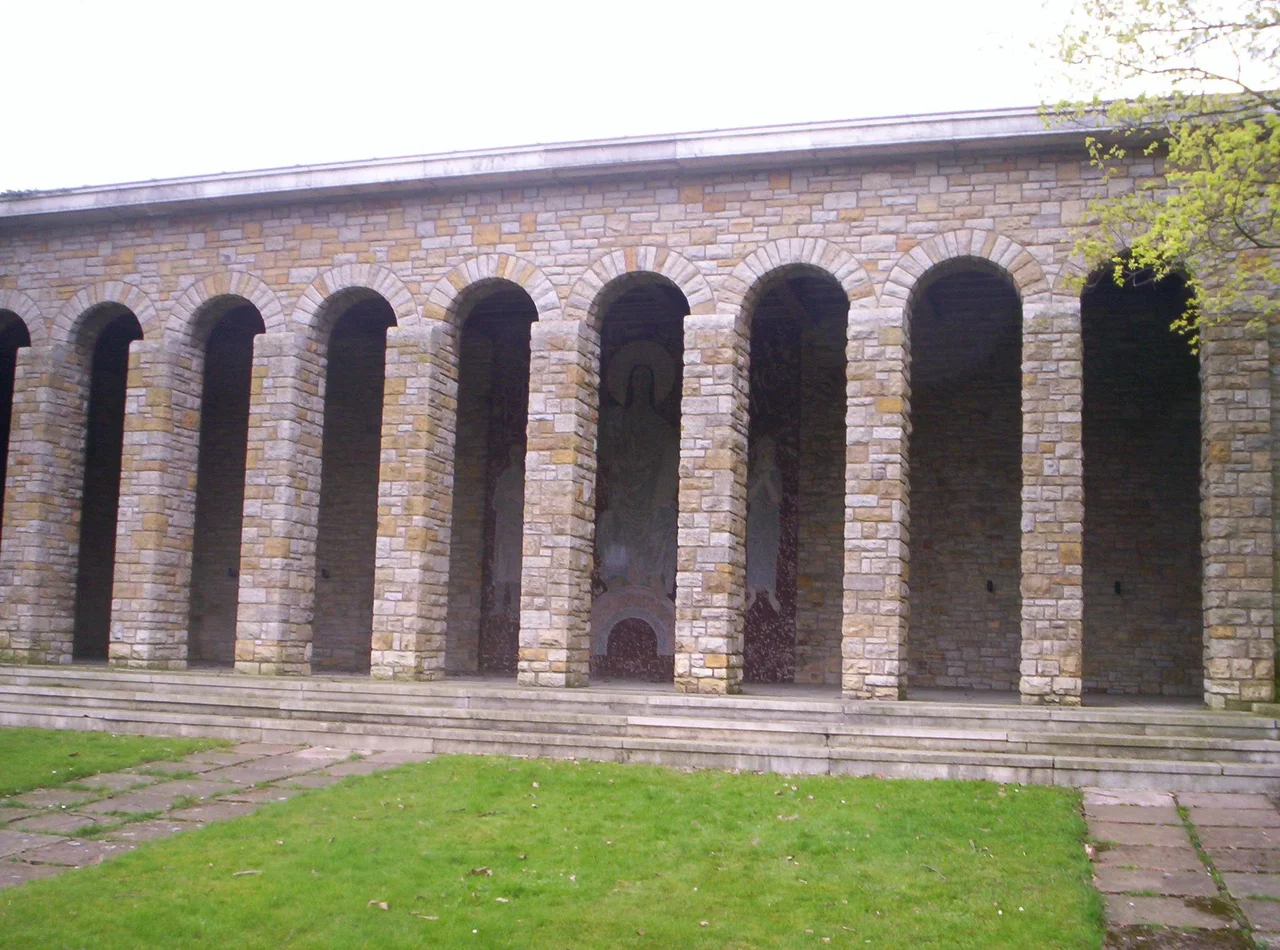

Hooglede German War Cemetery
There are no white crosses at Hooglede. There were once, but they were taken away in the late 1950s and replaced with dark flat stones set close to the earth, so that the cemetery now reads less like a battlefield and more like a long, patient sentence pressed into the grass. Eight thousand two hundred and forty-seven young Germans lie here, six kilometres northwest of Roeselare, in soil their armies seized in October 1914 and gave back four years and ten million European deaths later. Most of them never came home. Their families, after the wars, were sometimes still embarrassed to admit they had ever wanted them to.
October 1914
The Germans arrived in Hooglede on 19 October 1914, during the first weeks of the war that everyone had promised would be over by Christmas. They were on their way south to the Yser, where the Belgian army was about to open the sea sluices and turn the whole coastal plain into a shallow, salty swamp full of corpses. Many of the men buried at Hooglede died in that battle, or in the brutal exchanges that followed at Diksmuide and along the railway embankment - reservists and conscripts, mostly, fathers from Westphalia and farmworkers from East Prussia, soldiers who had been told they were defending Germany and who, by the time they understood the shape of what was actually happening, were already dead. By 1917 the village graveyard could no longer hold them, and a new cemetery opened along the Beverenstraat to absorb the overflow.
The Long Aftermath
After the French liberated Hooglede in 1918, about 4,100 German soldiers were already buried in its soil, and more kept arriving for decades. Between 1956 and 1958, the German War Graves Commission gathered scattered graves from 128 small cemeteries across Belgium and consolidated them into four places in Flanders: Langemark, Vladslo, Menen, and here. The renovation of 1957-58 reduced the entrance arches of the chapel to nine and replaced the crosses with the dark flat markers you see today. The change was deliberate. Germany after the Second World War could no longer mourn its First World War dead the way it once had - too much had happened in between - and the cemeteries, by necessity, became quieter, less heroic, more honest about grief.
A Chapel of Borrowed Stone
The small memorial hall at the heart of the cemetery, the Gedenkhalle, was built in 1937 from stones taken from a German pavilion at the Paris World Exhibition. There is something quietly bitter about that detail. A pavilion built to show the world what Germany had become in the 1930s, dismantled and shipped to Flanders, became a chapel for the boys Germany had sent out a generation earlier. Then the Second World War came and twenty-nine more Germans were buried at Hooglede before being moved elsewhere. The Belgian organisation Nos Tombes cared for the cemetery until 1954, when the Volksbund Deutsche Kriegsgräberfürsorge took over the work that two world wars had handed it.
Smaller Than Langemark
Hooglede is one of the four main German cemeteries in Flanders, but it is the least visited. Langemark draws the buses and the school groups. Vladslo has Käthe Kollwitz's grieving parents kneeling in the grass, sculpted from the artist's own loss of her son Peter. Menen has the bulk - 47,000 names. Hooglede has its own quality, which is harder to describe. The trees lean in. The dark stones sit so close to the earth that from a few metres away you stop seeing them as graves and start seeing them as a pattern in the lawn. In 2008 the Belgian heritage office formally classified the cemetery as a historical monument for its architectural and cultural value. It is, in the end, a place that asks nothing dramatic of you. It only asks that you walk slowly.
Reconciliation Among the Graves
The Volksbund operates youth camps here under a phrase that translates, plainly, as 'reconciliation among the graves, work for peace.' Teenagers come from across Germany and from neighbouring countries to weed, clean stones, and learn what their great-great-grandparents' generation did to itself. Reconciliation is the right word for Hooglede. The men buried here did not choose the war; their grandchildren did not start it; their great-grandchildren now stand in the same grass with French and Belgian and British students and try, mostly without speeches, to make something of it. The cemetery is built for that, not for triumph. Flat stones, dark grass, low chapel, the rain coming in off the North Sea. Eight thousand two hundred and forty-seven names that history mostly forgot, kept by a country that is no longer the country that sent them.
From the Air
50.978°N, 3.094°E, near Hooglede in West Flanders, 6 km northwest of Roeselare and roughly 30 km south of Bruges. Cruise at 2,000-3,000 ft for the best view of the cemetery's wooded enclosure off the Beverenstraat. Nearest airports: Ostend-Bruges (EBOS, ~30 km northwest) and Kortrijk-Wevelgem (EBKT, ~30 km south). Flat Flemish farmland in all directions; visibility usually good except for North Sea drizzle.
Nearby Stories
- Fort des Dunes 1.6 km away
- Battle of Messines (1914) 7.3 km away
- Castle of Ronse 8.1 km away
- Vinkt Massacre 8.7 km away
- Battle of Schooneveld 12 km away
- Arques, Pas-de-Calais 13 km away
- Zeebrugge Raid 15 km away
- MV Tricolor 19 km away