
Feyenoord
Geen woorden maar daden. No words, just deeds. The motto belongs to Rotterdam itself, but no institution embodies it more completely than Feyenoord. While Amsterdam's Ajax built a reputation on flowing artistry and continental sophistication, the football club in Rotterdam-Zuid took the harder path: it was the dockworkers' team, founded in a pub in 1908 by men who poured their wages into a club named after their neighbourhood. When that club finally took on the giants of European football in 1970, it didn't just win. It became the first Dutch side ever to lift the European Cup, beating Glasgow Celtic in Milan and rewriting what Dutch football could be.
Born in a Pub
On 19 July 1908, a small group gathered in a pub called De Vereeniging in the south Rotterdam district of Feijenoord and founded a football club. They called it Wilhelmina, then SW, then Hillesluis, before finally settling on the name of the neighbourhood itself: SC Feijenoord. The early colors were blue-sleeved red shirts with white shorts. By 1912, when the club joined the national football association, those had given way to the iconic split red-and-white halves with black shorts the team still wears today. The choice of name mattered. Other Dutch clubs took the names of cities or aristocratic patrons. Feyenoord took the name of a working-class quarter on the south bank of the Nieuwe Maas, and it became a club for the people who lived there: stevedores, shipyard workers, the families of the men who built and unloaded the ships that made Rotterdam Europe's largest port.
The Golden Decade
The 1960s arrived, and with them the greatest team Rotterdam had ever produced. Coen Moulijn dribbled along the left flank with feet that seemed too quick for any defender; Willem van Hanegem orchestrated the midfield with a left foot that became proverbial; Swedish striker Ove Kindvall scored the goals. Under coach Ernst Happel, Feyenoord won the Eredivisie in 1969, then walked into the 1969-70 European Cup and won that too, beating Celtic 2-1 in extra time at Milan's San Siro on 6 May 1970. They became the first Dutch club to win the trophy. Months later, in the Intercontinental Cup against Argentina's Estudiantes, midfielder Joop van Daele scored the winning goal in Rotterdam, only to have an Estudiantes player rip his glasses from his face and stamp on them in fury. "You are not allowed to play with glasses," the player said, "at least not in South America." Feyenoord were now world champions. The Dutch had arrived.
De Kuip
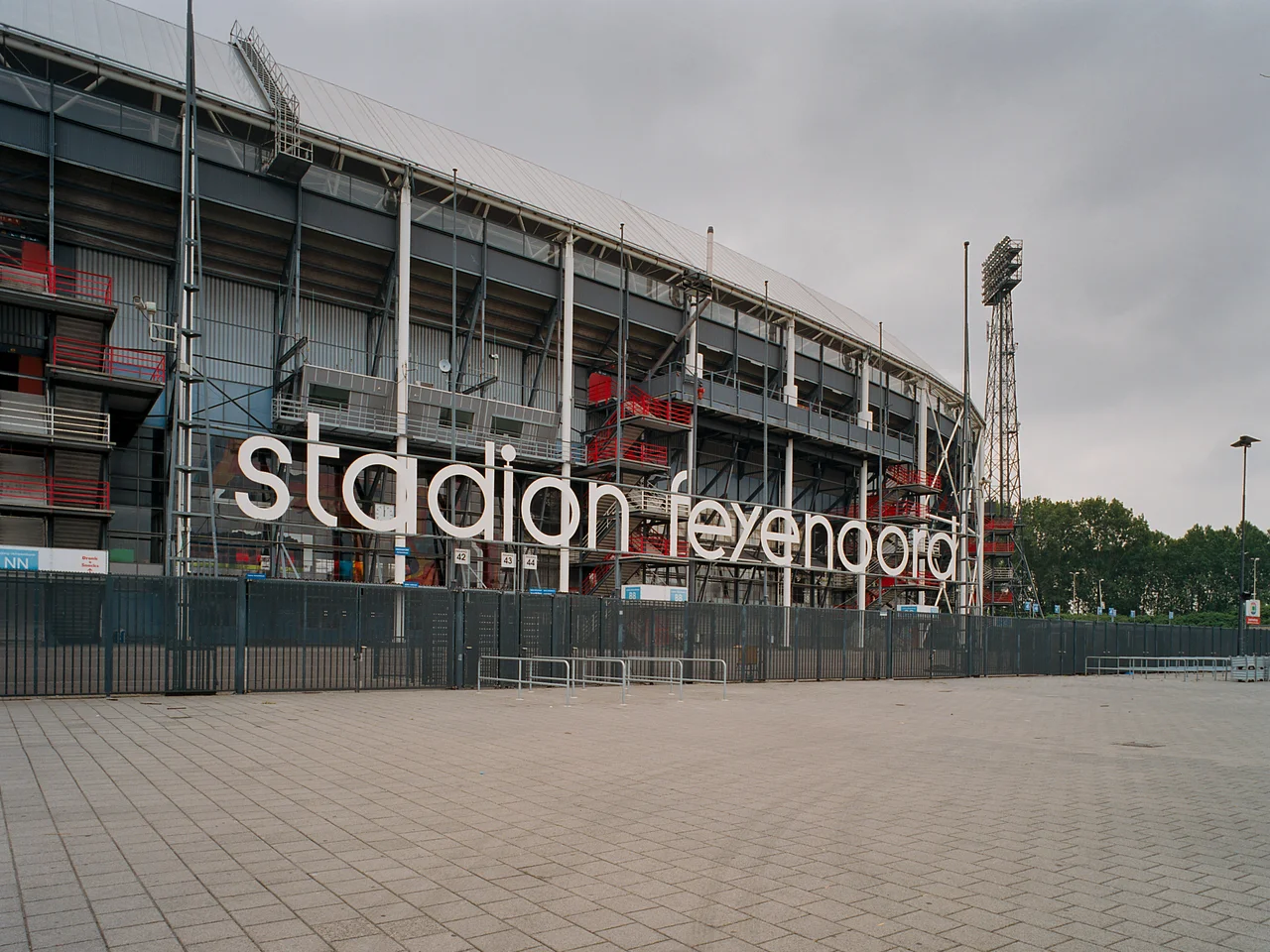
South of the river, just across from where the freighters dock, sits the stadium that gave the club its character. Officially the Feijenoord Stadion, everybody calls it De Kuip - The Tub - for the way the steep concrete tiers wrap around the pitch like the walls of a wooden bath. It opened in 1937 and has hosted more UEFA finals than any other stadium in continental Europe. The 51,117 seats sit closer to the touchlines than at almost any modern arena, which is exactly why visiting players have spent decades describing the place as terrifying. Former striker Mike Obiku put it simply: "Every time you enter the pitch, you're stepping into a lion's den." Plans for a sleek new stadium have come and gone for two decades - Feyenoord City, a 65,000-seater, was officially abandoned in 2022 - and many supporters were quietly relieved. De Kuip is not a stadium they want to lose. It is the soul of the club poured into concrete.
De Klassieker
Twice or more each year, Feyenoord play Ajax, and the country stops. They call the fixture De Klassieker - The Classic - and it is not really about football. It is about Rotterdam against Amsterdam, port against canal city, manual labour against merchant wealth, brusque against urbane. When the canals froze in 1953 and Amsterdam celebrated, Rotterdam shoveled snow off the docks. When the Luftwaffe levelled Rotterdam's medieval centre in May 1940, Amsterdam emerged from the war architecturally intact. These wounds and resentments live on in the singing inside De Kuip. The rivalry has produced moments of brilliance - Feyenoord's 6-0 demolition of Ajax in April 2024, the biggest Eredivisie defeat in Ajax's history - and moments of shame, including riots and bans that have shadowed both clubs for decades. But it has also produced loyalty. The supporters call themselves Het Legioen, The Legion. Squad number 12 is never assigned to a player. It belongs, permanently, to them.
The Long Wait, and the End of It
After Ernst Happel and the golden era, the trophies grew rarer. The 2002 UEFA Cup final, played at De Kuip against Borussia Dortmund, gave the club one more night of European glory - Pierre van Hooijdonk's penalty and free kick and a 3-2 win on home turf, in front of fans still grieving the recent murder of Rotterdam politician Pim Fortuyn. Then came eighteen seasons without a league title, a wandering of managers and financial near-disasters and several Eredivisie campaigns that ended in disappointment. The drought finally broke in 2017 under manager Giovanni van Bronckhorst, with captain Dirk Kuyt scoring a hat-trick against Heracles on the final day to clinch the championship. Six years later, Arne Slot's relentless attacking side won it again in 2023 before Slot himself was hired by Liverpool. The club still chases the ghosts of 1970, of Moulijn and Van Hanegem and Kindvall, but with each new season Het Legioen returns to De Kuip and sings Hand in Hand, the hymn since 1961, and the city of deeds raises its scarves once again.
From the Air
Feyenoord and De Kuip are located at 51.89°N, 4.52°E in the Feijenoord district of southern Rotterdam, on the south bank of the Nieuwe Maas. Best viewed from cruising altitude on approach into Rotterdam The Hague Airport (EHRD), about 8 km north-northwest. Amsterdam Schiphol (EHAM) is roughly 60 km north. From the air, De Kuip is unmistakable: an elliptical bowl just east of the Erasmus Bridge and the Rotterdam skyline.
Nearby Stories
- European Cooperation for Space Standardization 2.2 km away
- Operation Pheasant 5.6 km away
- Dutch Language 8.3 km away
- Moerdijk 9.9 km away
- Amsterdam University Medical Center 10 km away
- Delta Works 11 km away
- HMS Cressy 14 km away
- Moermond Castle 24 km away