
Westfries Museum
On the night of 9 January 2005, while the staff in Hoorn were preparing to celebrate the Westfries Museum's 125th anniversary the next morning, four men slipped inside, walked through 25 galleries hung with Golden Age paintings, and walked out with 24 of them, plus most of the silver collection. Some of those paintings would surface in Ukraine in 2016. Another would appear in a Kraków apartment in 2024. The rest, including a Jan van Goyen from the master's youth, are still missing. The museum closed for renovation in 2023 and is rebuilding its foundations from below. Somewhere in the world, the missing pictures still hang on someone's wall.
The Building Itself
Before the museum, the building was government. Roode Steen 15 was the meeting house of the Gecommitteerde Raden van West-Friesland en het Noorderkwartier - the regional council that managed the affairs of West Friesland and the northern quarter under the States of Holland. Completed in 1632, with a stepped facade of brick and pale stone trimmed by carved coats of arms, it was the kind of architecture that announced civic confidence to anyone arriving by ship. Hoorn was, in those years, a power on the inland sea. The Dutch East India Company kept a chamber here. The herring fleet, the whaling fleet, the merchant ships of the Zuiderzee all knew this skyline. After the council moved on, the building became a court. Until 1932, half of it dispensed justice while the other half displayed history. The museum took over the whole thing eventually, and in 1953 someone went looking under the floors and found 15th-century cellars no one had remembered were there.
The Heist on the Anniversary
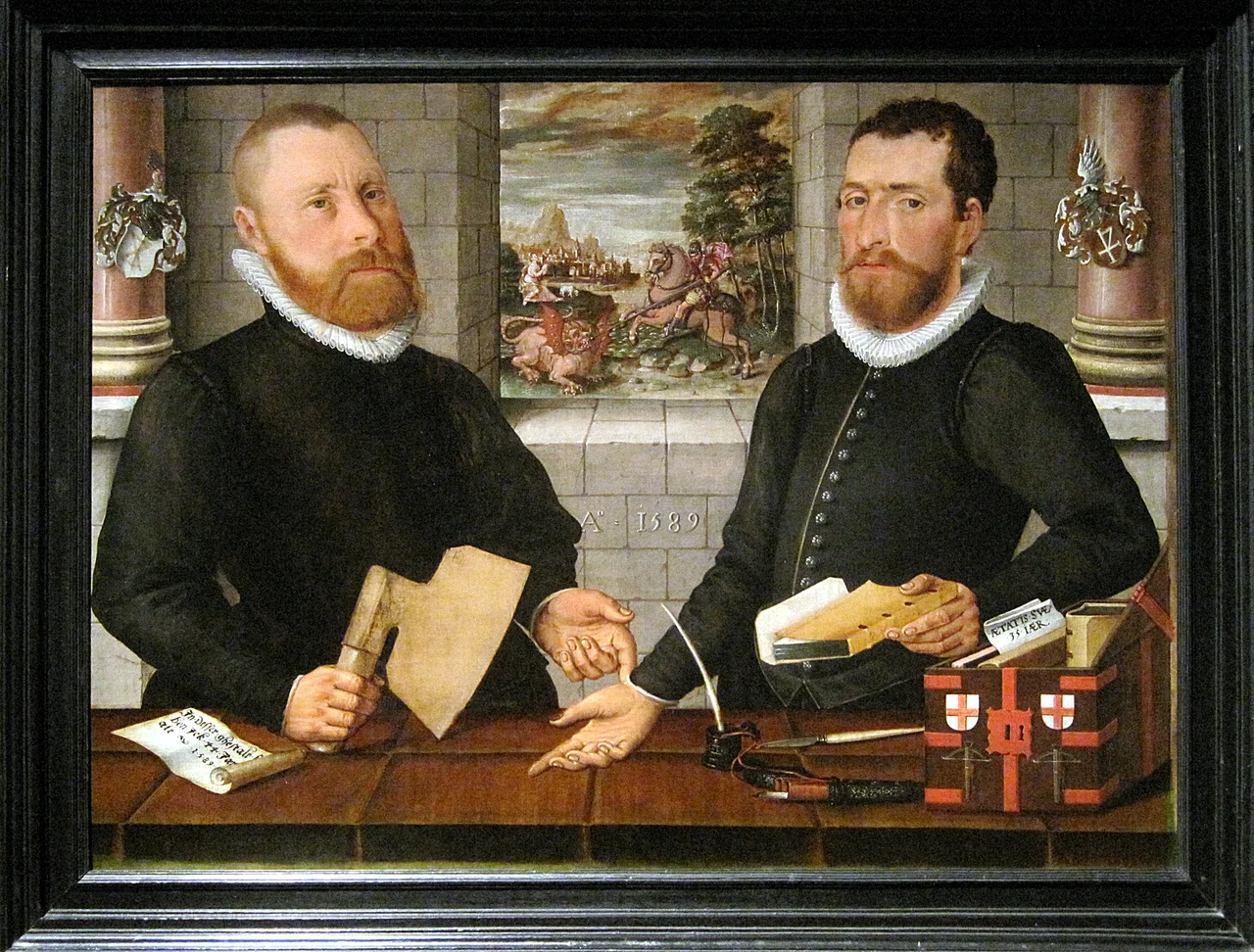
Begin with the timing. The museum was throwing itself a 125th birthday party on 10 January 2005. The night before, four people entered the building and removed twenty-four paintings from the walls of twenty-five rooms - works that had been in the collection for generations - along with a substantial portion of the silver. The total value ran into the millions of euros. One of the stolen paintings was an early Jan van Goyen, made before the artist became the most prolific landscape painter of his age. Another was Jacob Waben's Vrouw Wereld, 'Lady World', a 1622 vanity allegory. There were harbour scenes by Matthias Withoos and Gerrit Pompe and Jan Claesz Rietschoof, members of the Guild of Saint George in militia portrait, and the gilt book-clasps of West Frisian silver. The thieves were never caught in the act. The trail went cold.
Ukraine, Kraków, Wherever
It took eleven years for the paintings to begin reappearing. In 2016 five of the stolen works were located in Ukraine, where they had been used as collateral, traded between buyers who likely understood exactly what they were holding. Three were recovered in damaged condition. The full story involved Ukrainian militiamen, dubious intermediaries, and the kind of murky brokering that surrounds high-value stolen art. The other paintings remained missing. Then in 2024, nearly twenty years after the heist, a single canvas by Jan Linsen turned up in an apartment in Kraków, Poland. Each recovery raises the same question: where are the rest? The Westfries Museum keeps a public list of every missing painting, with images and provenance, in the quiet hope that someone, somewhere, will recognize the picture above their grandfather's sideboard.
What the Collection Was - and Will Be Again
Set the heist aside for a moment. The Westfries Museum at its best is a portrait of a 17th-century port town. Twenty-five rooms held VOC-related objects from the company's Hoorn chamber, military regalia from the schutterij civic guard, painted views of the harbour as it looked when 150 ships might anchor there at once, and the everyday silverware and porcelain of a wealthy mercantile class. One room is preserved as a period interior. Below the building, the medieval cellars now display archaeological finds from old Hoorn - pottery, leather, the small surprises of urban excavation. Since 1 January 2023 the museum has been closed for a major renovation. New foundations are going in. A reception, a shop, a café, and access to the inner garden are being added. The neighbouring building at Roode Steen 15 is being folded into the complex. The collection is gathering itself up to be redisplayed.
Hoorn from the Air
From above, Hoorn presents itself like a Golden Age townscape come to life - the Hoofdtoren guarding the inner harbour, the dense terracotta roofs of the old city pressed against the dyke, the open water of the Markermeer stretching away to the southeast. The Roode Steen, the small square where the museum stands, is recognizable by its red-tiled centre and by the bronze statue of Jan Pieterszoon Coen that overlooks it. The museum building's stepped gable rises just to the east of the square. While the doors are closed for renovation, a temporary museum location operates from the Statenpoort on Nieuwstraat, a few minutes' walk away. The water around Hoorn was where Dutch merchant capitalism was practised first. The town built a court to govern that wealth, and the court became a museum, and the museum became, briefly and unwillingly, the scene of one of the great unfinished mysteries of Dutch art.
From the Air
Coordinates: 52.6392°N, 5.0588°E. Located in the historic centre of Hoorn on the western shore of the Markermeer, North Holland. From the air the old harbour with its Hoofdtoren and the stepped-gable Statencollege on Roode Steen are clearly visible. Nearest airports: Schiphol (EHAM) about 40 km southwest, Lelystad (EHLE) about 25 km east across the Markermeer. Low overflight is restricted by Schiphol's TMA; cruise altitudes give the best perspective of Hoorn's harbour-town footprint.
Nearby Stories
- Pampus 2.8 km away
- De Fryske Marren 4.2 km away
- French submarine Amazone (Q161) 7 km away
- Ermelo, Netherlands 9.2 km away
- Wind Power in the Netherlands 11 km away
- Afsluitdijk 11 km away
- Keukenhof 13 km away
- IJssel 16 km away