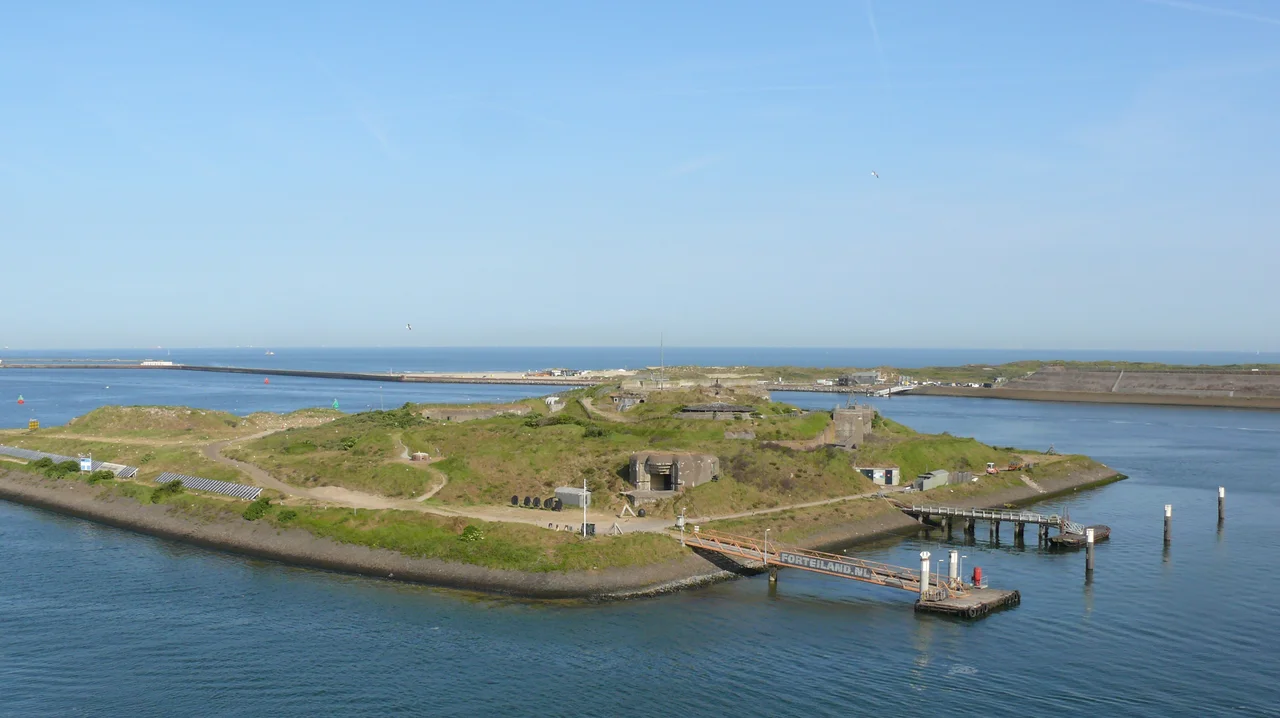

Fort IJmuiden
By the time the masons laid the last bricks at Fort IJmuiden in the late 1880s, the fort was already a museum piece. Engineers had begun the work in 1879 to defend the new North Sea Canal locks, the gateway between Amsterdam and the open sea. They built a hexagonal stronghold of brick and earth on the canal's northern bank, with five enormous 24-centimetre naval guns staring out toward the horizon. Then the high-explosive shell was invented, and quick-firing guns followed close behind. The fort that had cost more than a million guilders to build could now be shrugged off by any modern battleship parked four hundred metres offshore. A monument to a defence doctrine that had outrun itself before it ever fired a shot in anger.
Why Build a Fort Here
In November 1876 the North Sea Canal opened, cutting straight west from Amsterdam through the dunes to a new harbour mouth at IJmuiden. It was an engineering triumph and an immediate vulnerability. Around the same time the Dutch government ordered construction of the Stelling van Amsterdam, the great ring of fortifications and controlled-flooding zones that would shield the capital from overland attack. That whole system depended on one assumption: the locks at IJmuiden had to stay in Dutch hands. Lose the locks and the inundations could be drained. Lose the locks and a hostile fleet could push into the heart of Holland. Fort IJmuiden's job was to make sure that did not happen.
Hexagon of Brick and Earth
The completed fort was an irregular hexagon, three levels deep, set behind a dry moat. The lowest and largest level held quarters for a 325-man garrison and the central ammunition magazines; its windows, in time of war, could be shuttered with steel plates pierced for rifle fire. The second level stored shells for the heavy guns above. The top level carried the main armament: five 24 cm MRK L/30 guns crouched behind an armoured gallery - the pantsergallerij - aimed across the canal mouth. A rotating armoured cupola at the rear mounted two 15 cm guns to fight off attackers from inland. Inside the moat, small gun galleries called caponnieres could rake the ditches with shrapnel if anyone got close enough to try a foot assault. It was sound late-19th-century military architecture, executed with care.
Obsolete on Delivery
The trouble was that late-19th-century military architecture was a moving target. Brick and earth had been the standard answer to solid round shot. Once shells filled with high explosive arrived in the 1880s, those same walls became liabilities - they shattered rather than absorbed. The fort's huge slow-firing guns, capable of a single shot every five or six minutes, ran into the next generation of quick-firing naval artillery, which could put three rounds downrange every two minutes. By 1906 a Dutch writer was noting drily that a King Edward VII-class or Braunschweig-class battleship could anchor four hundred metres from the fort and pound it apart without ever entering effective range of its guns. The brand-new fortress was, in the only sense that mattered, already historical.
Mobilised Anyway
Plans were drawn up before World War I for a second, more modern fort on the south side of the canal, with paired armoured turrets and 28 cm guns. The plans were debated, costed, deferred, redrawn, and never built. When war seemed imminent in 1914, the Netherlands mobilised Fort IJmuiden regardless of its limitations - obsolete or not, it was what they had. Dutch neutrality held, and the big guns stayed silent. Then in 1929 engineers dug a new branch of the canal directly north of the fort, and the old hexagon found itself on an island. During World War II the German occupiers stripped the guns and armoured cupola for scrap metal, but left the armoured gallery in place because removing it cleanly was too difficult. In 1942 the island became part of the Atlantikwall: thirty-seven concrete bunkers and modern artillery with an 18-kilometre reach were grafted onto the old brickwork.
Island Heritage
In 1963 Fort IJmuiden became the last of the Stelling van Amsterdam forts to lose its military role. Four years later engineers widened the canal again and demolished two-thirds of the island in the process. Most of the German bunkers were blown up. The original fort, against considerable odds, came through largely intact. In 1996 the entire Stelling van Amsterdam was inscribed as a UNESCO World Heritage Site, and restoration work began. Since 2008 a private company has run the forteiland as a team-building and events venue - corporate groups arrive by boat, eat dinner in casemates that once stored shells, and walk past the surviving pantsergallerij, the rare armoured emplacement that still stares out toward the sea, waiting for ships that never came.
From the Air
Coordinates 52.465°N, 4.576°E. The fort sits on a small island in the North Sea Canal at IJmuiden, immediately south of the great IJmuiden lock complex - a unique navigation landmark visible for miles. From 1,500-3,000 ft AGL the island reveals its hexagonal footprint with overlapping WWII bunker concrete. Schiphol (EHAM) lies about 12 nm southeast; the Amsterdam terminal area is heavily controlled, so VFR transits typically follow the coast or canal. The deepwater port of IJmuiden directly west is one of the busiest fishing and ferry hubs in the Netherlands.
Nearby Stories
- Battle of Camperdown 2.1 km away
- Randstad 6.4 km away
- Oostvaardersplassen 6.7 km away
- Luchterduinen Offshore Wind Farm 7 km away
- HMS Prince George (1895) 7.2 km away
- Amersfoort 9.6 km away
- Ockenburg 16 km away
- Stavoren 18 km away