
Oostvaardersplassen
The land was supposed to become an industrial estate. When the southwest of the Flevopolder was pumped dry in 1968, planners marked off this stretch along the Markermeer for factories and roads. Then the economy shifted, the industry never came, and the rectangle of fresh seabed sat empty. Reedbeds took it first. Then geese, by the tens of thousands. By the time anyone thought to ask what to do with it, the Oostvaardersplassen had decided for itself: it was going to be wild. What followed turned this fifty-six-square-kilometer accident into one of the most famous and most contested conservation experiments in Europe.
Birds Arrived First
The geography did the work. A pumping station kept the water table just high enough to flood the clay flats, and the reedbeds spread without anyone planting them. Greylag geese moved in by the thousand, then cormorants, spoonbills, great egrets, white-tailed eagles, Eurasian bitterns. By 1989 the reserve carried enough ecological weight to be declared a Ramsar wetland of international importance. From the Oostvaardersdijk, the long sea dike along the Markermeer, a flat horizon of reed and water stretches south as if the polder had never been engineered at all. In 2018, when Nieuw Land National Park was created, the Oostvaardersplassen became its centerpiece.
The Vera Theory
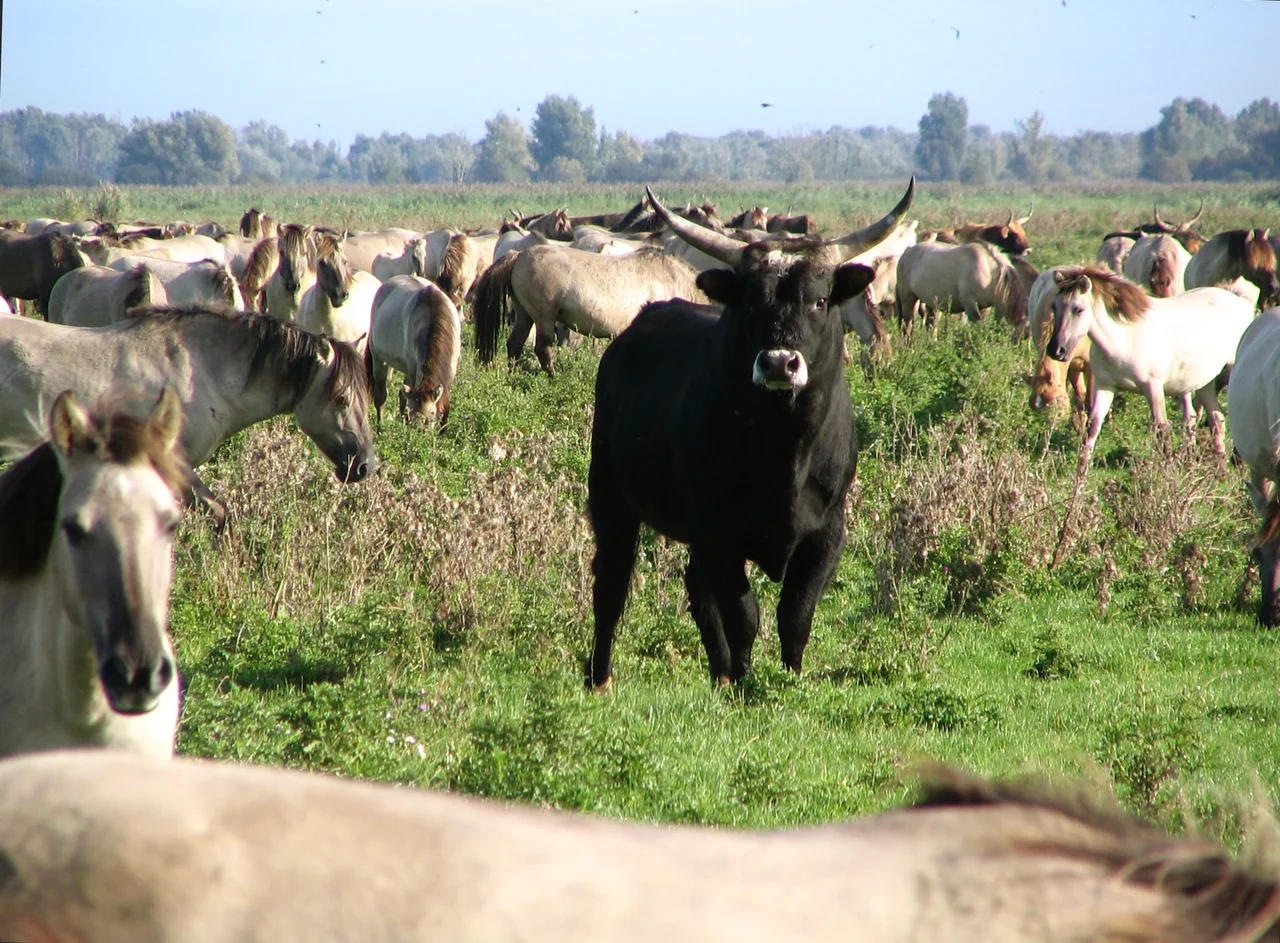
The reeds were the easy part. The trickier question was the dry half of the reserve, where willow seedlings threatened to turn open marsh into closed woodland and drive the water birds away. In 1983, the Dutch ecologist Frans Vera proposed a radical answer. The standard model of pre-human Europe was unbroken forest, but Vera argued that large herbivores once kept the landscape half-open, more savannah than woodland. Aurochs, tarpan, red deer, wisent. Bring back proxies for the extinct species, he said, and let them keep the meadows from closing. The experiment began with 32 Heck cattle and 18 Konik horses in 1983, with 57 red deer added in 1992 and 1993. The Heck cattle had been back-bred in Germany as a guess at the aurochs; the Koniks were small primitive horses from Poland.
Winters Without Walls
The herd grew quickly. By the mid-2010s, around 3,300 red deer, 1,150 Konik horses, and 350 Heck cattle roamed the reserve, with no predators and no supplemental feeding. The point was to let them live as wild animals; the consequence was that hard winters killed them in numbers the public could not unsee. A severe winter in 2005 brought the first public outcry. The winter of 2017 to 2018 was worse. Roughly 3,300 animals died of starvation, and people drove to the dike with bales of hay and were arrested for crossing into the reserve. Newspapers carried photographs of carcasses scattered across the polder. The defenders said this was nature; the critics said this was negligence dressed up as ecology. Both sides had a point, and the people who suffered most were the animals caught between a fence and an idea.
Policy Catches Up
The province appointed a commission led by Pieter van Geel, the former state secretary for the environment. Its report, approved on 11 July 2018, drew a clear line: manage the terrain, do not pretend it is wilderness. Target populations were set at 500 red deer, 550 Konik horses, and 210 Heck cattle. Animals above those numbers would be shot or relocated. The decision drew its own protests and court challenges from the original rewilders, who argued the reserve was being killed twice over: first the animals, then the experiment. The connecting corridor to the Veluwe forest that might have let herds migrate naturally had been canceled in 2012 after political and financial collapse, and four regional parliamentarians had resigned over it. Without the corridor, there was no way to make the polder behave like wilderness, no matter what was inside the fence.
What Remains
Visit today and the controversy is invisible. The viewing hides along the railway between Lelystad and Almere still look out on reed and water and grazing horses, and the bird counts remain extraordinary: spoonbills wading the shallows, white-tailed eagles patrolling overhead, kingfishers darting along the channels. The Oostvaardersplassen never resolved the question it raised, which is whether nature on a piece of land smaller than Manhattan, surrounded by farms and motorways, can still be called wild. The polder is a quiet place that started an argument the rest of European conservation is still having.
From the Air
Located at 52.45°N, 5.37°E, between Lelystad and Almere on the Flevopolder, at sea level. Visible from cruising altitude as a dark green and water-mottled patch contrasting sharply with the geometric farm fields of the polder. The Markermeer borders it to the northwest. Lelystad Airport (EHLE) is 12 km northeast; Amsterdam Schiphol (EHAM) is 40 km southwest.
Nearby Stories
- Zaanstreek-Waterland 0.5 km away
- Veluwsche Stoomtrein Maatschappij 5.3 km away
- Hattem 6.3 km away
- Giethoorn 6.8 km away
- Onze Lieve Vrouwetoren 7.2 km away
- Windpark Noordoostpolder 10 km away
- Battle of Woerden 13 km away
- Battle of Krabbendam 14 km away