
Veluwsche Stoomtrein Maatschappij
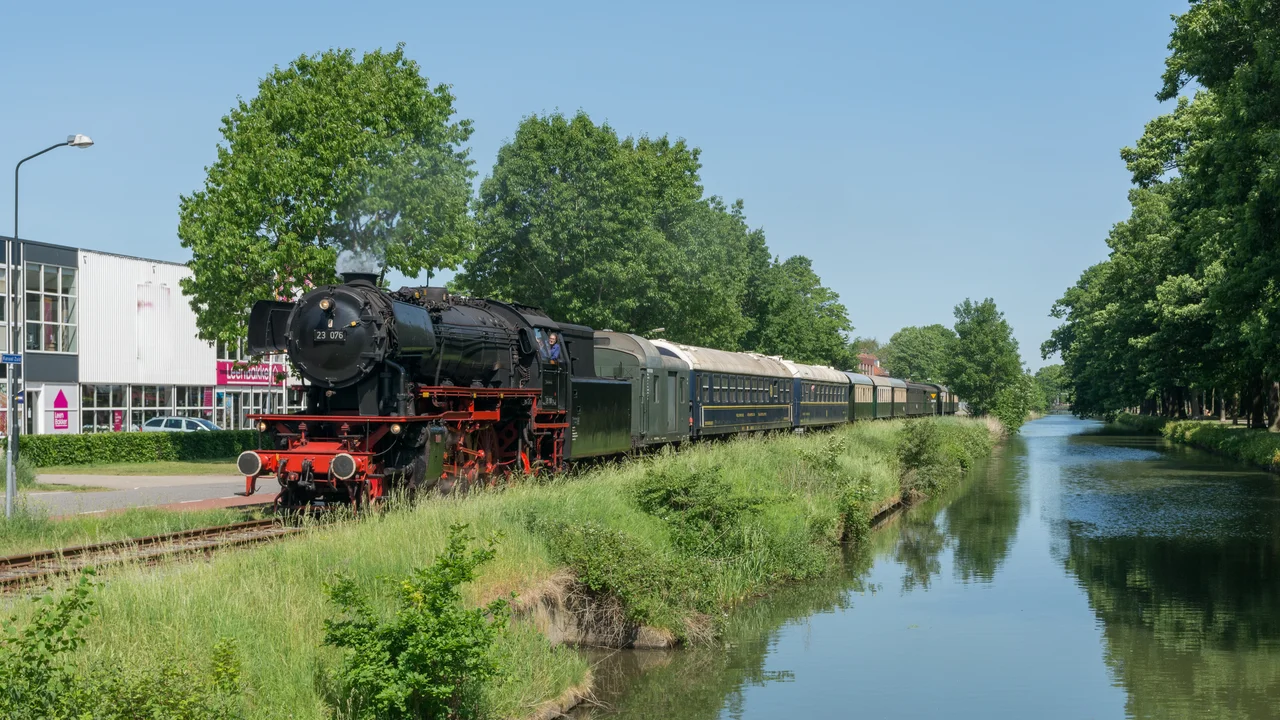
Imagine a single train, ten steam locomotives, all of them under steam at once - some pushing, some pulling, the sound of forty cylinders working in rough syncopation as black smoke piled into the September sky over Apeldoorn. That was the closing run of the Terug naar Toen festival in 2005 and 2006: a procession of borrowed and beloved iron, every working engine the Veluwsche Stoomtrein Maatschappij owned, coupled to a single line of carriages. The VSM is a heritage railway, but heritage here is not nostalgia under glass. The oldest engine in the shed was built in 1929 and is still expected to pull a load. The volunteers keep the fires lit because the alternative - cold boilers and silent yards - is unimaginable.
A Branch Line Saved
When the Dutch state railway, Nederlandse Spoorwegen, retired the line between Apeldoorn and Dieren for regular service, a group of enthusiasts saw what the timetable did not: 21 kilometres of well-graded track through some of the prettiest woodland in the Netherlands, dropping gently through Lieren and Beekbergen and Loenen and Eerbeek toward the IJssel valley. In 1975 they founded the Veluwsche Stoomtrein Maatschappij and started running steam trains. Half a century later the operation is still entirely volunteer-driven, with the depot at Beekbergen as the working heart of the line. Trains run mainly during the summer holidays, when families from across the Netherlands ride the rails to see the Veluwe at the pace it was meant to be seen - which is to say, slowly, with the windows open.
Engines From Three Countries
The VSM owns 19 steam locomotives and 23 diesels, a fleet that reads like a roll call of mid-century European railways. Most of the steam engines are German, products of the Deutsche Bundesbahn and the Deutsche Reichsbahn from the 1940s and 50s - the workhorse classes 23, 44, 50, 52.80, 64, 80, and 41 that hauled coal and people across the chaos and recovery of post-war central Europe. Two locomotives came from Poland, where the wartime utility class TKp shunted steel mills and bracket lines for decades. One came from Austria. The oldest member of the fleet is number 80 036, a German DRG Class 80 built in 1929 and at the VSM since 1976. It has been in service longer at this little Dutch railway than it spent in the country that built it.
Diesel Heritage Too
Heritage railways often dismiss diesels as a footnote, but the VSM treats them as a collection in their own right. The diesel fleet comes almost entirely from Nederlandse Spoorwegen and spans the workhorses of post-war Dutch railroading: tiny locomotors of the 200/300 series for the smallest yards, shunters of the 500/600 series, and mainline engines of the 2200, 2300, 2400 and 2500 classes. Among the passenger stock are six 'Blokkendozen' (literally 'block-boxes,' the boxy 1924-built Mat '24 coaches), eleven 'Bolkoppen' ('bulb-heads,' so named for their rounded ends), and a clutch of Austrian carriages with old-style open platforms at the ends. Three Wagon Lits dining cars and three Mitropa cars round out the stock - the kind of rolling stock that once served sleepers across the continent and now serves Sunday lunch on a Veluwe day trip.
Terug naar Toen
Each year on the first full weekend of September, the VSM holds Terug naar Toen - 'Back to Then.' The principle is simple: run everything that runs. Guest locomotives are invited from heritage railways elsewhere in Europe, the volunteers work double shifts, the platforms at Beekbergen fill with the kind of crowds you usually see at a small-town festival. Until 2007 the highlight was the Saturday-evening parade out of Apeldoorn, in which a single train was pushed and pulled by every operational steam locomotive on the railway - ten engines in 2005 and 2006. The practical logic was thin and the spectacle was tremendous. People talked about it for years afterwards. They still do.
Keeping the Collection Together
Heritage railways exist on a knife edge: an engine that breaks down at the wrong moment, a generation of volunteers that ages out, a private collection sold in pieces to museums abroad. In March 2011 one of the major locomotive owners decided to sell his collection, which would have stripped the VSM of some of its biggest and most beloved engines. The railway made an unusual choice. Rather than watch the collection scatter, it bought the whole lot - 'in order to keep for future generations,' as the VSM put it. The decision was financially uncomfortable and absolutely correct. The locomotives stayed at Beekbergen, the timetable held, and the September weekend kept its full roster of working steam.
From the Air
Coordinates 52.16 N, 5.99 E for the Beekbergen depot, with the line running roughly 21 km from Apeldoorn south-east to Dieren through Lieren, Loenen, and Eerbeek. From the air, look for white smoke and steam trailing along the wooded right of way - on operating days the train is easy to follow visually. Recommended altitude 2,000-3,000 ft AGL to keep the whole line in view. Teuge International (EHTE) is 5 nm north and makes an ideal base for a visit; Deelen (EHDL) lies west. The line crosses into the IJssel valley near Dieren, where it meets the mainline and the Hof te Dieren estate.
Nearby Stories
- Haaksbergen 5.8 km away
- Heerde 6.1 km away
- Kleve 7.3 km away
- Heesen Yachts 9.8 km away
- Aviodrome 11 km away
- Grebbe Line 12 km away
- Raesfeld Castle 15 km away
- Hans Philipp 17 km away