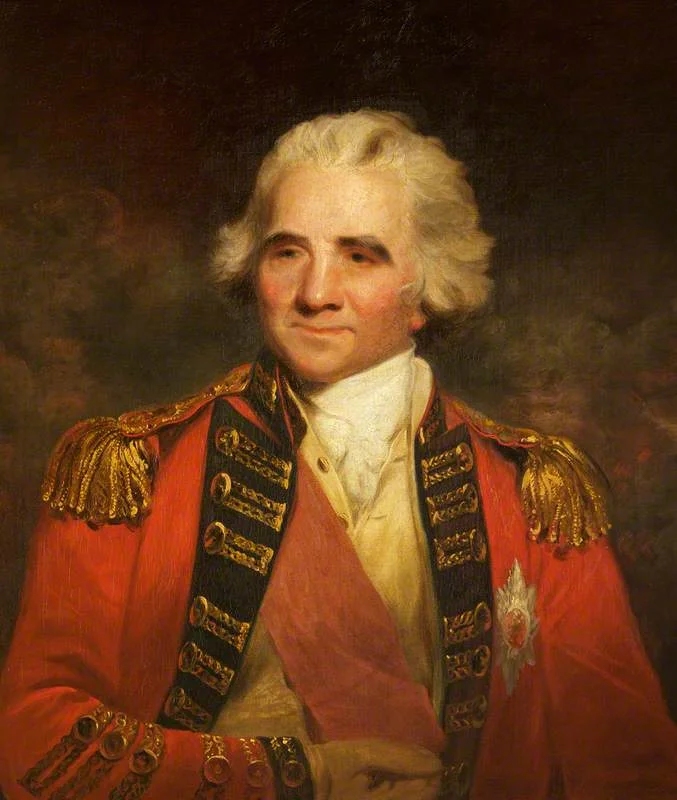

Battle of Bergen, 1799
The Russian troops were already in Bergen by eight in the morning. They had marched through the dark, attacked before dawn, and taken the town. Then they stopped and waited for the British, who were supposed to be on their right flank. The British did not come. They had not even formed up for the battle - because in 1799, no one had thought to synchronize the clocks of a British army and a Russian army fighting together for the first time. By midmorning the French had encircled the Russians inside Bergen. By afternoon Lieutenant General Hermann was a prisoner, his deputy was dead, and the Anglo-Russian invasion of the Netherlands had begun unraveling in earnest.
An Awkward Alliance
The Batavian Republic, the French puppet state set up after the conquest of the Netherlands in 1795, was supposed to be the soft underbelly of Revolutionary France. In the summer of 1799, with Britain and Russia newly allied against the Republic, a combined expedition of 30,000 troops landed on the dunes of North Holland. Prince Frederick, Duke of York and second son of George III, was supreme commander; the Russians fell under Lieutenant General Ivan Hermann, a Baltic German officer in the service of Tsar Paul I. The plan was bold: drive south through North Holland, take Amsterdam, and topple the Batavian government. The Dutch held the canals and dikes; the French general Guillaume Brune held the dunes; and the Dutch general Herman Willem Daendels held Langedijk. On 19 September the Duke of York's four columns moved forward from Schagerbrug to crack the line in one day.
Clocks and Canals
On a map the plan looked elegant. The left column would turn the French right on the Zuiderzee. The right column would seize the heights of Camperduin and the town of Bergen. The right-centre would take Warmenhuizen and Schoorldam. The left-centre would punch through to Oudkarspel on the road to Alkmaar. In the field it disintegrated almost immediately. The ground was a polder country - sliced every three or four hundred yards by deep wet ditches and canals, with every bridge destroyed in advance by the Republicans. The Russians started attacking before daylight, hours before the British were ready, because no one had set a common hour for the assault. Their fire was probably more destructive to themselves than to the French. By the time the British were forming up, the Russians had already taken Bergen, lost the initiative, and been surrounded. Major-General Manners's brigade and the 35th Regiment under Prince William fought back into Schoorl to relieve them, but ammunition ran short and exhaustion did the rest.
What Was Won and What Was Lost
Some columns did exactly what they were ordered to do. Lieutenant-General Dundas took Warmenhuizen in a textbook dawn assault, three Russian battalions under Sedmoratsky storming one side as the 1st Guards entered the other. The left-centre column overcame Daendels's main force and seized Oudkarspel, opening the road to Alkmaar. Sir Ralph Abercromby, far on the eastern flank, captured Hoorn on the Zuiderzee. But the right wing had collapsed at Bergen, and one collapsed flank in a four-column attack is enough. The Duke of York pulled everyone back to their starting positions. The casualties were appalling for one day's work: the Russians lost 1,741 enlisted soldiers and 44 officers killed or captured, with another 1,225 wounded. The Dutch lost over 1,500 dead or wounded and 1,052 men taken prisoner. The French lost 815. The British casualties ran to over a thousand.
The Russian Monument
Two weeks later, on 6 October, the same armies clashed again at Castricum, and the Anglo-Russian expedition was finished. The Duke of York negotiated the Convention of Alkmaar and the British and Russians sailed home. Mikhail Kutuzov, dispatched from Saint Petersburg to take over the Russian forces, learned of the disaster while passing through Hamburg and turned around. The Batavian Republic survived another seven years. Today the battlefield is a quiet stretch of polder farmland and dune forest. In Bergen itself, near the spot where Hermann's troops were encircled, stands the Russisch Monument - the Russian Monument - erected in 1902 by Tsar Nicholas II to honor the soldiers who died here for someone else's cause. The Duke of York wrote afterward to Tsar Paul that he could not praise the Russians enough; their courage, he said, had simply outrun the slower clock of his own army.
From the Air
Coordinates 52.67 N, 4.70 E - the battlefield spans the polders and dunes between Schoorl, Bergen, and Alkmaar in North Holland. From altitude the geometry of the 1799 fight is still visible: the dune ridge running north-south along the coast, the polders laced with straight drainage canals to the east, and Alkmaar's compact medieval core to the south. Schiphol (EHAM) is 40 km south; De Kooy (EHKD) 25 km north. Recommended viewing altitude 3,000-5,000 ft AGL in good visibility.
Nearby Stories
- Koopvaarders Lock 4.9 km away
- Enkhuizen 6 km away
- Blauw-Wit Amsterdam 6.3 km away
- Princess Amalia Wind Farm 6.4 km away
- Hollandse Kust Zuid Offshore Wind Farm 7.2 km away
- The Green Cathedral 7.4 km away
- Tjaskers in Friesland 19 km away
- Action of 22 September 1914 33 km away