
Blauw-Wit Amsterdam
Ons ideaal, dat is Blauwwit, de Club waar pit in zit. Our ideal, that is Blauw-Wit, the Club with grit. The chant ended with a yell - alabimba, alabimba, blauwwit, blauwwit, blauwwit - and it carried in the late 1940s across the Olympic Stadium in Amsterdam, sung by supporters who painted their cars in zebra stripes of blue and white and followed their team to away matches as a self-conscious novelty. They were the loud ones. They were also, in a city now famous for one football club, supporters of the team Ajax actually had to beat to be Ajax.
Two Neighborhood Clubs
On 10 May 1902, in the Kinkerbuurt in west Amsterdam, a group of young men founded a football club they called VICTORIA! - exclamation mark included. The team merged shortly after with another neighborhood club called Holland, took on the combined name Blauw-Wit, and was allowed by the Dutch football federation into the Derde Klasse. This was when amateur football was the only football that existed. There were no transfer fees, no contracts, no televised matches. A club was its neighborhood and its colours. Blauw-Wit's colours - blue and white - would last 113 years.
Sharing a Stadium with Ajax
From 1928 onward, Blauw-Wit played its home matches in the Olympic Stadium, built that year for the Amsterdam Olympics. So did Ajax. The two clubs shared the ground for forty-four years and played each other in fifty-two competitive matches. Ajax won twenty-three of them. Blauw-Wit won sixteen. Thirteen ended level. The aggregate goal difference was 83-66 in Ajax's favor - close enough that the Stadsderby, the city derby, was a real rivalry rather than a polite formality. In 1929, the cabaret artist Louis Davids released a 78 rpm record called De Voetbalmatch about a Blauw-Wit versus Ajax encounter. It is the only Dutch pop song from the interwar era about a specific football match, and the team it featured no longer exists.
Seven Times Champions
Before the Eredivisie - that is, before professional football arrived in the Netherlands in 1954 - the top flight was the Eerste Klasse, split by region. Blauw-Wit won the West I division seven times. They beat district champions like Heerenveen, where Abe Lenstra played, and Ajax, where a young Rinus Michels was learning the game. In March 1946, three Blauw-Wit players started for the Netherlands national team in a 6-2 win over Luxembourg. Cor Wilders wore the captain's armband. Co Bergman scored. For a brief moment, in a small country emerging from occupation, the Dutch national team was led by men whose home ground was a stadium they shared with their bitterest local rivals.
The End That Wasn't
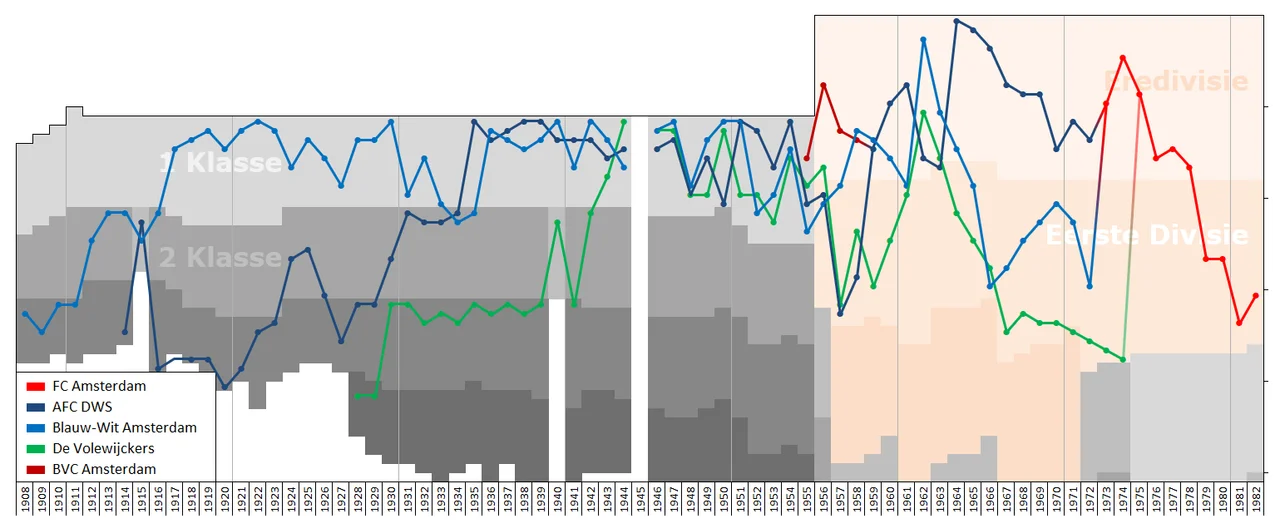
Professional football arrived and the old order died fast. In 1954, before Blauw-Wit had even entered the Eredivisie under its own name, a club called BVC Amsterdam stripped Blauw-Wit's roster bare. Players renounced amateur status without compensation and walked across town to professional contracts. The supporters called the replacement squad the Foreign Legion. The team was relegated in 1960. In 1967, dwindling crowds drove Blauw-Wit off the main pitch at the Olympic Stadium and onto a side field. In 1972, the professional section merged with DWS to form FC Amsterdam; Volewijckers joined the following year. FC Amsterdam was dissolved in 1982. Ajax, of the three old Amsterdam clubs, was the only one that came through the transition intact. The reason was money: Ajax had been quietly compensating players even before pro football was legal, so they kept their squad.
Amateurs Forever
Here is the part the headlines miss. When the professional Blauw-Wit died in 1972, the amateur section kept playing. They restarted in the Vierde Klasse, won championships in 1968-69, 1969-70, 1973-74, and 1976-77, and climbed to the Hoofdklasse - the top of Dutch amateur football. They relegated, they re-promoted, they relegated again. In 2002 they merged with Osdorp-Sport. In 2003 they merged with three more clubs and reclaimed the name FC Blauw-Wit Amsterdam. In 2015 they merged with VV De Beursbengels to form Blauw-Wit Beursbengels, which is where the storied old name finally gives way. But for a hundred and thirteen years, somewhere in Amsterdam, men were pulling on blue and white shirts on Sunday afternoons and chanting the same alabimba their grandfathers had chanted. The trophies are in cabinets now. The club, in the strictest sense, is gone. But football is not just trophies.
From the Air
The Olympic Stadium sits at 52.343N, 4.853E in Amsterdam Zuid, southwest of the city center. The original ground - now used for athletics and lesser football fixtures - is still there, ringed by the streets of the 1928 Olympic neighborhood. The club's birthplace, the Kinkerbuurt, lies a few kilometers north. Nearest airport: Amsterdam Schiphol (EHAM), 10km southwest. Best viewing altitude: 2,000 to 4,000 feet, with the stadium's oval visible from above.
Nearby Stories
- Polanen Castle 1.6 km away
- Gouda 2.6 km away
- Princess Amalia Wind Farm 3.5 km away
- The Green Cathedral 4.2 km away
- Egmond Abbey 7.1 km away
- Dorestad 7.7 km away
- Hollandse Kust Zuid Offshore Wind Farm 11 km away
- Enkhuizen 16 km away