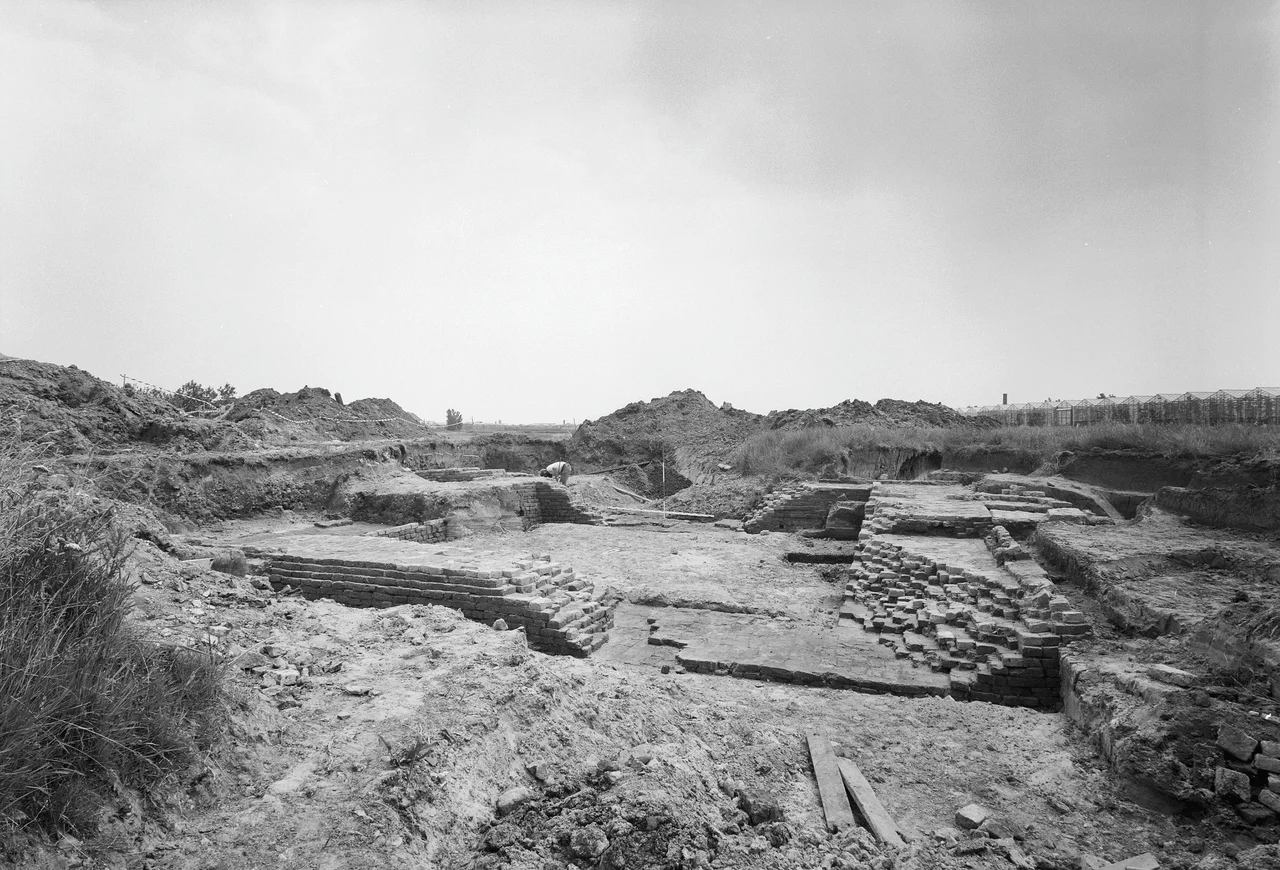

Polanen Castle
In the night of 22-23 September 1392, the mistress of the Count of Holland - a young noblewoman named Aleid van Poelgeest - was hacked to death in a street in The Hague. Among the chief suspects was Philip II, Lord of Polanen. He fled the county. Two years later, in 1394, county accounts record a mason being paid for ten weeks of breaking bricks out of Polanen Castle. Another contractor was paid for twenty-eight days of filling in the moats and carting the medieval brickwork up the road to The Hague for reuse. The castle that vanished into the count's new building projects had been an ancestral seat - the seat of the family from whom, four generations later, the Counts of Nassau would inherit their Dutch fortune.
A Tower in the Dunes
The fief was granted on 6 November 1295. Floris V, Count of Holland - the count who would be murdered by his own nobles a year later - handed the land at Polanen, just outside the village of Monster on the South Holland coast, to a younger man of the Van Duvenvoorde family named Philips. The site is unusual. Most solitary tower houses of the period sat on cramped islands, just big enough to hold their donjon. Polanen got built on an inner bailey forty-two by twenty-nine meters, ringed by a moat twelve meters wide - room for outbuildings, room for ambition. The donjon itself went up around 1300 on the northeast corner: eleven-and-a-half meters square outside, walls two meters thick at the foundation tapering to one-and-a-third at the top, at least twelve meters high. In the 1320s a small stair tower with a privy was added, smoothed and painted red on the outside, with a fall pipe straight down into the moat. The kitchen and stores sat in the cool northwest corner. The bridge across the moat ran south from the gatehouse. It was built to grow into a real castle. It never quite did.
The Polanen Line
Philips's son John was the family's making. He acquired fiefs across the dunes near Monster, took the surname Van Polanen by 1305, and rose to become a counselor of Count William III. The career outgrew the house. In 1320 John was granted Nieuwendoorn Castle, a proper full-sized fortress. In 1327 he got Oud Haerlem Castle. By the time he died in 1342 the Polanen family was operating from grander seats, and the original tower house outside Monster was passed down to a younger branch as a subfief. That branch took the family's side in the Hook and Cod Wars - the conservative Hook alliance, supporting Margaret II of Hainaut against her son William V of Holland. It was a losing bet.
The Siege of 1351
When William V seized Dordrecht in April 1351 and turned on the castles of his Hook enemies, Polanen was on the list. The young count had already taken Rosenburg near Voorschoten and Binckhorst near The Hague. On 1 June 1351 the battering ram that had been used at Rosenburg was carted to Polanen, along with a second one - both nicknamed *mol*, mole, after the burrowing animal whose work they imitated. A siege tower was under construction in The Hague. Philip I of Polanen was not there to defend his castle; he was holding Geertruidenberg for the other side, and Geertruidenberg would itself fall in October. The besiegers at Polanen were never many - perhaps fifty men, including a contingent of twenty-four English under Lord Willem van der Wateringe, arriving on 8 June. But they brought a trebuchet, and the bombardment was real. Archaeologists working the site in 1981 pulled trebuchet stones and arrowheads out of the old moat. The garrison surrendered on or about 22 June. Strangely, the castle was not destroyed. Philip I made his peace in 1355, kept his fief, and was a counselor of the count by 1366.
The Mistress and the Mason
What finally killed Polanen Castle was not a war but a murder. Aleid van Poelgeest was the mistress of Count Albert of Bavaria, who ruled Holland as regent and then count from 1358 onward. She was killed in The Hague in September 1392, a political assassination by enemies of her growing court influence. Philip II of Polanen - Philip I's grandson, by then bailiff of Schieland and Hoogheemraad of Delfland - was one of the chief suspects. He fled. By 1394 the count had ordered Polanen Castle taken down brick by brick, the moats filled in, the materials hauled to The Hague to build something for him instead. The 1981 excavation found exactly what the county accounts described: a layer of debris with whole bricks from 1351, a quiet sediment layer above it suggesting the castle was barely lived in afterward, and then a top layer thick with mortar and small brick fragments - the chaff of the 1394 dismantling. By 1396 Philip II had made his peace with Albert. He built a smaller manor southeast of the old site between 1396 and 1401. It gradually became a working farm; the moats were filled in around 1700; a regular farmhouse went up using the medieval brick. The fief eventually passed through Van Heenvliet and Van Naaldwijk hands, and in 1627 Frederick Henry of Orange bought what was left for 13,390 guilders. After the 1981 dig, when greenhouse farming was proposed for the terrain, the medieval bricks - the *kloostermoppen*, the big monastic bricks of the original donjon - were dug up and stored for reuse, then judged unsuitable. The owner of the neighboring villa Nieuw Polanen used them instead to build a folly in his garden: a deliberate ruin, a pseudo-medieval ornament. The bricks that once stood as the seat of the Polanen lords now stand as a faux ruin in someone's lawn - the only above-ground trace of a family whose name was carried, through the marriage of Johanna van Polanen to Engelbert of Nassau, into the line that became the Dutch royal house.
From the Air
Located at 52.03°N, 4.20°E in Monster, South Holland, near the Westland greenhouse belt and just inland from the North Sea coast. Nothing of Polanen Castle remains above ground - the original site was excavated in 1981 and then leveled for agricultural use; the only physical trace is the brick folly in the garden of villa Nieuw Polanen nearby. Recognition cues from the air: the dense glass roofs of the Westland greenhouses sprawling north and east, the coastal dunes and beach a few hundred meters to the west, the village of Monster's church tower, and the urban edge of The Hague (Den Haag) about 8 km to the northeast - the city to which Polanen's bricks were carted in 1394. Nearest airport: Rotterdam-The Hague (EHRD) about 12 km east. Best viewed at 1,000-2,000 ft in clear weather.
Nearby Stories
- J. & K. Smit Shipyard 7.7 km away
- Holland 8.1 km away
- Watersnoodmuseum 8.1 km away
- NAC Breda 16 km away
- Hollandse Kust Zuid Offshore Wind Farm 18 km away
- Battle of Cadzand 36 km away
- SS Elbe 40 km away
- Southern Bight 48 km away