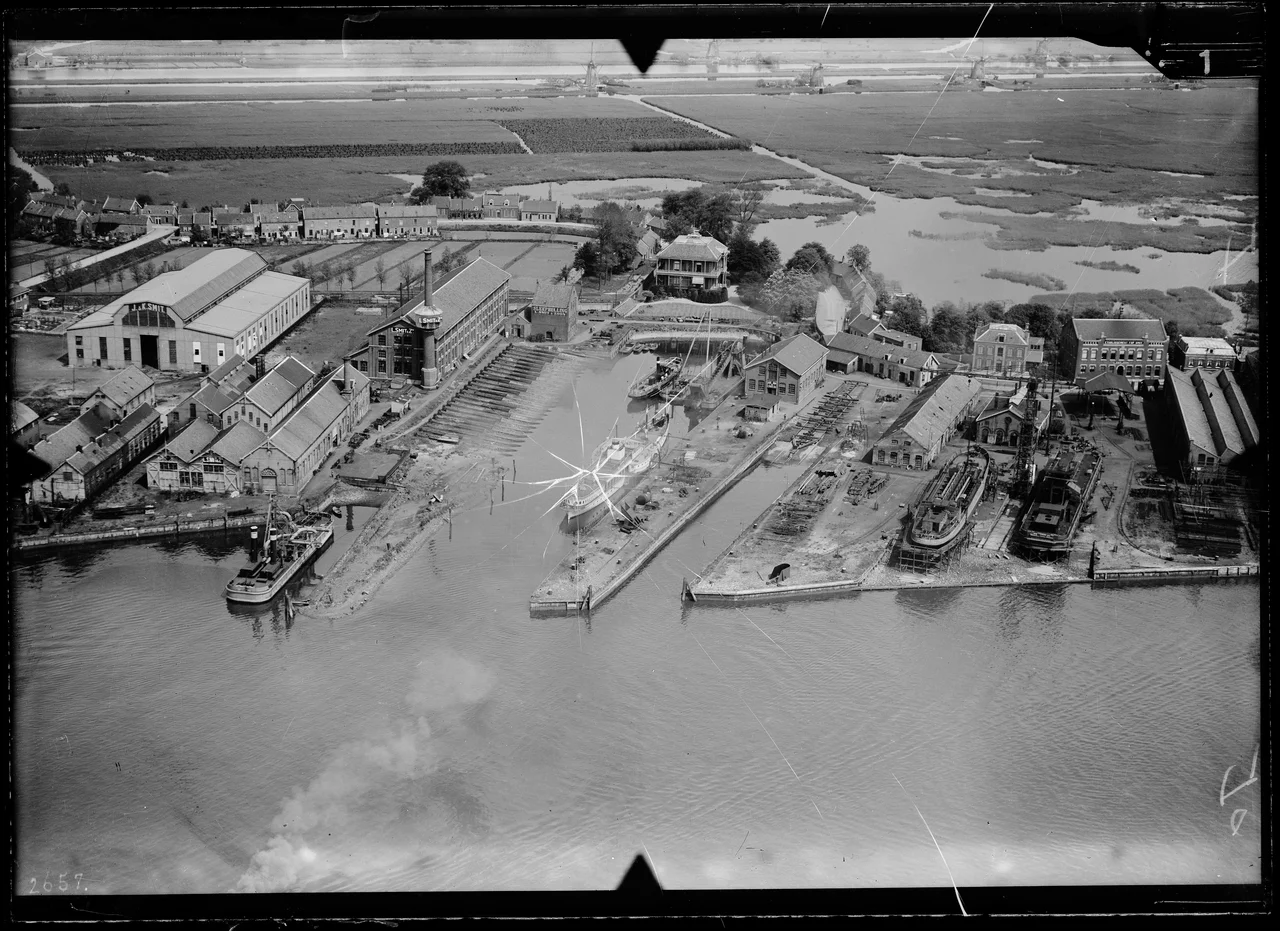

J. & K. Smit Shipyard
In 1847, two brothers named Jan and Kornelis Smit broke ground on a new shipyard along the Lek River at Kinderdijk. They were not the first Smits to build ships here, and they would not be the last. The family had been at it since 1785, with cousins and uncles and brothers spinning off rival yards up and down the Alblasserwaard. What set Jan and Kornelis apart was a brother-in-law: Murk Lels, a Frisian sailor turned shipping magnate who had married their sister Ottolina the year before they started. Murk needed ocean-going barques to haul cargo to the Dutch East Indies. The Smits could build them. Within a year their first ship slid down the slipway, named with cheerful confidence: Eersteling, 'the first.' She sank on her maiden voyage. Murk ordered another.
The Lels Connection
Murk Lels arrived in the Smit family with a sailor's eye and a merchant's ambition. He had gone to sea at fourteen, swallowed the anchor at twenty-two, and by his twenties was managing nine ships totaling 7,248 tons on the Dutch East Indies route. Marrying Ottolina Smit in 1846 plugged him into a clan of shipbuilders. He repaid the favor by routing his orders to his in-laws. Over the next two decades J. & K. Smit launched a steady procession of barques for him: Kinderdijk, Cornelis Smit, Otto, Ottolina, Johanna en Geertruida, each carrying a family name into the South China Sea. Murk also moved on to Yokohama, where in 1864 he founded the trading house that became Carst, Lels & Co., one of the early European firms in newly opened Japan. He even founded a coffee company at Banyuwangi on Java. The shipyard at Kinderdijk was his back office, half a world away.
The Pivot to Dredgers
By the 1880s the great age of Dutch ocean sail was ending, and J. & K. Smit had the sense to see it coming. In 1878 they delivered Adam I, the first Dutch self-loading suction dredger, to the contractors building the new locks at IJmuiden. It was such a hit that Adam II followed the same year for work on the Nieuwe Waterweg, the deep channel cut to connect Rotterdam to the sea. The French government ordered three of the things in 1883. By January 1886 the shipyard had completely retooled: every vessel on the slipway was a dredger, including one going to South Africa, one to Japan, and one to the city of Utrecht. The Japanese dredger had to be disassembled after launch and shipped abroad in pieces. Holland's land-from-water expertise, born of necessity, had become an export product. By the end of the century, dredgers from Kinderdijk were digging harbors in Argentina, Australia, Denmark, Russia, and along England's River Wear, the last won on price against local British shipbuilders by a margin of more than 3,000 pounds.
Greenpeace's Tugboat
Among the hundreds of tugs J. & K. Smit launched into the Lek, one carries a second life worth pausing over. On October 14, 1958, the yard launched the Elbe, a sister to the seagoing tug Clyde delivered the previous year. She was the thirtieth tugboat off the line for the family's tug-service partner L. Smit & Co. Decades later she was sold to a young environmental organization and rechristened MV Greenpeace. Her sturdy Kinderdijk-built hull absorbed years of confrontations with whaling fleets and nuclear test sites. After her activist career ended she was renamed Elbe again, and today she sits as a museum ship at Maassluis, a few kilometers downriver from the yard that made her. The same shipyard also built, in 1962, the fourth tug to bear the name Zwarte Zee. At her launch she was billed as the biggest, fastest, and most powerful tug in the world.
Tin Dredgers for Bangka
The dredging specialty branched in unexpected directions. In 1926, J. & K. Smit built a tin-bucket dredger for the government mines on Bangka Island, off the Sumatran coast. More followed. The Sergang and the Soerabaya went to the Singkep Tin Company in 1927. The Weltevreden was sent to Bangka in 1928 for the Tinbagger Maatschappij. These were strange, floating, factory-like machines, scooping the tin-bearing sands of Southeast Asian rivers into onboard separators. They were also extraordinarily profitable. When the Great Depression hit, the shipyard survived the lean years partly because its tin-dredger expertise kept finding customers in colonial mining outposts. By 1939 the launching of the great tin dredger Doejoeng marked the recovery of the market, just months before the war shut everything down.
Absorbed
After the Second World War, six dredging shipyards in the Netherlands looked at each other, looked at their post-war order books, and concluded they could not afford to compete with one another. They formed the Industriële Handels Combinatie, IHC for short. J. & K. Smit was in. So was L. Smit en Zoon, the cousin-yard down the same Lek riverbank. The two would slowly fuse. By 1966, the year after IHC formally became a single company, the boards merged the J. & K. and L. Smit shipyards into a partnership called Smit Kinderdijk. The names that had marked separate empires for more than a century became letters on the same letterhead. The modern shipyard that occupies the site today, part of Royal IHC, still contains the original brick buildings, but they are completely surrounded now by newer halls. From the river, you can no longer see exactly where one Smit ended and the next Smit began.
From the Air
Coordinates 51.883°N, 4.628°E, on the north bank of the Lek River at Kinderdijk, between Rotterdam and Dordrecht. The shipyard site is at the southern edge of the famous Kinderdijk windmill complex, a UNESCO World Heritage area where 19 historic windmills line the polder canals. From altitude, look for the bend in the Lek and the unmistakable line of windmills extending inland. Nearest airports: Rotterdam The Hague (EHRD) about 20 km northwest, and the smaller Midden-Zeeland (EHMZ) further south. Best viewed at low altitude (1,500-3,000 ft AGL) to pick out both the shipyard halls and the windmill row at once.
Nearby Stories
- Baarn 1.1 km away
- Oud Herlaer 3.5 km away
- Battle of the Slaak 5.5 km away
- Dorestad 5.8 km away
- Holland 7.2 km away
- Polanen Castle 9.8 km away
- Breda 11 km away
- Hollandse Kust Zuid Offshore Wind Farm 19 km away