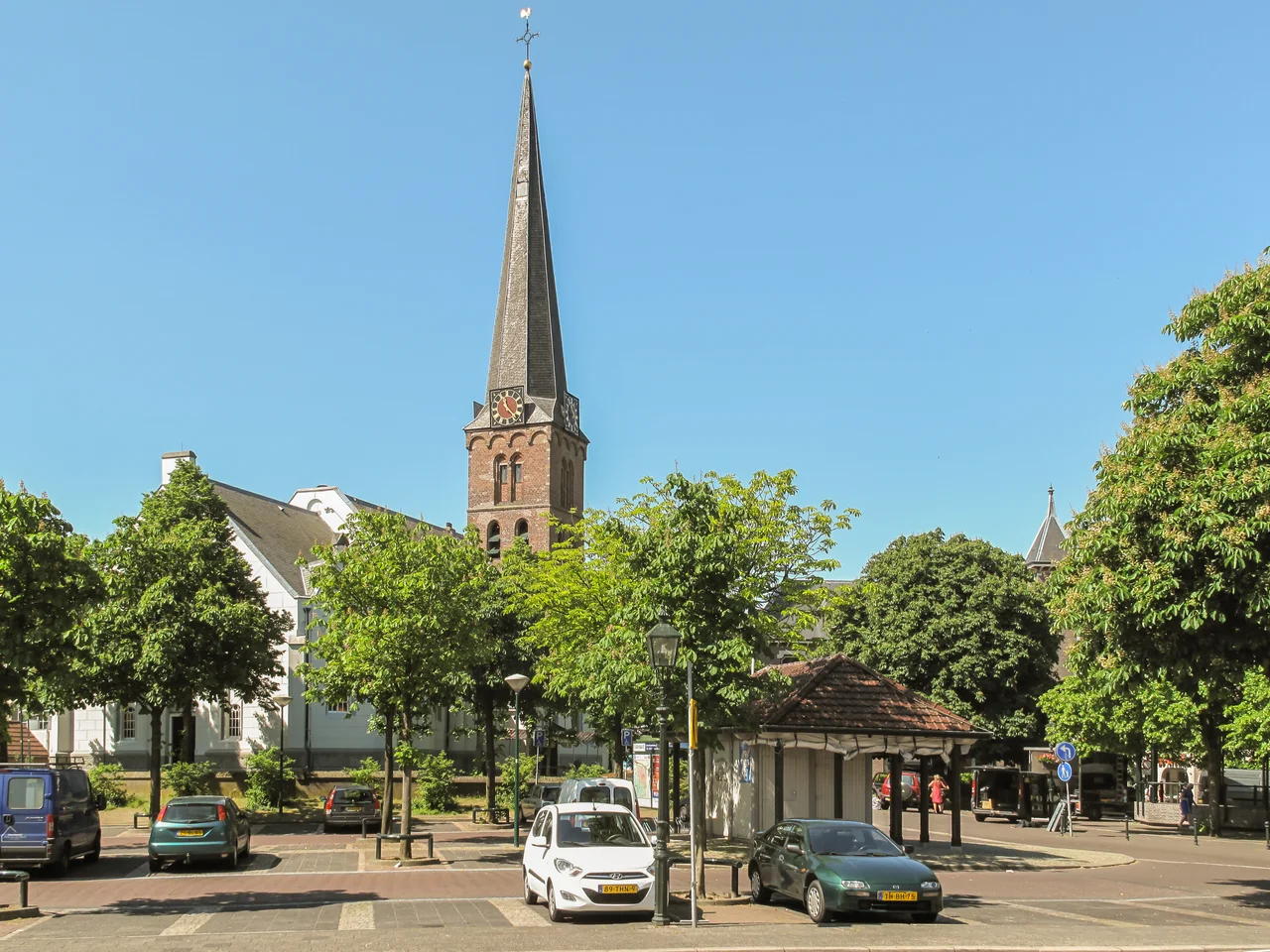

Baarn
M.C. Escher spent three decades here drawing staircases that go nowhere and hands that draw themselves. He moved to Baarn in 1941 and stayed until 1970, working out of a quiet studio in a town that, from the air, looks like nothing special: a tidy grid of red-tile roofs tucked between Hilversum and Amersfoort, surrounded by Utrecht woodland. But the ordinary Dutch town below has been hiding monarchs and artists in plain sight for centuries. Soestdijk Palace, just south of the town center, was home to Queen Juliana for more than sixty years. Three of her four daughters were born here. The current king, Willem-Alexander, walked these streets to school. Baarn is the place royals choose when they want to be left alone.
City Rights and a Long Quiet
Baarn received its city rights in 1391, late in the medieval shuffling of charters along the Utrecht frontier. The grant carried the right to hold markets and build defenses, but Baarn never grew into a fortress town. It stayed small and wooded, a place travelers passed through on the road between Amsterdam and the eastern provinces. For five centuries that anonymity was the whole point. When the railway arrived in the nineteenth century, connecting Baarn to Utrecht, Amersfoort, and Amsterdam, the town finally found its modern identity: close enough to the capital to matter, far enough to stay green. Today trains still depart every half hour from Baarn station, the same intervals they have run for generations.
The Palace in the Forest
Soestdijk Palace sits at the edge of Baarn, hidden behind a screen of beech and oak called the Baarnse Bos. The country house at its core was built in the mid-seventeenth century for Cornelis de Graeff, the Amsterdam regent. In 1815 a grateful nation presented it to the future King William II in recognition of his service at the Battle of Waterloo, and between 1816 and 1821 two wings stretched outward from the original house. Queen Emma lived there. So did Queen Juliana, who made it her home for more than six decades until her death in 2004. Her husband, Prince Bernhard, died the same year. The Orangery, a white-plastered pavilion built to overwinter laurel and citrus trees, now serves coffee and lunch to visitors who walk the grounds. The palace itself sits at the heart of a long conversation about what to do with a royal home that has outlived its purpose.
An Artist's Town
Escher chose Baarn for the same reason the royals did: it left him alone. He arrived in 1941, during the German occupation, and spent the next twenty-nine years producing the lithographs that would make his name a synonym for visual paradox. The tessellating lizards, the relativity of staircases, the self-drawing hands - most of them were composed in a studio here, surrounded by Dutch suburbia. Other artists found their way to the same streets. The graphic designer and type designer Martin Majoor was born in nearby Baarn. The theatrical producer Joop van den Ende, who built one of Europe's largest entertainment empires, still lives in town. Baarn does not announce these residents. There are no plaques on the buildings. The town's instinct, as with the royals, is to let people work in peace.
Sprinters and Swimmers
For a town of fewer than 25,000 people, Baarn has produced an extraordinary number of Olympians. Fanny Blankers-Koen, born just south in Lage Vuursche in 1918, became the first woman to win four gold medals at a single Olympic Games. She did it in London in 1948, racing while a thirty-year-old mother of two at a time when most observers considered her too old to compete. The Dutch press called her the Flying Housewife. Decades later, Sharon van Rouwendaal, born in Baarn in 1993, won gold in open-water swimming at the 2016 Rio Olympics. Diederik van Weel took team gold in field hockey at Sydney in 2000. Ilse van der Meijden did the same in water polo at Beijing in 2008. Whatever it is about this corner of Utrecht, it has been good to athletes who count their medals in fours.
What the Trees Remember
The Baarnse Bos is older than the palace. The Cantonspark, a small botanical garden tucked near the center of town, still grows specimens collected over more than a century. Groeneveld Castle, on the western edge, anchors another belt of woodland and now houses a national center dedicated to landscape and nature. Walk the polder roads north toward the Eem river and the town disappears into reeds and slow water. From above, this is what you see: a green crown of forest with a small town set into it like a stone in a ring. The palace is the centerpiece, but the trees are what hold the place together.
From the Air
Baarn sits at 52.21 degrees north, 5.29 degrees east, in the rolling Utrecht heath country roughly 35 km southeast of Amsterdam. The town is visible from cruising altitude as a compact grid set into woodland, with the long rectangle of Soestdijk Palace and its formal gardens immediately south. The A1 motorway threads east-west just north of town, and the Eem river meanders through polders to the north. Nearest airports: Schiphol (EHAM) lies 35 km west, Lelystad (EHLE) sits 25 km northeast across the IJsselmeer, and Hilversum airfield (EHHV) is just 10 km to the west. Recommended viewing altitude 3,000 to 5,000 feet for a clear read of the palace grounds and the surrounding forest belt.
Nearby Stories
- Amstelveen 4.4 km away
- 2001 United Kingdom foot-and-mouth outbreak 7.2 km away
- Dorestad 9.7 km away
- Schoonhoven 11 km away
- Noordhollandsch Kanaal 13 km away
- Liemers 15 km away
- Urk 15 km away
- Den Hulst 21 km away