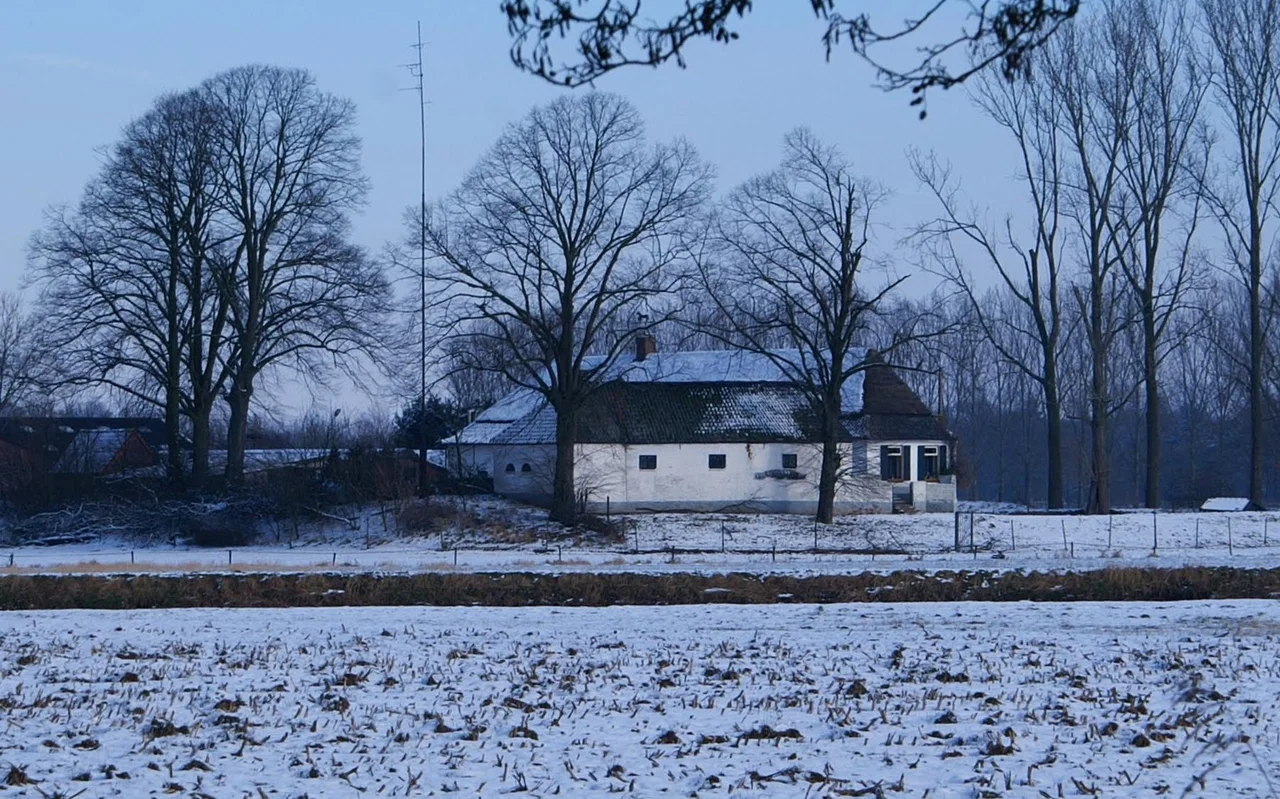

Oud Herlaer
Stand at Oud Herlaer today and you are standing on a small artificial hill. Three metres of sand and clay above the natural ground, deliberately heaped, then a brick farm sitting on top. Underneath are the foundations of a motte-and-bailey castle that probably went up in the eleventh century, and the ring wall of a stone castle that replaced it around 1250. The Lords of Herlaer ran a tidy operation from this spot - tolls on river traffic, peat from the wet meadows, and thousands of barge loads of sand sold off to expand the medieval city centre of 's-Hertogenbosch. Then in 1737 the castle was pulled down. The hill stayed.
Why Build Here
Oud Herlaer was within a kilometre of Maurick Castle in Vught, almost close enough to wave from one to the other, and yet the two belonged to different jurisdictions. The reason was the Dommel. In medieval Brabant the river and its tributaries were practically the only way to move bulk cargo north and south - and they were a serious obstacle to moving anything east-west. A castle on the right bank of the Dommel could tax the river and command the few crossings. The land itself, low and wet and interleaved with sand ridges, was barely good for anything but animal husbandry. But the position was worth more than the soil. As 's-Hertogenbosch grew into the second city of the Netherlands around 1400, the estate became one of the more valuable patches of land in the region.
The Van Herlaers Move On
The family that gave the place its name first appears in the records around 1080, in the early years of the medieval custom of naming nobles after their estates. The title "Lord of Herlaer" is attested in 1173. About ten generations of Van Herlaers can be traced. In the mid-twelfth century they acquired the lordship of Ameide on loan from the Bishop of Utrecht, and shifted their main seat there. In 1305 the family line at Oud Herlaer ran out through a daughter, and in 1315 her husband Gerard van Loon sold the castle outright to Gerard I of Horne. The original family kept going - Gerard's son Dirk continued the Van Herlaer line as Lord of Ameide - but they never came back to the Dommel.
The Strange Quiet of 1629
Oud Herlaer should have been wrecked many times over. It was a defensible point uncomfortably close to 's-Hertogenbosch. It could have been used by the city's defenders to delay a siege, or knocked down by besiegers after a failure. Somehow it stayed standing. During the great 1629 Siege of 's-Hertogenbosch, when Maurice of Orange's successor Frederick Henry finally took the city for the Dutch Republic, Frederick V of the Palatinate - the so-called Winter King of Bohemia - stayed at Oud Herlaer while Frederick Henry himself had quartered at nearby Maurick. The owner at the time, Count Hendrik van den Bergh, then promptly switched to the Dutch side in 1632, perhaps not coincidentally just after Herlaer had ended up inside the Republic's territory.
Demolition and a Farm Made of Castle
By the eighteenth century the great families who held the title - the De la Tour d'Auvergnes, then the Electors of the Palatinate and Bavaria - had bigger estates elsewhere and almost never visited. In 1737 the castle was demolished. By the 1760s a farm had appeared on the site, built in part from the medieval walls themselves - chunks of castle masonry recycled into the kitchen of a working farmhouse. In 1842 a baron used the buildings as a summer cottage; the cottage burned down eight years later. Through the 19th and 20th centuries almost nothing happened. Modern stables crept onto what was probably the outer bailey. In the 1980s the surrounding moat - the last visible scar of the castle's footprint - was filled in.
Excavation, Restoration, and a New Idea
In 2015 the Groen Ontwikkelfonds Brabant bought the farm with an eye to restoring the natural connections of the Dommel valley. The modern stables came down. Archaeologists from BAAC walked the terrain in 2016, mapped what was left, and in 2017 the moat was re-excavated, putting water back around the old castle hill for the first time in decades. That same year the conservation organisation Brabants Landschap won the tender to redevelop the site with a plan combining nature, art and history - a kind of small Kroller-Muller Museum of the south, in the words of the jury. Artists are to work and exhibit in the old farm. Eco-art will sit on the grounds. The medieval bed of the Dommel may be partially restored. The castle that vanished in 1737, in other words, is slowly being made visible again, not by rebuilding it but by digging carefully around the ghost of where it used to be.
From the Air
Oud Herlaer is at 51.659846 degrees north, 5.312569 degrees east, on the east bank of the Dommel between Vught and Sint-Michielsgestel - roughly one kilometre downstream from Nieuw-Herlaer. Eindhoven Airport (EHEH) is about 26 km south, Volkel (EHVK) about 23 km northeast. From cruise the site appears as an isolated cluster of farm buildings in green Dommel-valley pastures; the recently restored circular moat is visible at low altitude. Best viewed at 2,000-6,000 ft in clear conditions.
Nearby Stories
- Rivierenland 6.2 km away
- Wire of Death 7.5 km away
- Breda 9.6 km away
- Battle of Tolhuis 9.7 km away
- Schoonhoven 11 km away
- Hillenraad Castle 13 km away
- Weeze 16 km away
- Malle 16 km away