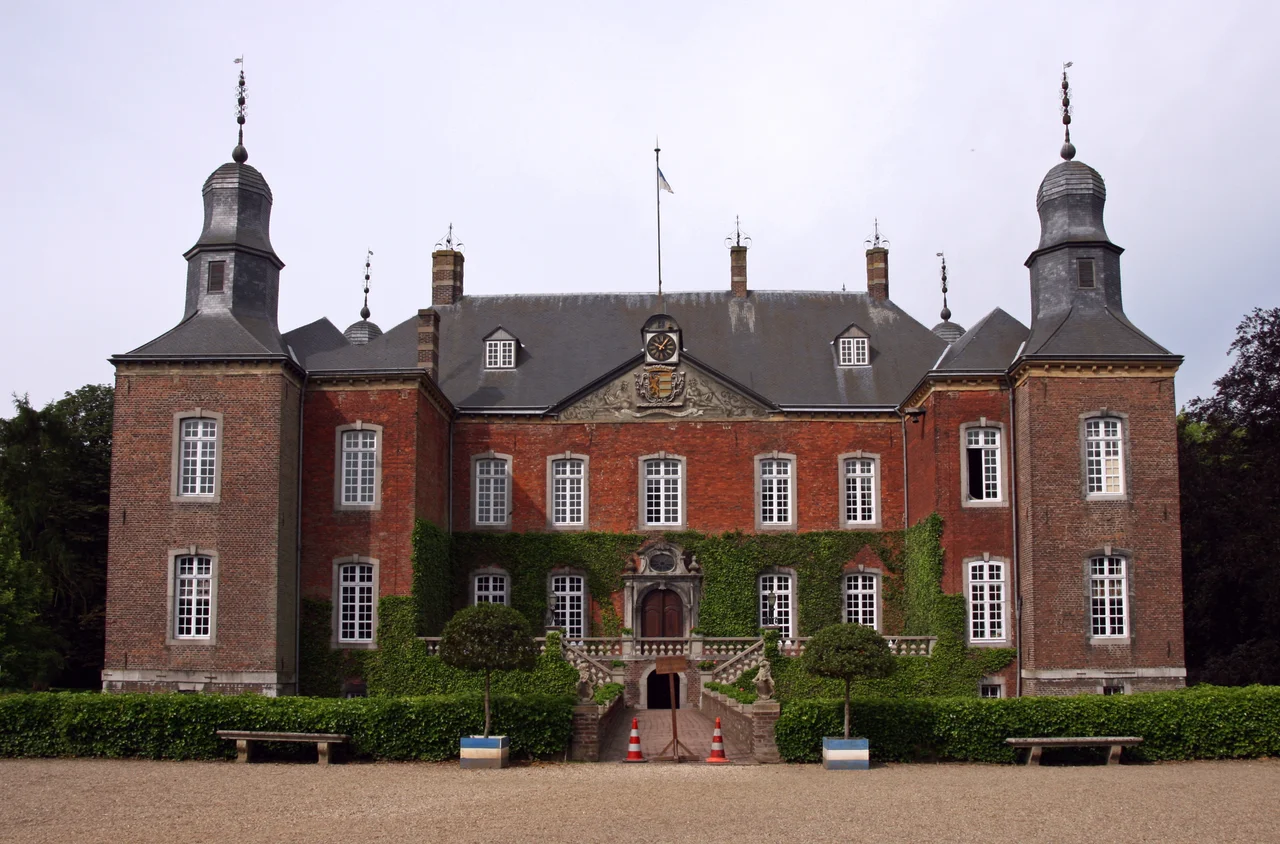

Hillenraad Castle
In November 1918, with his father's empire collapsing behind him, the German Crown Prince Wilhelm rode across the Dutch border with his military staff and was politely interned, by treaty, at a moated castle near the village of Boukoul. He stayed only days at Hillenraad before being shipped off to the island of Wieringen. But for that brief moment, this quiet square of brick and water on the south edge of Swalmen was front-page news across the world.
A House Built on a Loan
Hillenraad's earliest paperwork is not about the castle at all. In 1339, the knight Seger van Swalmen pledged eight acres of land at a place called Hoppenrade to Count Dirk van Loon as collateral for a loan. No castle is mentioned in that deed, which is precisely why historians think the castle came later. By 1380, the house of Hellenrade is on the record, belonging to Didderic van Oest of the Van Oys family. By 1382, Dirk had promised to make his castle available to the city of Cologne if it ever needed shelter during its quarrel with the local archbishop. Six months later the city and the archbishop reconciled. Dirk's pledge was never tested, and Hillenraad got to spend the rest of the Middle Ages quietly soaking in its moat.
Twenty-Five Children
The castle changed families through marriages rather than sieges. The Van Oest line bequeathed it to the Schenck van Nydeggen family in 1486 through Isabella van Oest's wedding. They kept it through the Eighty Years' War, leaving anchors on the forecourt walls dated 1648 to mark a renovation at the end of the conflict. In 1655 Christoffel Schenck van Nydeggen bought back the jurisdiction over Swalmen and Asselt that his ancestors had lost three centuries earlier - a transaction that elevated the family among the local nobility. Then came the Van Hoensbroecks. Frans Arnold van Hoensbroeck and his wife Anna Catharina Sophia van Schönborn had twenty-five children together - some stillborn, several recorded on the alliance crest above the orangery entrance. Under their son Lotharius Frans, the castle was rebuilt again. Under another Hoensbroeck, the Roermond bishop Philip Damiaan Lodewijk, Hillenraad became a center of musical life in the Maasland.
Four Towers and a Banquet Hall
The Hillenraad you see today took its shape in 1767, when four tower-like corner pavilions with octagonal lanterns and bell-shaped tops were added to a late-medieval core. The brick facade is crowned with a stone pediment bearing the alliance arms of the seventeenth-century Schenck-Van Oyenbrugge couple, flanked by painted figures of Zeus and Poseidon. Inside, the banquet hall on the main floor survives more or less intact: an oak-paneled, parquet-floored, stuccoed Gesamtkunstwerk that historians cite as a textbook example of Liège Baroque and Liège-Aachen furniture style. The dining room is hung with gold leather wallpaper. The forecourt is built around three perpendicular wings with hipped roofs, one of them housing a chapel marked by a bell tower on its peak. A garden pavilion sits in what used to be the vegetable plot, with the Hoensbroeck and Schönborn arms over its door.
The Crown Prince's Brief Stay
On 10 November 1918, Kaiser Wilhelm II crossed into the Netherlands and abdicated. His son and heir, Crown Prince Wilhelm, followed a day later. The Hague Convention required neutral countries to intern military personnel from belligerent nations, so the Dutch government had to find somewhere acceptable to put him. Hillenraad was offered by the Wolff-Metternich family, who had inherited the castle in 1909 from the last Hoensbroeck and were in the middle of a long restoration. The Crown Prince and his retinue stayed only a short time before being transferred to Wieringen, but for that handful of days a quiet Limburg country house was the address where the German monarchy ended.
Behind the Hedges
Hillenraad has been a protected Dutch national monument since 1970, with twenty separate entries in the register covering the main building, the outbuildings, and elements scattered through the gardens: bridges, balustrades, a weir, a garden gate, two benches, pedestals and statues. The estate includes a star-shaped forest and a series of formal avenues. None of it is open to the public. The castle remains a private residence, and visitors are limited to admiring it from the lanes around the property - a moated brick square with four pointed towers, half hidden in trees, watching its own reflection in still water as it has for six centuries.
From the Air
Hillenraad Castle sits at 51.22N, 6.04E, on the south side of Swalmen in Dutch Limburg, about 5 km north of central Roermond. Recommended viewing altitude is 2,000-4,000 ft AGL; the moated square and surrounding star forest are distinctive from the air. Nearest airports are Maastricht Aachen (EHBK) about 30 nm southwest, Mönchengladbach (EDLN) about 22 nm east-southeast, and Weeze/Niederrhein (EDLV) about 30 nm north. Skies over the Maasland are often hazy in summer.
Nearby Stories
- Operation Clipper 2.5 km away
- Neuss Hauptbahnhof 4 km away
- Wire of Death 8.2 km away
- Genk 8.7 km away
- Lindenstraße 12 km away
- Sint-Oedenrode 13 km away
- Weeze 14 km away
- Gladbeck 22 km away