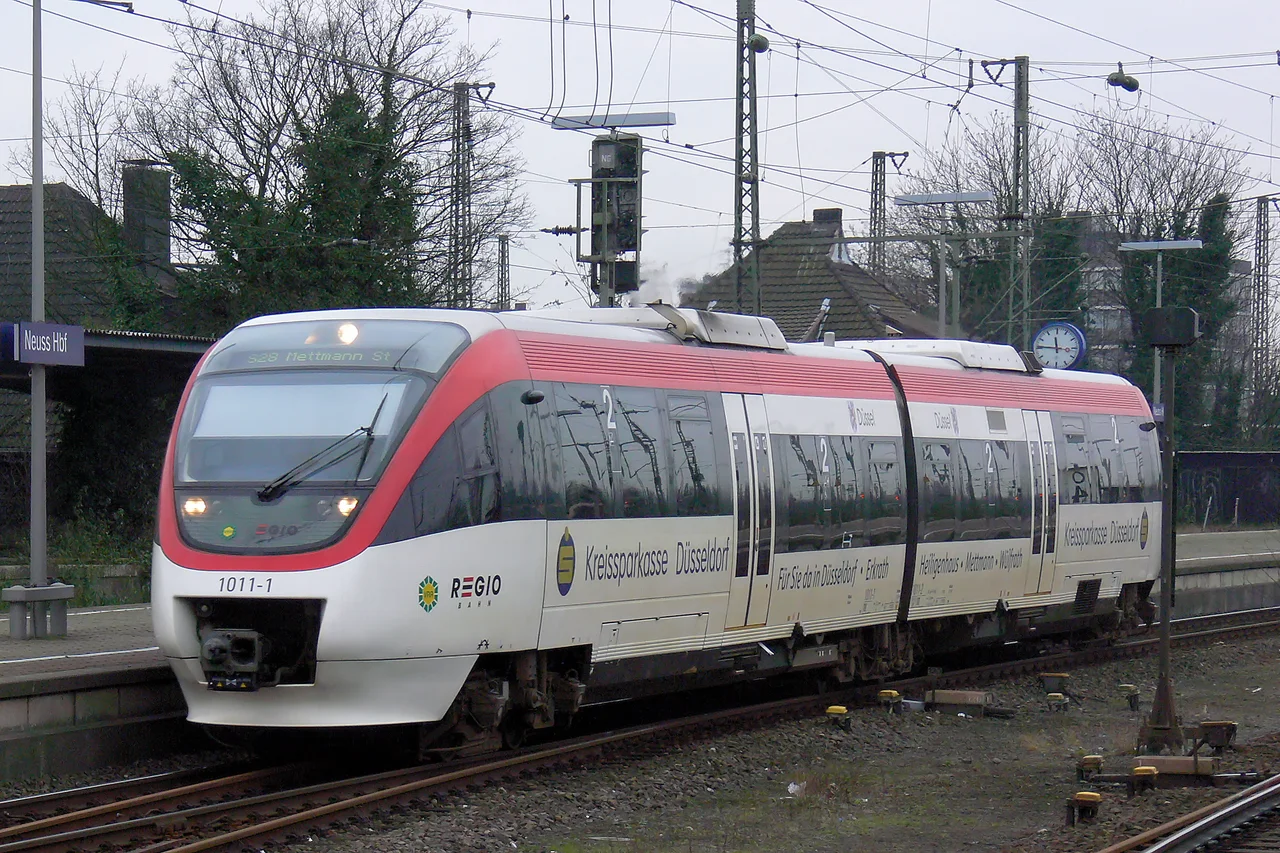

Neuss Hauptbahnhof
The architecture is not the point. The point is that four separate railway lines, built by four different ambitions across the second half of the 19th century, all decided that this patch of ground just west of the Rhine was the place to meet. Stand on the central platform - the station building is built between the tracks, an island, not a terminus - and a train from Cologne pulls in on one side while a train from Kleve glides past on the other. Twelve bus routes nuzzle the forecourt. A Stadtbahn rumbles by, a tram, six night buses, two long-distance Intercity services pointed at Berlin. This is not Germany's most beautiful station. It may be one of its most quietly essential.
The Junction
Neuss sits on the west bank of the Rhine, opposite Dusseldorf, at the historic crossing of north-south and east-west traffic through the Lower Rhine. When the railways arrived in 1853 - the same year the Crimean War began, the year Verdi premiered La Traviata - they planted their tracks at that crossing for the same reason the Romans had built a legionary fortress here eighteen centuries before. Geography rewards what it rewards. Four lines now thread through the platforms: the Lower Left Rhine Railway running north to Kleve, the Monchengladbach-Dusseldorf line running east-west, the Duren-Neuss railway, and the Neuss-Viersen line. The last of these terminates at Kaarster See and is operated by Regiobahn, a regional company founded in 1992 that began operating the route in 1999. Each line was built by a different concern, and the station has had to learn, repeatedly, how to be more than one thing at once.
The Second Building
The current entrance building dates to 1875-76, replacing the original 1853 structure. By then Neuss was industrializing fast - the harbor had expanded in 1835 and the city's population was climbing toward 20,000. The Wilhelminian station building was a statement of confidence in a young German Empire that had just defeated France and was beginning to think of itself as a continental power. It survived two world wars in the Rhine-Ruhr industrial heartland, which is its own form of luck. Deutsche Bahn now classifies it as a Category 2 station - meaning serious traffic, but below the major intercity hubs of Cologne or Frankfurt. About 30,000 passengers move through it on a typical day.
The S-Bahn Era
What changed Neuss Hauptbahnhof from a regional station into a true commuter hub was the Rhine-Ruhr S-Bahn. Line S11 opened in 1985, connecting Bergisch Gladbach through Cologne to Dusseldorf and onward. Line S8 followed in 1988, linking Hagen through Wuppertal to Monchengladbach via Neuss. The platforms had to be rebuilt. The footbridges multiplied. Suddenly Neuss was twelve minutes from Dusseldorf Hauptbahnhof at a frequency of every twenty minutes, and the city stopped being a place you visited and started being a place you lived in while working somewhere else. Property values shifted. The whole geography of opportunity tilted toward the tracks.
Modernisation Drives
By the 2000s the station was tired. In 2006 it got its first round of refurbishment - two of four platforms received elevators, the floors were redone, basic accessibility improvements installed. In December 2008 Deutsche Bahn, the Verkehrsverbund Rhein-Ruhr, and the state of North Rhine-Westphalia signed the so-called Masterplan NRW for systematic upgrades across the region. The second wave of work hit Neuss in 2012 under the program with the slightly grim name of Modernisierungsoffensive 2 - Modernisation Offensive 2. All remaining platforms got lifts. Guidance strips for visually impaired travelers were installed. The total funding for the early phase came to 767,000 euros. Not glamorous money. But this is what civic infrastructure is - decades of accumulated small decisions to keep something functional.
The Future That Keeps Not Arriving
For years there has been a plan to extend the Dusseldorf Stadtbahn line U81 from Rheinpark-Center through Neuss station and continue on across to the airport and Ratingen. It would knit the west bank of the Rhine into the Stadtbahn system properly for the first time. The project keeps getting postponed for lack of funding. Meanwhile, on Fridays and Sundays, an ICE departs Neuss for Berlin Ostbahnhof, taking commuters and weekenders straight across Germany at 250 kilometers per hour - a quietly remarkable service for a station most travelers outside the Rhineland have never heard of.
From the Air
Located at 51.204 N, 6.684 E in central Neuss, North Rhine-Westphalia, on the west bank of the Rhine opposite Dusseldorf. From cruise altitude the station appears as a thread of rail lines converging just west of the river's main channel. Nearest airport: Dusseldorf International (EDDL), 15 km northeast - 17 minutes by road, with the station serving as the main rail link to the airport area. Look for the dense rail fan spreading west from the platforms toward Monchengladbach.
Nearby Stories
- Lindenstraße 0.4 km away
- German Football Museum 5.4 km away
- Diamond Interchange: How a Simple Idea Reshapes Towns Like Julich 7 km away
- Gladbeck 12 km away
- Hagen Open-air Museum 12 km away
- Homburg Castle 13 km away
- RAF Bruggen 15 km away
- Weeze 16 km away